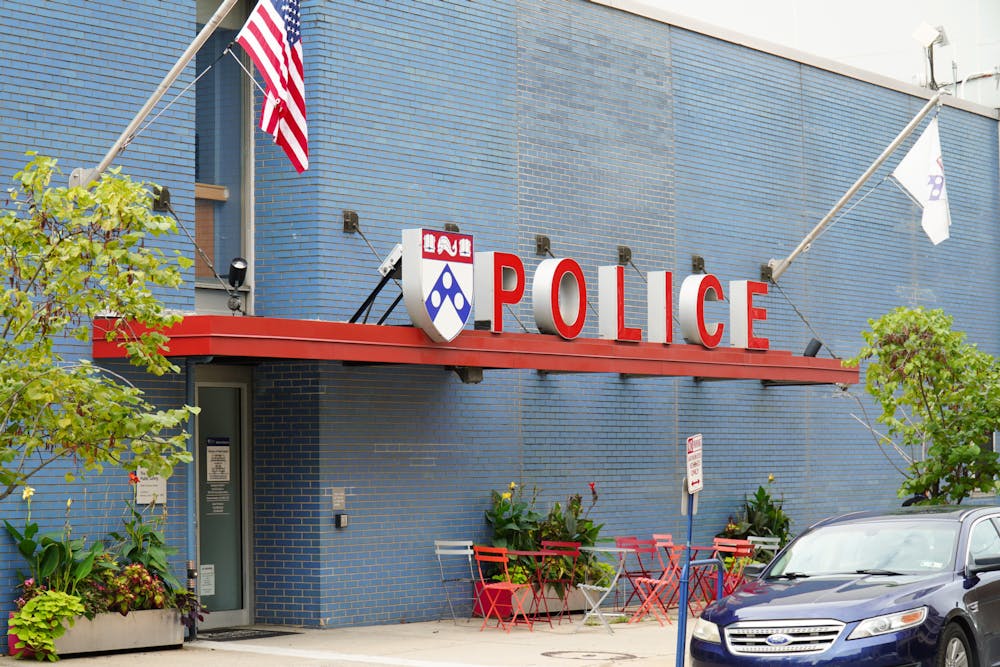
Penn warns students about crime, logs incidents, and reports campus safety by adhering to a federal law called the Jeanne Clery Disclosure of Campus Security Policy and Campus Crime Statistics Act.
Originally enacted in 1990 as the Crime Awareness and Campus Security Act, the Clery Act requires institutions of higher education participating in federal student aid programs to report information related to security policies, safety procedures, and campus crime data to students and employees. The policy was renamed in 1998 for Jeanne Clery, a 19-year-old Lehigh University freshman who was sexually assaulted and murdered in her campus residence hall in 1986.
Under the Clery Act, Penn's Division of Public Safety is responsible for issuing “timely warnings” when a reported crime presents an ongoing or serious threat to campus safety. These alerts are spread through the UPennAlert Emergency Notification System and can also be shared via email, campus publications, websites, crime alerts, or flyers.
In addition to timely warning, the Clery Act requires institutions of higher education to publish a report by Oct. 1 of each year that discloses campus crime statistics and campus security policies for the preceding three years. The Clery Act was amended in December 2024 by the Stop Campus Hazing Act to disclose additional incidents, publish information on hazing prevention programs, and develop a new Campus Hazing Transparency Report. These statistics, according to DPS’s 2025 Annual Security & Fire Safety Report, will be included for the first time in the 2026 annual report.
The Penn Police Department details its procedures for complying with federal campus safety reporting requirements in Directive 101, which establishes the official policy governing how Penn communicates crime information under the Clery Act. The directive — most recently amended in 2023 — identifies which crimes must be provided in reports, including criminal homicide, sex offenses, robbery, aggravated assault, burglary, motor vehicle theft, arson, domestic and dating violence, stalking, hate crimes, and arrest or disciplinary referrals related to weapons, drugs, and alcohol.
The directive also details Penn’s requirement to maintain a publicly accessible daily crime and fire log, which includes basic information about each reported incident. DPS posts specific crime incidents in the log within two business days of being reported and “reserves the right to exclude reports from a log in certain circumstances as permitted by law.”
Under the Clery Act, institutions of higher education that maintain a police or security department are required to maintain a daily security log that records all crimes reported within their patrol zone, as well as within the institution’s Clery geography, which is broken down into three separate categories — on-campus, non-campus, and public property.
DPS’s crime log encapsulates all alleged criminal incidents “reported to and made known” to DPS in the Penn patrol zone, which extends from 30th Street to 43rd Street and Market Street to Baltimore Avenue.
“We put more in our crime log than we are required to by law,” DPS told The Daily Pennsylvanian in an Oct. 8 interview. “We include geography beyond Clery geography — our entire patrol zone — and we include crimes reported in addition to Clery-reported crimes. This is about transparency and trying to best inform the community.”
The daily crime and fire log — including incident descriptions — is provided weekly to the DP for publication upon request. DPS also submits the log to Penn’s journal of record, The Almanac, for weekly publication.
The Clery Act stipulates that Penn’s annual statistics must include crimes reported to “campus security officials and campus officials with significant responsibility for student and campus activities.” While employees — including deans, coaches, and student affairs administrators — are considered “campus security authorities” by the law, professional and pastoral counselors are exempt from mandatory reporting to protect confidentiality.
Compliance with the act is monitored by the Department of Education, which can impose civil penalties up to $71,545 per violation and can suspend institutions from participating in federal student financial aid programs.
Senior reporter Amy Liao covers student life and can be reached at liao@thedp.com. At Penn, she studies philosophy, politics, and economics and cinema and media studies. Follow her on X @amyliiao.