“B-ballllls” my uncle would sigh whenever he was frustrated. My mother’s frustration, instead, was portrayed by the stomping of her feet, which is quite funny to see from a 5-foot-1 woman.
We see the child-like quirks of our elders in how they talk, walk, and act. Sometimes they cross their arms when they’re upset and make a mad Grinch face until you appease them. Other times they call you a “nincompoop” before giggling like SpongeBob. They have childish tendencies baked into their adult habits.
It’s a natural consequence of growing up: we sometimes tap into our “inner child.” For Penn students, though, that “inner child” is dysfunctional at best, and it is because many of us never got to nurture them.
Don’t get me wrong, we make plenty of decisions with a childish edge. It’s the hazing we do at parties to get into the adult “cool club.” It’s students’ anti-Wharton vendetta. It’s the rebellious phase where we call our culture one of “sellouts.” That’s not to say that criticism of Wharton or Penn culture isn’t valid, because it certainly is. If you were to ask me, though, calling your audience a “social ill” or “nothing” comes off as a punk looking to start a fight than an adult provoking a civil conversation.
In other words, there is something inherently different about these manifestations of childishness than those by my uncle or mother. What my uncle and mother did embraced their childish quirks. What Penn students are doing is trying to fill the void where those mannerisms should have been. Translation? We didn’t really get to “be a kid,” and now have unconsciously coped with that by “working hard,” “playing hard,” and criticizing harder.
In many ways, this makes sense. Our journey to and arrival at Penn has come with the expectation of great success at a young age. With that expectation comes the natural need to mature faster. In that process, however, we are robbed of the chance to develop emotionally and socially, and thus never fully nurture our “inner child” at the level of our non-Penn friends and family.
I know many of you will think that the connections I’m making are a stretch. Coping by partying? Sounds absolutely and totally bonkers! Fair enough. Let me ask you, then, if what I am saying is untrue, why does Penn have one of the most depressed student bodies in the country? After all, our graduates go on to be some of the wealthiest, most powerful people in the world.
If my argument is so ridiculous, then why do we fight about getting into exclusive clubs whose “initiations” mock and treat us as subhuman? There are plenty of other extracurriculars that can boost our resumes just as much. Why do we pretend to be “too cool for school” when in reality, the loneliness and anxiety we feel outside of it is killing us?
I’ll tell you why. We do it in an attempt to reconcile with this belief that we shouldn’t act “childish” or have child-like fun. Penn students have “adult” fun by partying like animals on the weekend after grinding like “champions” throughout the week. They don’t tease like a toddler or sigh when in frustration, but drink, dismiss, or yell those emotions away because we don’t know how to process them.
That’s the disconnect. We’re not letting our “inner child” run wild and excessively influencing our decisions; we’ve lost touch with it and don’t know how to start looking for something we’ve “lost or never found.”
It’s bittersweet. The sweet part, other than me (wink wink), is we’re still young enough to nurture and grow our child side. Armed with that realization and the maturity we have developed over recent years, we have the chance to define our own kind of childish fun that doesn’t involve an after-dark McDonald’s run or a paralyzing hangover.
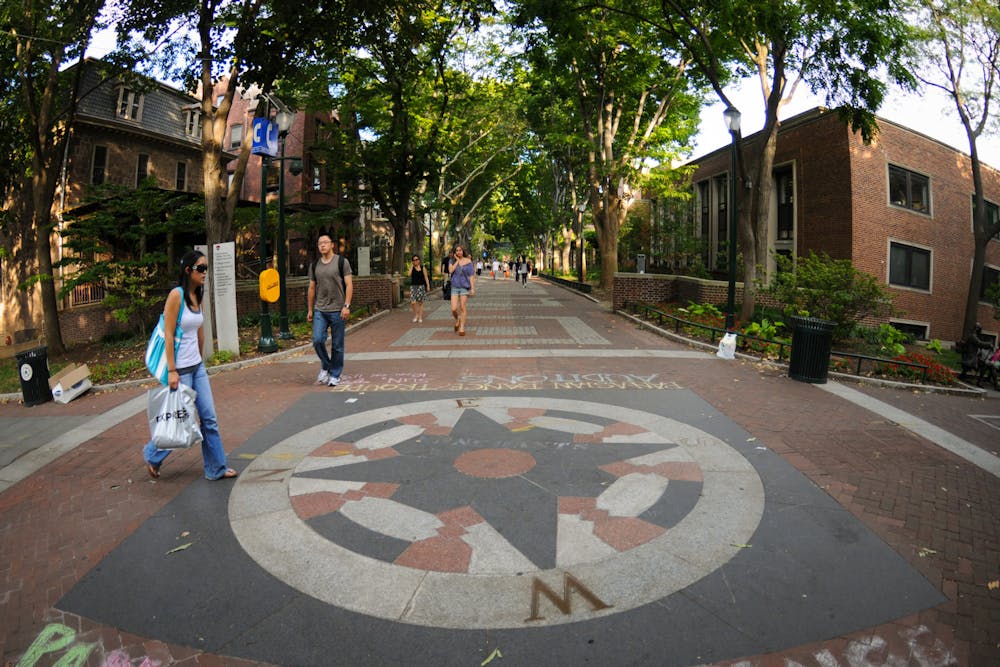
I urge each of you to take it. It starts with a single thought or action. One day, start frantically skipping around Locust Walk to the sound of music that gets you going. In another moment, especially when you’re talking to someone, feel more with your emotions than think with reason. If you’re feeling bold, tap into your mind and imagine what your life would be like if the sky was truly the limit.
It may sound silly. Yet taking these steps will not only allow us to feel comfortable with who we are, but provide clarity on who we want to be. Plus, it’s not as if nurturing your “inner child” has no material benefit. In the end, some of the most profitable ideas in history have been “childish.”
ZAID ALSUBAIEI is a College junior studying mathematical economics from Al-Khobar, Saudi Arabia. His email address is zaidsub@sas.upenn.edu.