

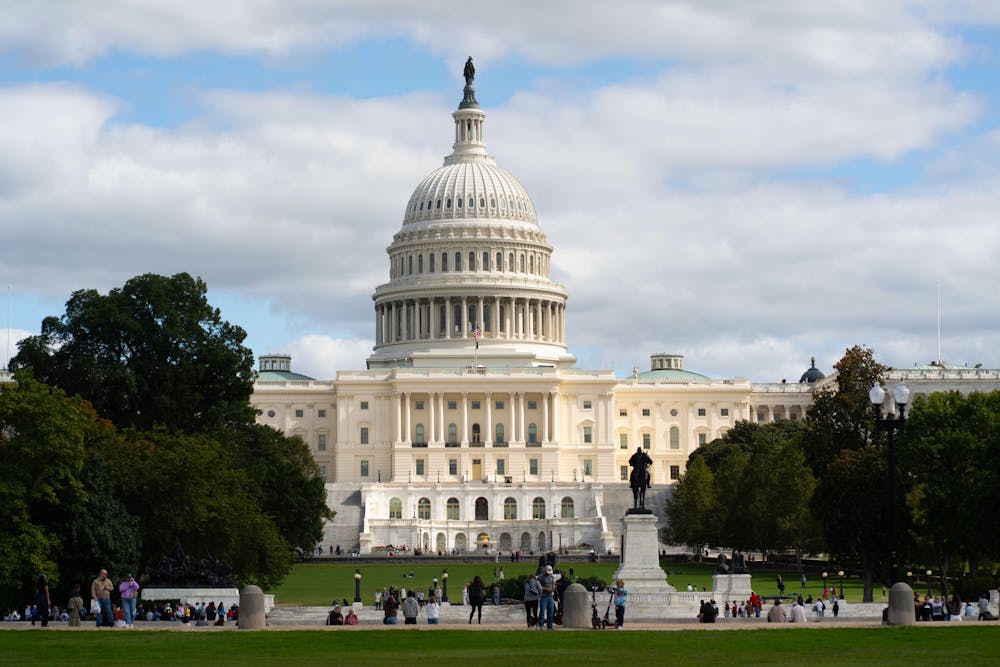
In light of numerous recent school shootings and a recent political assassination, I’m ashamed to admit that the only piece of news I can’t stop thinking about is the month-long government shutdown that began on Oct. 1. Perhaps it’s the straw that broke the camel’s back; the jaded sensation that after all the political discord that has racked this country for the past eight years, the government still cannot find the willpower to keep moving forward because of the entrenched political views of many in Congress. Most will discuss the cause of the shutdown in general terms related to political polarization, but I would like to refine it as a problem of specific incentives related to garnering votes. It seems to me that in the age of the internet the incentive for politicians is not necessarily to sow discord, but to keep the wheels of government in deadlock. This means overwhelmingly popular bills such as reducing the number of guns or requiring background checks never get passed. The political incentives that exist today mean that politicians stall bills that could end up stopping this violence. As constituents, we must prioritize voting for politicians who can end this vicious cycle.
In the book “Freakonomics,” the authors discuss the idea of misaligned incentives, which occur when the incentives that exist prompt a group to act in a manner contrary to what we expect or want. A politician’s main incentive for practically anything they do is to get more votes. In the past, this meant keeping up an appearance of integrity and respectfulness. However, with the advent of mass media, how constituents perceive your actions comes second to how often constituents see you on their phone or TV. This means politicians have less incentive to keep up appearances and more incentive to appear on national news at all times. Whether or not this trend manifests subconsciously or consciously is irrelevant. The result is clear: When it comes to disputes such as keeping the government open, a politician’s incentive is not necessarily to work in the interests of the people and prevent a shutdown — an ongoing dispute might just get them in the news enough to boost their reelection chances.
Moreover, a long-standing dispute in Congress, such as a government shutdown, usually involves politicians voting in blocks, which means that it’s unlikely that a single politician will be blamed. Under this system, most politicians can absolve themselves of any negative flack from voters relating to their inability to prevent a shutdown by claiming that they are just a cog in a larger political machine that they cannot control.
It’s important to make the distinction that individual acts of violence have consistently been on the rise. This is Individualized violence can be addressed by regulation on guns and stricter background checks, both of which would limit a lone gunman’s ability to obtain a deadly firearm. Furthermore, nearly 6 out of 10 of Americans actually support stricter gun laws. But because of the incentive structure that rewards headlines as opposed to concrete actions, laws such as universal background checks sit indefinitely on the House of Representatives floor while the two parties attempt to negotiate an impending shutdown at the end of almost every fiscal year.
Some may argue that political polarization primarily spurs the uptick in violence, and for the most part, they are correct. Political polarization, especially in the form of online radicalization, does plant the seed of violence. Still, I would argue that the absence of regulations that would prevent these agents from taking that next step of committing an act of violence has had a greater effect on the recent wave of political violence.
Politicians are continuing to play the political game with a new meta: Keep people watching and talking about you at all costs. Just take 1968 Wharton graduate and President Donald Trump’s interjection in last year’s presidential debate: “They are eating the dogs. … They are eating the cats.” Obviously, this is ridiculous at face value, but it served a purpose. In an interview about the subject with National Public Radio, JD Vance said, “If I have to create stories so that the American media actually pays attention to the suffering of the American people, then that’s what I’m going to do.” Vance understands that it’s not the veracity of the claim that matters but rather, the impression left on people.
Democracy is a glorified popularity contest, and that will never change. However, as constituents, we can still control what constitutes popularity. We can ensure that the popular candidate is not one who speaks in terms of amorphous ideas but instead depicts a concrete vision and carries a proven track record. It’s currently raining cats and dogs, but we still have a chance to stop the flood.
ROSHAN GOPAL is a sophomore from New York studying mathematics. His email is rgopal@sas.upenn.edu.
SEE MORE FROM ROSHAN GOPAL:


