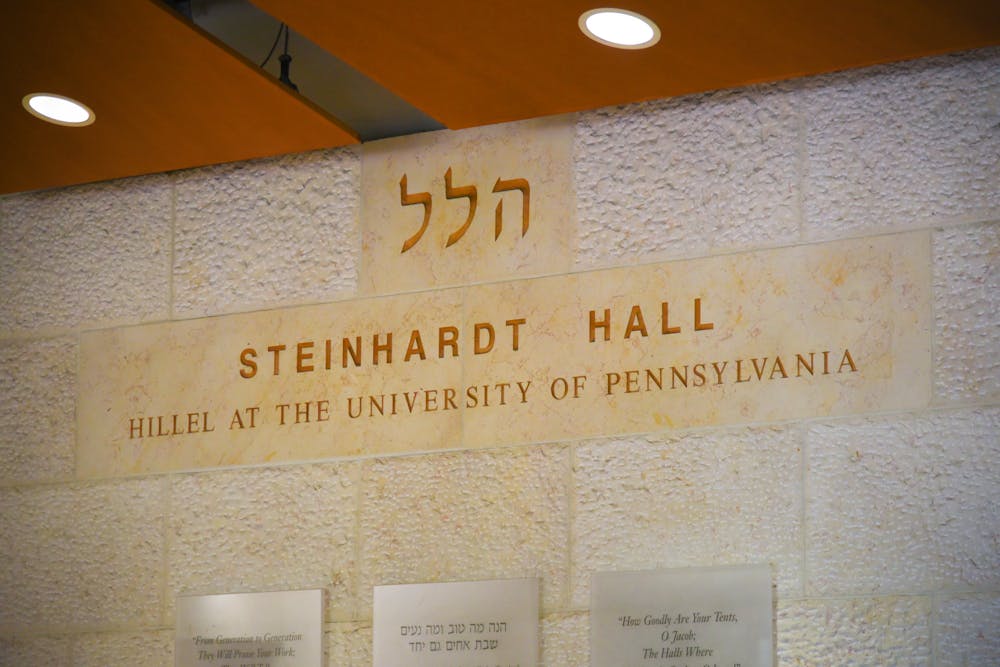
Penn Hillel shared the results of a University-wide survey it conducted that polled Jewish students about their experiences on campus.
The survey was circulated among Penn students beginning in February and collected responses throughout the 2025 spring semester. Its results — which were shared by Hillel at a webinar hosted for University alumni and parents of students two weeks ago — indicated that 85% of respondents said they experienced, heard about, or witnessed “something antisemitic” at Penn.
Franklin’s Forum, a Penn alumni newsletter, first published the results of the survey that were presented by Penn Hillel Executive Director Gabriel Greenberg during a webinar attended by alumni and parents of Penn students two weeks ago.
"In the spring of 2025, Penn Hillel undertook the first major campus-wide survey on Jewish life at Penn in many years," Greenberg wrote in a statement to The Daily Pennsylvanian. "We shared some preliminary results from the survey in a webinar for parents and alumni."
During the presentation, Greenberg highlighted six priorities for addressing antisemitism and maintaining Jewish students’ feelings of belonging — including “ensuring fairness in the classroom” and “building and restoring Jewish unity,” according to Franklin’s Forum. He noted that there had been a decrease in antisemitism since the survey’s release but stated that more progress was necessary.
A request for comment was left with a University spokesperson.
The survey asked students about their personal connection to their Jewish identities, their feelings about Israel and related discourse at Penn, and the extent to which they had heard of or experienced antisemitism on campus.
According to survey results, 96% of respondents were proud of their Jewish identity and 97% considered Judaism to be important in their lives.
RELATED:
Israel-Palestine discourse on Penn's campus has intensified over time, DP archival review finds
Penn philosophy professor to lead implementation of antisemitism task force recommendations
Along with the 85% of students who said they experienced, heard about, or witnessed “something antisemitic” at Penn, 45% stated that they felt uncomfortable or intimidated because of their Jewish identity or relationship with Israel, and 31% said they felt the need to hide their identity.
29% and 26% of students responded that they felt unwelcome in certain campus spaces and experienced antisemitic or anti-Israeli comments from professors, respectively.
Jewish students surveyed offered varying opinions on the state of Israel. 84% of respondents believed that Israel has the right to self-determination, while only 62% would describe themselves as Zionists. 80% agreed with the statement that critiques of Israel often become antisemitic.
Over 60% of students responded that they wanted a “space on campus free of antisemitism” and “wanted to be a part of a Jewish community.”
Over the past few years, concerns about antisemitism on Penn’s campus have drawn heightened national attention and increased scrutiny from the federal government.
In September 2023, the Palestine Writes Literature Festival drew criticism from students, alumni, and national Jewish groups who objected to the inclusion of speakers they alleged had made antisemitic remarks.
Despite a statement from then-Penn President Liz Magill condemning antisemitism, faculty members and prominent alumni donors urged the University to take a stronger position against the festival. As tensions escalated following Hamas’ Oct. 7, 2023 attack on Israel, members of the University Board of Trustees called for the resignations of Magill and then-University Board of Trustees Chair Scott Bok.
After several instances of alleged antisemitism in the fall of 2023 — including threats against Hillel and Lauder College House and projections of pro-Palestinian messages onto campus buildings — Magill announced the University’s Action Plan to Combat Antisemitism. That same month, the Department of Education launched an investigation into Penn over allegations of campus antisemitism.
In December 2023, Magill faced widespread backlash for her congressional testimony, in which she said that it was “context dependent” whether calls for the genocide of the Jewish people violated Penn’s code of conduct. Days after her testimony, both Magill and Bok resigned.
Soon after Magill’s testimony, the United States Equal Employment Opportunity Commission launched an investigation into the University for its responses to campus antisemitism. This November, the agency sued Penn, claiming that it had not produced documents relevant to an ongoing antisemitism investigation.
In a response to the suit, Penn wrote that it has “cooperated extensively with the EEOC, providing over 100 documents, totaling nearly 900 pages.”
RELATED:
Israel-Palestine discourse on Penn's campus has intensified over time, DP archival review finds
Penn philosophy professor to lead implementation of antisemitism task force recommendations
Senior reporter Lavanya Mani covers legal affairs and can be reached at mani@thedp.com. At Penn, she studies comparative literature. Follow her on X @LavanyaMani_.