

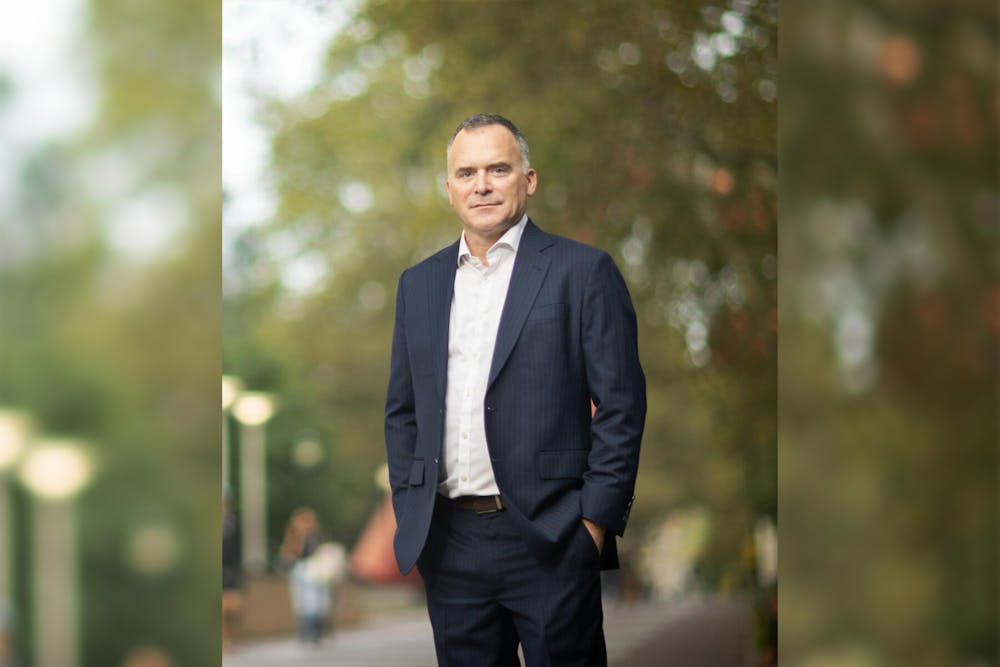
Philosophy professor and Perry World House Director Michael Weisberg was appointed to lead the implementation of recommendations from Penn's 2024 Task Force on Antisemitism and the Commission on Countering Hate and Building Community.
Weisberg, whose appointment follows the departure of former Deputy Provost Beth Winkelstein in August, shared his goals for the role in a question and answer with Penn Today. He also highlighted his previous relevant experience and belief in the importance of community effort throughout the process.
“As we strengthen our community, combating antisemitism and other forms of hatred and bias are critical priorities for Penn,” Penn President Larry Jameson said in the announcement. “In spearheading our University-wide efforts, Professor Weisberg brings steady, trusted leadership and a deep commitment to advancing our highest aspirations for excellence, freedom of inquiry and expression, and mutual respect.”
When asked about his motivations for assuming the role, Weisberg highlighted the "twin challenges of combating hate and bringing people together."
He pointed to his high school experience in deepening Holocaust education for teachers as well as his later research as a graduate student and professor dedicated to understanding how scientific communities “produce knowledge even against the backdrop of radical disagreement.”
A fundamental question Weisberg seeks to answer moving forward is how Penn can best live up to its commitment to pluralism. Specifically, he seeks to find ways for individuals at Penn to “live well together,” despite having differences.
"I’ve yet to meet a person at Penn who is not excited about building community and willing to lend a hand in combating hate," he said to Penn Today. "I would like to find ways to further enrich our community. Even those who are quite critical of the University or how we handled events on campus over the last two years still believe in the core project of building an academic community based on the shared values of academic freedom and mutual respect."
He highlighted "building our physical safety net" as an example of what Penn has accomplished in the process so far, referencing the recent acquisition of third-party security contractors to assess various spaces on Penn’s campus — including Penn Hillel and Chabad — and provide recommendations for the University to upgrade facilities, among other initiatives.
RELATED:
Takeaways from Penn's antisemitism task force, Commission on Countering Hate final reports
Penn presidential commission to combat hate makes initial recommendations to Larry Jameson
He looks towards empathy and modeling dialogue as a way to promote understanding among individuals going forward.
"Universities are very special places," Weisberg said. "Here we can create our own campus based on our shared values. We are so privileged to be in a place where we have so many tools at our disposal, so much expertise, and people from so many countries in the world and from every state, with so much incredible knowledge and so many resources and experiences. We can make that the basis of how we build a wonderful community. But it is ours to build — it’s not simply given to us."
To that end, he encouraged colleagues and students to find new ways to understand each other, including "being present" and listening with "empathy and compassion" in conversations with people who have different views.
"Those moments of connection are actually how we begin to build community," he concluded.
RELATED:
Takeaways from Penn's antisemitism task force, Commission on Countering Hate final reports
Penn presidential commission to combat hate makes initial recommendations to Larry Jameson
Staff reporter Naija Agarwal contributes to data and enterprise reporting and can be reached at agarwal@thedp.com. At Penn she studies philosophy, politics, and economics.


