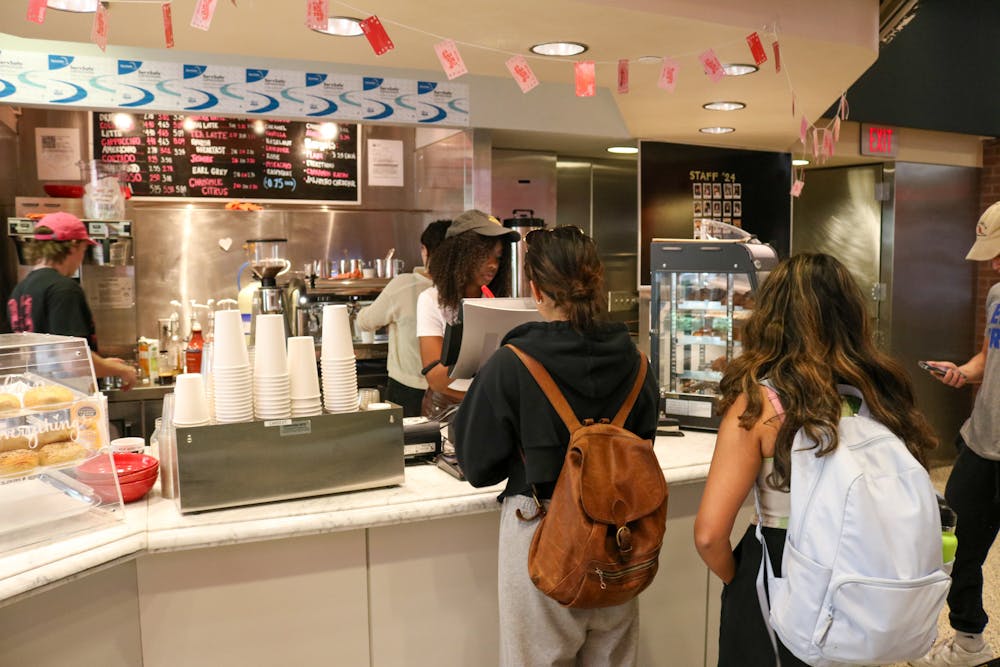
The Daily Pennsylvanian analyzed cafes on and around Penn’s campus — comparing pricing, hours, and seating across over 20 locations — to find the ideal location for a club “coffee chat” or a quick coffee stop between classes.
The DP surveyed sites located between 32nd and 47th streets and from Woodland to Lancaster avenues, selecting 24 cafes on Penn’s campus and within the surrounding area. The shops ranged from independent small businesses — such as Karak Cha House and Top Hat Coffee Lounge — to large chains like Starbucks and Pret a Manger.
Several cafes already have an established presence on Penn’s campus — such as Starbucks in 1920 Commons, Pret a Manger in Huntsman Hall, and Williams Cafe in Williams Hall — because they are housed within University buildings.
While Penn offers a variety of options for meeting and eating on campus, from dining halls to food trucks to preparing their own meals with ingredients from a nearby grocery store, students told the DP that coffee shops occupy a unique role in their lives — including by serving as sites for “coffee chats” and club interviews.
While drink prices at the 24 cafes varied greatly by location, size, and type of drink, the DP found that the average price of a standard 12-ounce drip coffee across cafes in the area is $2.99, while the average cost of a 12-ounce latte is $4.62.
Based on a standard size — 12 and 16 ounces for hot and cold drinks, respectively — the DP found that, on average, a mocha was the most expensive drink at the surveyed locations. A 12-ounce mocha costs customers an average of $5.26. By comparison, a hot 12-ounce tea — the cheapest drink on most menus — averaged about $3.16.
While several cafes on and around Penn’s campus have closed in recent years, there are some upcoming additions. 1920 Commons, for instance, is slated to be renovated by 2029, a project that will include replacing the building’s Starbucks — commonly known as “Stommons” — with a new 176-seat coffee house.
Stommons is the largest of the surveyed locations by far, with 150 seats available. That number nearly doubles the next largest location — the Starbucks in Penn’s bookstore — which has just 83 seats. Around one-third of the locations analyzed had at least 50 seats available.
According to urban studies lecturer Richard Berman, windows and comfortable seating are important considerations for cafe design.
“People want to feel like it’s a third place — a place you can hang out,” Berman said.
Aside from physical amenities, Berman also emphasized the human role in providing a comfortable setting.
“The management actually matters,” Berman said. “It often is nice when they know your name, your order, or something that makes you feel at home.”
Vincent Adelsberger, who is the owner and operator of Top Hat Coffee Lounge, echoed this sentiment.
“When we get Google reviews of people being like, ‘The space is great, the staff is great,’ those are really interesting moments when you feel something becoming bigger than yourself,” Adelsberger told the DP.
Wharton junior Sandra Cheah told the DP that she enjoys going to cafes such as ELIXR Coffee Roasters and ReAnimator Coffee for productivity and typically spends anywhere from two to five hours at a cafe per visit.
“I like being around busy people,” Sandra told the DP. “It’s good to just do work with friends and have a good drink with you to get you through it.”
“If I’m doing a coffee chat with a new member of a club, I would totally opt for a cafe hop scenario, try a new cafe,” she added.
75% of cafes near campus open at or before 8 a.m. on some — if not all — days of the week. For customers who want to stay longer or grab a drink later in the evening, 63% of the cafes close at or after 6 p.m. Nearly one-third of the surveyed locations are closed at least one day per week.
While students such as Sandra may often frequent cafes to study with friends or grab a coffee between classes, several coffee shops on Penn’s campus have shut down in recent years.
United By Blue at 34th and Walnut streets closed abruptly in 2023, and Saxbys at 40th and Locust streets closed in May after Penn Dental Medicine ended the coffee shop’s lease. Williams Cafe’s new Houston Hall location was short-lived and closed in November — just two months after opening — due to financial strain.
Adelsberger described running a cafe as being “so dynamic and so challenging.” He explained that aspects of the job include roasting coffee, training new employees, and restocking ingredients — all while considering seasonal variation in activity, which is in part influenced by the schedules of nearby universities.
“Every day is different in a good way,” Adelsberger said. “When things are going well, it’s in a really good way, and when things kind of hit the fan, it can feel like chaos.”
Sociology and urban studies lecturer Alec Gershberg said that sharing a meal or a drink can help people “understand each other better culturally.”
He told the DP that cafes serve as an additional space for students to socialize in addition to a college setting, which provides “repeated, unplanned meetings or interactions between people.”
“Universities are already, in many ways, the best places to have this recipe of making friends,” Gershberg said. “Cafes around Penn are simply another ingredient or another place where people can do this.”
Staff reporter Srishti Bansal contributed reporting.
Senior reporter James Wan leads administration reporting and can be reached at wan@thedp.com. At Penn, he studies communication and computer science. Follow him on X @JamesWan__.
Senior reporter Kathryn Ye covers central administration and can be reached at ye@thedp.com. At Penn, she studies biochemistry and philosophy. Follow her on X @Kathryn__Ye.