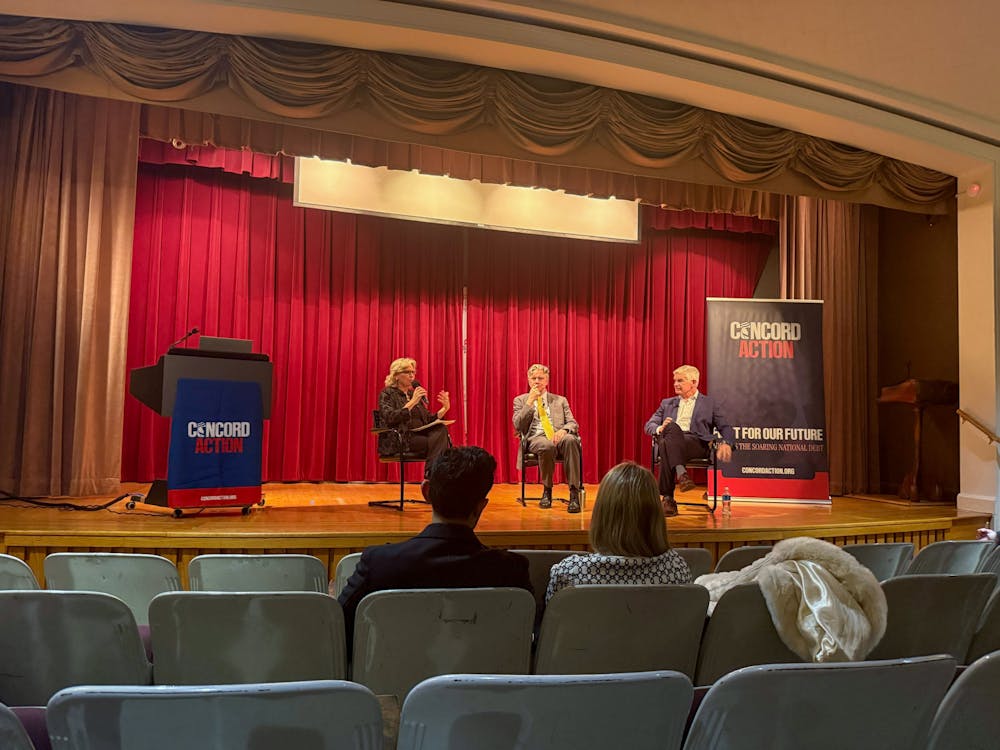
The Penn Wharton Budget Model and Concord Coalition co-hosted the Philadelphia Citizens’ Debt Forum at the Philadelphia Free Library on Nov. 3.
The free event featured Carolyn Bourdeaux, a former member of the House of Representatives and current Executive Director of the Concord Coalition; Kent Smetters, Faculty Director of the Penn Wharton Budget Model; and Patrick Harker, former President of the Philadelphia Federal Reserve. Speakers emphasized the impact of unsustainable fiscal policy on all American citizens.
The Concord Coalition is an organization dedicated to educating the public on issues relating to the growing national debt and fiscal policy more generally.
Bourdeaux warned that allowing unsustainable fiscal policy to go unaddressed would mean “economic ruin.” According to her, the national debt currently stands at $38 trillion, far greater than the United States’ gross domestic product.
“It is something that folks with a policy background or a fiscal background are very concerned about, but it really has not made it out into the public at large,” Bourdeaux said. “This will lead to a serious economic crisis.”
As the government shutdown continues, Smetters explained how shutdowns can provide opportunities to set new norms and make important decisions as to how the budget can be managed in the future.
“What would be really spooky for capital markets would be if somehow this ends, but there’s not a clear resolution on the future of the debt path,” Smetters said.
According to Bourdeaux, “one out of every five dollars you spend on taxes is going to interest on the debt.” When the nation accumulates debt, it is obligated to spend more on paying back interest. Given that a majority of the budget is already allocated to mandatory spending, she added that this increase in interest puts pressure on discretionary government spending.
RELATED:
Here’s what local store managers think about business turnover in University City
Wharton School claims sole possession of top spot on 2025 U.S. News Best Business Schools ranking
Though the issue of increasing debt is “not always the center of attention,” Harker highlighted that its impacts will certainly be felt by the average Philadelphia resident. He explained that Philadelphia is particularly dependent on educational institutions, which in turn depend on some level of federal funding.
Smetters added that the status quo of federal debt will lead to significant inflation if it is not addressed.
Turning to solutions, the speakers highlighted the importance of increasing revenue in the short term and decreasing expenditures in the long run.
“Maybe it’s kind of unrealistic,” Smetters said. “However, I do know something that’s even less realistic, something that has a 0% chance of working, and that’s current law.”
RELATED:
Here’s what local store managers think about business turnover in University City
Wharton School claims sole possession of top spot on 2025 U.S. News Best Business Schools ranking
Staff reporter Lavanya Mani covers legal affairs and can be reached at mani@thedp.com. At Penn, she studies English. Follow her on X @lavanyamani_.