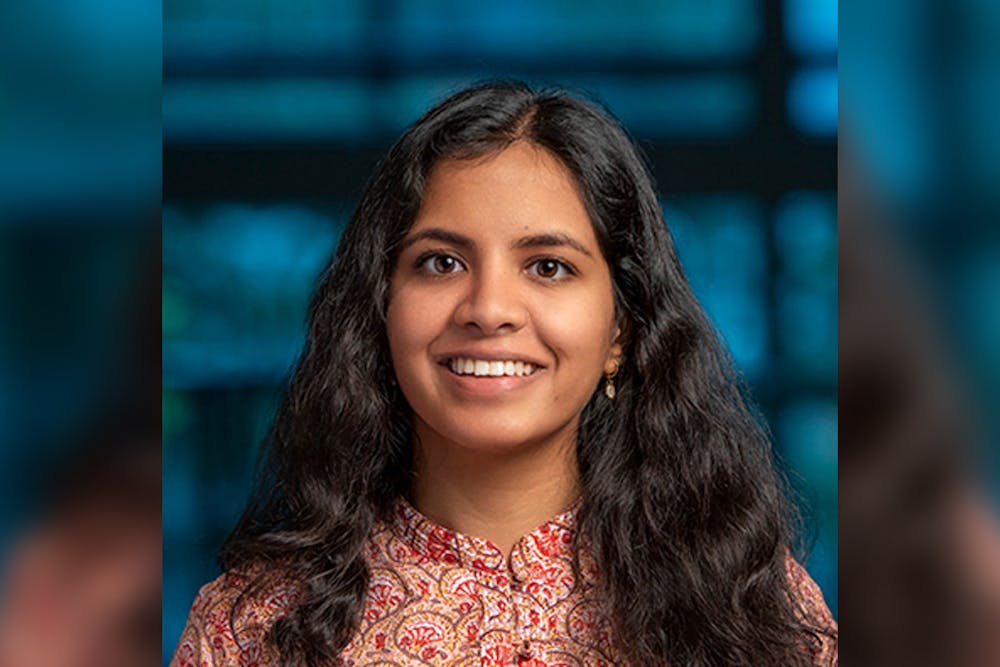
Penn computer science professor Surbhi Goel has been named a 2025 Schmidt Sciences AI2050 Early Career Fellow.
In a Nov. 5 press release, Schmidt Sciences announced that Goel is one of 28 researchers receiving over $18 million in funding to study the potential of artificial intelligence to benefit humanity. The fellowship, launched in 2022, aims to create a “healthier, more resilient, and more secure world” by harnessing AI.
“I am deeply honored to be named a 2025 AI2050 Fellow by Schmidt Sciences,” Goel said to Penn Engineering Today. “My research aims to build a solid theoretical foundation for why modern AI systems work, and more importantly, why they fail.”
Goel’s research explores the “trust deficit” in modern AI, or concerns surrounding AI’s tendencies to make errors and generate harmful content. With the funding, Goel said that she is hoping to contribute to AI that is “reliable, predictable, and safe by design.”
“This technology can and will bring about an epochal shift in our society – and the AI2050 fellows are shaping that change so it is a benefit for all people,” James Manyika, co-chair of AI2050, said in the announcement.
As part of the fellowship, Goel will receive three years of financial support, including funding that supports exceptional computational needs, and she will attend annual gatherings with other AI2050 scholars to share his findings and network with experts in the field.
“AI is underhyped, especially when it comes to its potential to benefit humanity,” Eric Schmidt, co-founder of Schmidt Sciences, said in the announcement. “The AI2050 fellowship was established to turn that potential into reality.”
Of the 28 scholars in the program, seven are “senior fellows” and 21 – including Goel – are “early career fellows.” The fellows include professors and assistant professors across a range of top American and international universities.
RELATED:
Penn Biomedical Engineering Society receives national Commendable Achievement award
Penn Engineering researchers develop mathematical ‘Rosetta Stone’ to predict molecular movements
Computer and Information Sciences professor and department chair Zachary Ives said the award reflects Goel’s “exceptional ability” to develop deep insights to answer pressing questions about AI.
“Her work is helping to shape a future in which AI systems are not only powerful, but also principled and trustworthy,” Ives added.
RELATED:
Penn Biomedical Engineering Society receives national Commendable Achievement award
Penn Engineering researchers develop mathematical ‘Rosetta Stone’ to predict molecular movements
Staff reporter Samantha Dasika contributes to data and enterprise reporting and can be reached at dasika@thedp.com. At Penn, she studies neuroscience.