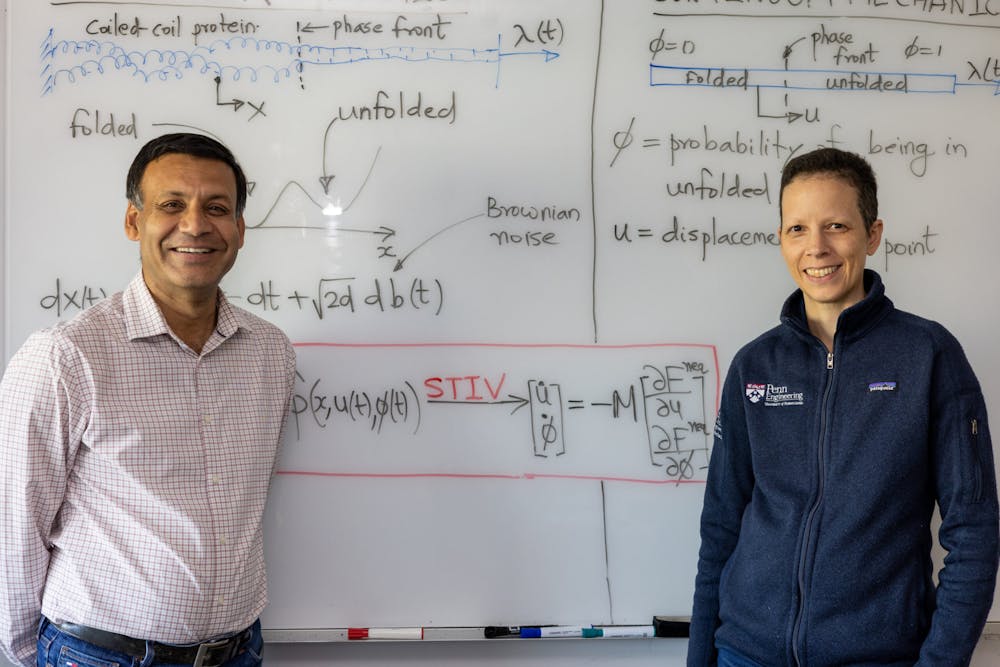
A mathematical “Rosetta Stone” to translate atomic and molecular movements into predictions of larger-scale effects has been developed by Penn School of Engineering and Applied Science researchers.
2025 School of Arts and Sciences graduate Travis Leadbetter and Mechanical Engineering and Applied Mechanics professors Prashant Purohit and Celia Reina spent years developing the model. The technology could potentially cut down the costs of time-consuming simulations and experiments and make it easier to design medicines and semiconductors.
The model's main tool is "Stochastic Thermodynamics with Internal Variables," created to solve a 40-year-old problem in phase-field modeling, a widely used method for studying shifting boundaries between two states of matter.
“STIV gives us the mathematical machinery to describe how that frontier evolves directly from first principles, without needing to fit data from experiments,” Purohit said to Penn Engineering Today.
The significance of the STIV framework lies in its ability to bypass the traditionally expensive and time-intensive simulations or experiments to predict phase transitions and interface dynamics, while maintaining both accuracy and efficiency.
“If you want a rigorous model, typically it takes a long time to compute, and if you want results fast, you have to simplify and lose accuracy,” Purohit added.
Funding from the National Science Foundation, the National Institutes of Health, and defense research grants supported the study and development of STIV.
“Just as the Rosetta Stone unlocked countless ancient texts, the STIV framework can translate microscopic movements into larger-scale behavior across non-equilibrium systems," Reina explained.
Engineering School receives $11M donation to expand Clark Scholars program
Penn researchers develop AI tool that creates antibiotics to combat harmful bacteria
Reina said she saw further significance in STIV’s ability to link research on diverse matter under a unified framework.
“STIV gives us a common language for problems that used to be treated in isolation,” Reina added. “That means researchers studying subjects as varied as proteins, crystals, and cells can draw on the same framework. That kind of universality points to enormous potential for future discoveries.”