

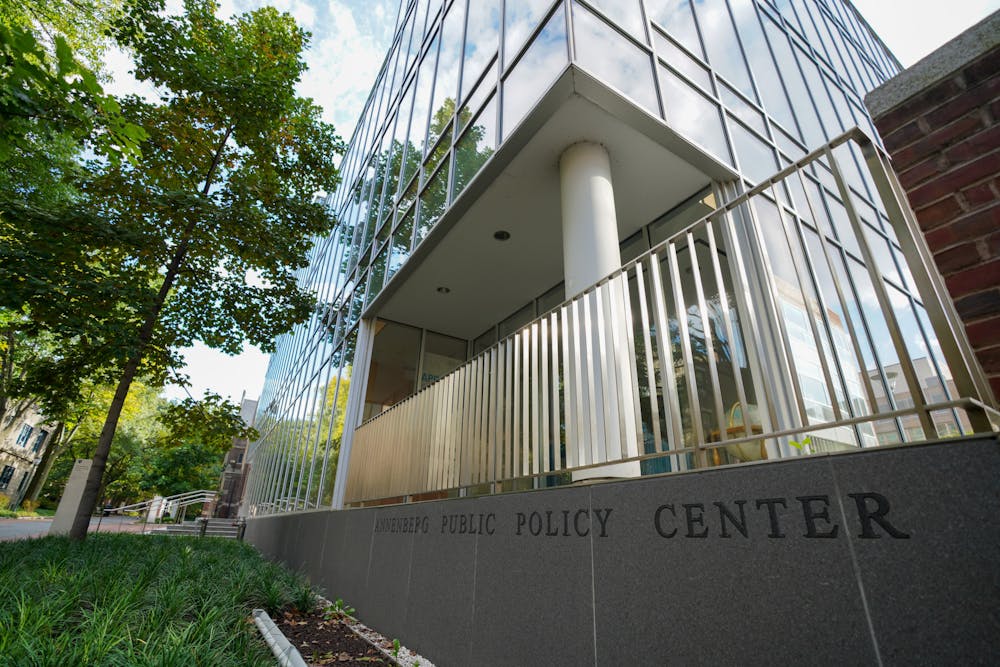
A survey conducted by Penn’s Annenberg Public Policy Center found that the public has low knowledge of the significance of the MMR vaccine and measles-related risks.
The survey, conducted in August 2025 with nearly 1,700 U.S. adults, revealed a decrease in U.S. adults’ likelihood of recommending that eligible children in their household get the MMR vaccine. It also showed a decrease in concern for the threat of measles as well as an increase in confusion regarding whether or not the vaccine could cause autism.
Another focus of the survey was public response to Health and Human Services Secretary Robert F. Kennedy Jr. Those surveyed demonstrated confusion regarding Kennedy's guidelines: only 23% responded that Kennedy does recommend childhood vaccination against measles, while 29% said he does not recommend it, and 48% were not sure.
“Mixed messages about the safety and efficacy of measles vaccination from those leading health agencies fuel confusion and cultivate a climate that is hospitable to an otherwise preventable and sometimes deadly disease,’’ APPC Director Kathleen Hall Jamieson added.
With regard to MMR vaccines, 82% of adults surveyed said they would support eligible children in their household getting MMR vaccine, a significant decrease from the 90% reported in November 2024. 65% correctly said that it is false that MMR vaccines cause autism, a decrease from prior years when more than 70% of the public agreed that vaccines have no link to autism.
Of this year’s reported measles cases in the U.S., only 4% of recent cases involved those known to be fully vaccinated. 92% were either unvaccinated or had unknown vaccine status, and 4% had received only one of the two vaccine doses.
Dr. Paul Offit, director of the Vaccine Education Center at the Children's Hospital of Philadelphia, believes that the numbers could actually be higher.
"If you talk to people on the ground, including not only in Texas, but other states, they all say the same thing, which is that the numbers are much worse than that," Offit said to NPR in October. "Probably closer to 5,000 cases, and it's not done."
RELATED:
Penn Med, CHOP cardiovascular director named 2025 American Heart Association Distinguished Scientist
Penn's Comparative Immunotherapy Program conducts canine cancer study to delay metastatic disease
The APPC also surveyed the respondents on false claims surrounding vaccines and a mercury-based preservative thimerosal. The preservative has long been a target for anti-vaccine advocates, who have claimed that it is ineffective and is linked to autism.
51% of those surveyed said they were not sure if thimerosal “increases, decreases, or has no effect on the chances” of developing autism, while 37% correctly said it has no effect and 10% said it increases chances.
The survey also shows that a quarter of the public thinks that getting measles is likely to be less deadly than it is. Only 30% of respondents correctly said that measles increases the chances of developing serious illnesses later in life, and only 9% knew the correct death rate for children who catch measles — approximately 1 in 1,000. 58% said that they didn’t know, while 26% chose lower rates.
RELATED:
Penn Med, CHOP cardiovascular director named 2025 American Heart Association Distinguished Scientist
Penn's Comparative Immunotherapy Program conducts canine cancer study to delay metastatic disease
Senior reporter Addison Saji leads coverage of science and health and can be reached at saji@thedp.com. At Penn, she studies English. Follow her on X at @addisonsaji.


