Being a first year in college is hard. I don’t think that’s a very bold statement to make. But amid the pressure of daunting midterms and chaotic club applications, there’s one aspect of my first-year experience that I look forward to every week — my 90-minute “Kite” seminar with Kevin Platt.
After responding to a survey this past summer, I was offered the opportunity to join the College Foundations First-Year Curriculum. I was never told what this program actually was apart from descriptions of the four courses it required and a list of the general education requirements those courses would fulfill. But it seemed promising enough, so I signed up. And I’m so glad I did.
The College Foundations program is a total reenvisioning of the current complex and convoluted sectors and foundations system, which received its latest update in 2005 (a year before I was born) and is in dire need of an overhaul. The current system requires students to fulfill 13 “Sectors of Knowledge” and “Foundational Approaches,” which, in practice, forces students to find the one or two niche and obscure courses that fulfill a specific requirement instead of making room for genuine exploration.
Instead, College Foundations envisions a Franklinian core curriculum in students’ first year at Penn, with near-unbridled academic freedom beyond the four core courses. Students will take a writing seminar — which is already required — and a first-year seminar on any topic they choose, together with the newly created Kite and Key seminars. They then spend the rest of their time at Penn focusing on their major requirements, along with eight elective classes in any field or discipline, provided those classes are unrelated to their major.
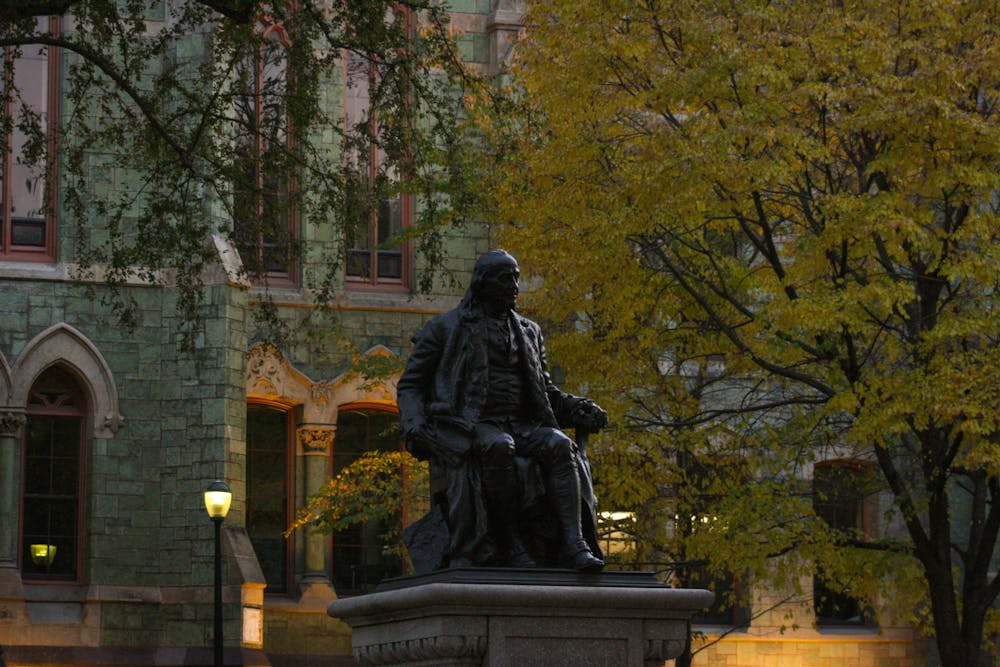
As the bedrock of the new curriculum, Kite and Key seminars are designed to embody Ben Franklin’s intentions when he established the Academy of Philadelphia almost 300 years ago. Franklin believed students should study “every Thing that is useful, and every Thing that is ornamental.” Yet at the same time, he recognized the impossibility of this endeavor and instead proposed a liberal arts education as one in which students should aim to study the things that are “most useful and most ornamental” with “regard being had to the several Professions for which they are intended.”
In line with Franklin’s philosophy, Kite and Key seminars both cover a sprawling range of subjects and concepts that stretch across the humanities, STEM, and social sciences, giving students a bird’s-eye view into what each discipline entails.
Weeks on “knowledge” and “ideology” had us discussing Descartes, Nietzsche, Marx, and Foucault, while the “art” and “body” weeks took us to an art gallery at the Fisher Fine Arts Library and to the Penn Museum’s Anthropology department. Kite seminars give first years a common vocabulary: an arsenal of texts, ideas, and concepts that each provide the tiniest of windows into the depth of knowledge waiting to be acquired at Penn.
I applied to college as someone interested in a wide variety of subjects. My options for majors ranged from philosophy, religion, and politics to law, psychology, and economics. The Kite seminar has allowed me to get a quick taste of each topic in a way the hyperspecialized sectors and foundations system never could. I’ve learned that I love critiquing the ideology of Slavoj Žižek and analyzing the themes of Kazuo Ishiguro’s “Never Let Me Go,” and I’ve also confirmed that majoring in history or anthropology is not for me.
While I won’t be taking a Key seminar until the spring, the basic structure of the course is designed to give students the skills necessary for careers in STEM and the quantitative social sciences. Students learn to code, analyze statistics, interpret data, and run experiments, among other skills that can be readily applied to a wide range of fields and majors at Penn.
Both Key and Kite seminars utilize a weekly lab where small 15-student groups meet with their teaching assistant, during which they might do hands-on coding and experiments for Key seminars or watch relevant documentaries and read required material for Kite seminars.
The Kite seminar has not only provided me with a range of topics and ideas to play with, but it has also built a community for myself and my classmates around our shared experience in the course. Spending hours together each week has turned us into a friend group that shares inside jokes, college tips, and a weekly snack rotation. Different students shine in different weeks. Some of my peers commandeered “sports” week with personal football anecdotes, others dominated “power” week with their debate on systems of oppression, and some even graced our class with a 15-minute interpretive dance performance during “joy” week.
All Penn students bring something unique to the College of Arts and Sciences, and the Kite seminar has afforded us each our time to shine as we journey through everything “most useful and most ornamental.” Franklin’s vision of a liberal arts education is certainly a lofty one — but the College Foundations First-Year Curriculum brings Penn one step closer to embodying it.
ELIAV ZENDEHDEL is a College first year from Los Angeles, Calif. His email is eliavzen@sas.upenn.edu.