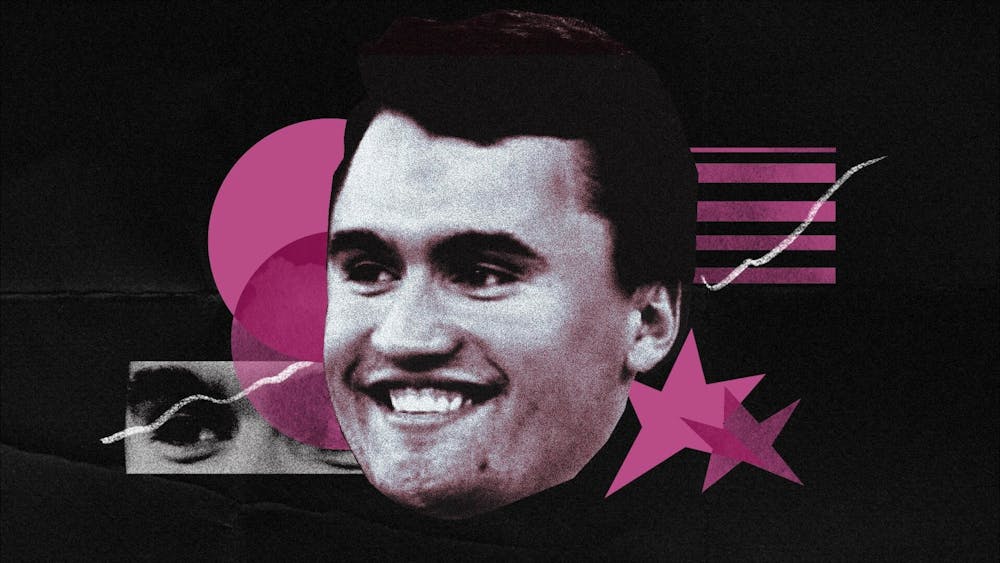
Since I became invested in politics at the age of 13, Charlie Kirk had been a dominant voice in the political world. While he had opinions and methods I disagreed with, I always saw him as an example of the kind of political influence I aspired one day to have. He founded Turning Point USA at just 18 years old, by 22 he was speaking at national conventions, and by 24 he was shaking hands with the United States president. His explosively exponential rise was simply unheard of, and it’s now been topped by his equally shocking fall.
Kirk’s assassination is a tragedy for all those who knew and loved him, a stain on the page of modern U.S. history, and a harbinger of what’s to come if the U.S. body politic fails to recognize the growing cancer of polarization in our society.
This is not a critique or condonation of Kirk’s viewpoints, his sphere of influence, or the impact he had on American politics and society. Frankly, the kind of person Kirk was and the ideas he advocated for are irrelevant in the wake of his assassination. His death represents a threat to the tenets of our nation and Western society as a whole. A cornerstone of our democratic republic has always been our championing of free speech, and our defense of the right of the individual to assemble and petition, to speak, and to write. These freedoms are the fundamental tools with which one is to actively participate in our society.
Kirk was known by his allies and, especially, by his enemies, as the person who would speak to anyone. He was the man sitting at a table at one college or another, microphone in hand, eager to engage any and all people in civil conversation. Kirk’s murder for the crime of speaking his truth and defiantly embodying the First Amendment will serve as a turning point in the minds of the generation he wished to influence.
There are thousands like me, first years in college, just beginning to enter the big leagues and endlessly debating whether or not to take a stand. We ask ourselves: Do I join my school’s political club? Do I start writing for my school’s political journal? Or do I remain silent, keeping my views private for fear of their impact on future job interviews or graduate school applications? Two days before Kirk was assassinated, I was in that exact position, my applications for Penn’s political organizations having laid open and untouched on my computer for weeks.
Now, in the days after Kirk’s assassination, students like me are faced with the gravity of these pending decisions. We tell ourselves that we just don’t want to risk it. We don’t want to risk slander and hate, bullying and harassment. And now, we don’t want to risk death.
But if we choose to remain silent — if we choose to take Kirk’s death as a sign to keep quiet rather than raise our voices — then his murderer will have taken not only Kirk’s life but will have snuffed out the thousands of voices he sought to inspire.
Do not let Kirk’s assassin kill our voices. Do not let public debate and conversation become a thing of the past. Do not let the free market of ideas turn into a ghost town of people scared into silence.
Kirk’s death leaves behind a vacuum of influence where he once stood, thousands of batons waiting to be picked up by the generation he worked so hard to inspire. Not just picked up by the right, but by every young voice who has an opinion and has been too afraid to share it. I urge you, speak to someone you view as “radical” or “crazy” and you’ll find them to be more moderate than they seem. The echo chambers on social media have convinced us that politics live only in extremes, yet the more you dialogue with tangible human beings, the more you’ll realize just how much common ground we as Americans share.
I implore you, my fellow students, to join me in unabashedly stating your views and in engaging in dialogue with those with whom you vehemently disagree. Conduct yourselves civilly and responsibly, and walk away with a hug and perhaps a slightly altered outlook on life.
Kirk’s assassination was a turning point in the United States, and we must do everything in our power to make it a turn toward something greater. As Americans and human beings, we can and will do better.
Rest in peace, Charlie Kirk.
ELIAV ZENDEHDEL is a College first year from Los Angeles, Calif. His email is eliavzen@sas.upenn.edu.