Content warning: This article contains mentions of racial discrimination and racial slurs that can be disturbing and/or triggering for some readers.
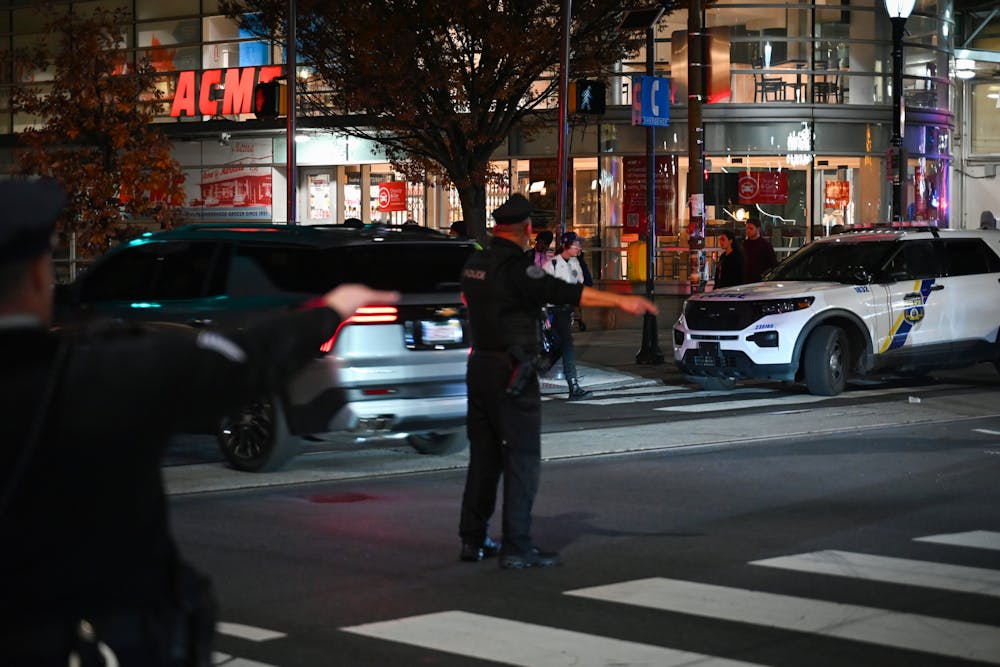
Last Saturday night between 7 and 8 p.m. Police responded to reports of 400 to 500 people gathered around 40th Street between Market and Walnut streets. Most of these individuals were kids, and were reportedly “acting disorderly and causing disturbances to businesses in the area.” Apparently, fights broke out and, while separating the fights, officers were injured. Three were taken to the hospital where their eyes were flushed after being pepper sprayed.
Now, juxtapose the scenes of teenagers with those of young men jumping on and flipping cars, lighting them on fire, and fighting and destroying city property in the aftermath of both the 2018 and 2025 Superbowl celebrations. I, along with many other Penn students, attended the festivities last year. We witnessed shenanigans involving fellow students on top of trash trucks, climbing lightpoles, and publicly urinating. Yet their public nuisance, indecent exposure, and disorderly conduct was treated with far less scrutiny than that of the teenagers on 40th Street, and I’ll leave you to speculate why. The overall sentiment afterward was not disdain for their behavior, but praise for how unifying it was.
This brings me to the recent discourse that occurred on Sidechat pertaining to Saturday’s incident. As is typical of the anonymous platform, the conversation surrounding this event was not about condemning general violence or wishing the officers good health. It was full of racist remarks — the kinds of things that are unbecoming of what a Penn student should represent. This event, regardless of how you feel, should not warrant a devolution into racist and ignorant remarks. I am disturbed by the way Penn students used this incident as a springboard for anonymously expressing their racist ideas.
What started with one post calling for non-Black people to refrain from calling young Black teenagers “YN’s,” an abbreviation for a word that includes a slur, turned into a whirlwind of racist remarks offensive to Black people as a whole. Through a few incidents involving local teenagers and Penn students, the tension was building, and some people couldn’t restrain their inner racist.
Two comments that struck me as particularly egregious were as follows: “YNs [were] terrorising our neighborhood,” and “I mean Penn is like 300 years old. The african american households that reside in Philly have been here for like 40ish years. I think it is safe to say Penn was here before them.” These comments recast, diminish, and erase, the role of Black people in the history of Philadelphia. Despite the confident tone, these statements are factually incorrect, unfounded, and their dismissive nature only serves to highlight the author’s lack of knowledge. Penn relocated from Old City to West Philadelphia in 1872. In fact, Greenville, a late 1800's West Philadelphia community itself was home to a large and growing Black community later known as The Black Bottom. Roughly from 33rd to 40th streets, with Lancaster Avenue as the northern limit and Market Street as the southern one. So, if anything, the Black teenagers have a rightful place in the areas immediately surrounding campus. Penn exists within the University City neighborhood, which has expanded throughout the broader West Philadelphia region over time. We are the true outsiders in “our” neighborhood.
Then came the comments attributing it to culture or the long overused fatherlessness comments. As if these kids’ families were self-created tragedies rather than the result of generations of policies meant to destabilize Black households. What struck me most wasn’t the laziness of the argument, but how confidently people pushed it as if it were some airtight explanation for complex social issues.
And here’s the part everyone on Sidechat seemed to miss: people argued over whether this behavior came from bad parenting, culture, or “being Black” without ever pausing to consider that it could be all of those things filtered through a much larger social structure. So yes, bad parents exist and teenagers are immature. But everything about this discourse is rooted in structural racism — the entrenched practices, and established beliefs and attitudes that produce, condone, and perpetuate widespread unfair treatment of Black people. That’s the part nobody wanted to say out loud.
The threads revealed how quickly people were willing to attribute the actions of these kids to their Blackness instead of the realities that shape their lives: growing up in an underfunded part of the city, being teenagers in 2025, and living in a neighborhood shaped by a history of disinvestment. The “fatherlessness” talking point only made that clearer. Commenters threw it around like a punchline while refusing to acknowledge why it is disproportionately concentrated in Black communities in the first place.
The reasons are not mythical moral failings. They are the direct and deliberate outcomes of slavery’s forced separations, Jim Crow laws that crushed economic stability, discriminatory welfare programs, mass incarceration, and policing practices that remove Black fathers from their homes. This is a pattern designed by policy, not destiny.
So yes, bad parents exist. Teenagers do dumb things. Pop culture is a mess. But you cannot separate behavior from the historical scaffolding holding these circumstances in place. Pretending that you can is how racial stereotypes survive under the disguise of just being honest.
So, I'll say it with my full chest: if you are a non-Black person at Penn, you should not be calling Black children “YN’s,” especially in an aggravated manner – nor should you be participating in conversations that denigrate entire groups of people. Equating screaming, fighting, and causing trouble with being Black is disgusting, inherently wrong, and dangerous. Just because you put the Y in front doesn’t change the fact that you’re saying the “N-word.” We see you, we hear you — loud and clear.
What unfolded on Sidechat wasn’t a debate about behavior. It was a textbook example of racial ignorance in action. White teenagers, even when drunk, destructive, or loud, are read as “kids being kids.” It’s ironic that this event occurred on the same day as homecoming, a day where hundreds of drunk Penn students stumble around in broad daylight and pee on our poor founder. Black teens are read as threats before they even open their mouths. This is how a crowd of minors waiting for an event becomes, in the comments, “40th Street YNs,” a label that reduces them to a stereotype instead of human beings.
The real story isn’t what happened on 40th Street. It’s what happened on Sidechat when hundreds of Penn students felt safe enough to say the quiet part out loud. Penn markets itself as progressive, global, inclusive, but are we really?
Many students treat the surrounding neighborhoods as “dangerous” and see themselves as worthy citizens facing encroaching thugs, not neighbors. This intellectual distance creates entitlement: people feel free to generalize about West Philly kids because they don’t see them as part of “our” community. And now Sidechat becomes a laboratory where that entitlement mutates into open racism.
MARIE DILLARD is a College sophomore studying history and urban studies from Englewood, N.J. Her email is mdilla@sas.upenn.edu.