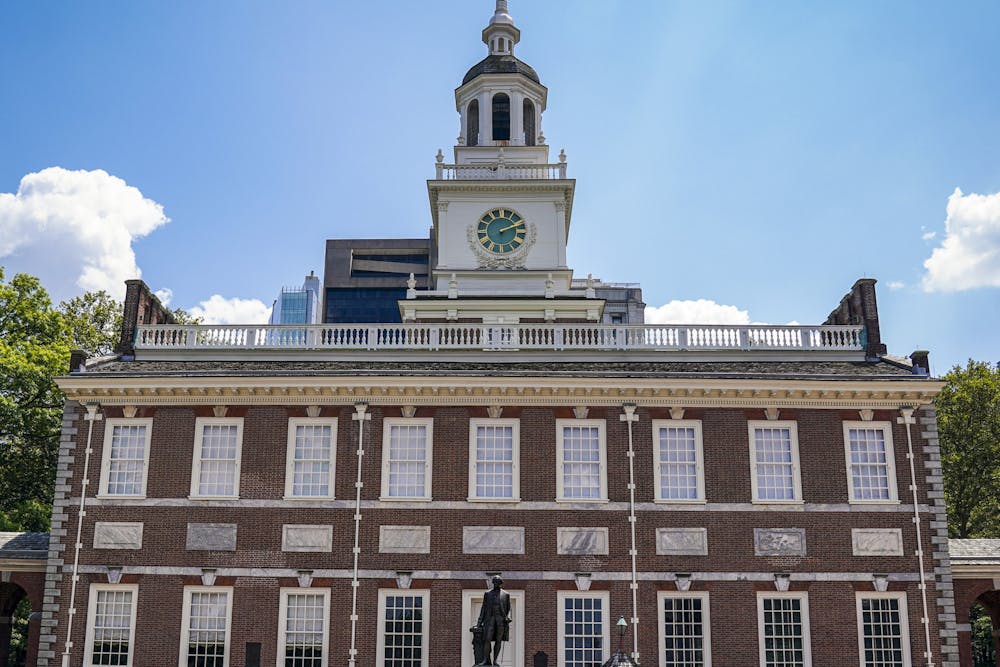
Philadelphia protesters rallied to defend exhibits at Independence National Historical Park that were deemed inappropriate by the Trump administration on Aug. 2.
In an executive order released by the White House on March 27, 1968 Wharton graduate and President Donald Trump ordered the restoration of historical sites, monuments, and statues to remove “ideological indoctrination or divisive narratives” from their exhibits. An exhibit at Independence Park titled “The President's House: Freedom and Slavery in the Making of a New Nation” is at the center of this controversy.
The exhibit, located at Sixth and Market streets, displays the remaining foundation of the house of Presidents George Washington and John Adams. However, its main focus remains the slaves who lived and worked in the house during Washington’s presidency.
In a statement to The Daily Pennsylvanian, VanJessica Gladney, Penn history Ph.D. candidate and lead tour guide and digital historian for the Penn & Slavery Project, wrote that while Philadelphia is often remembered as a champion for abolitionist history, its laws allowed for loopholes for prominent figures like Washington.
“That's what the President's House exhibit represents: the fact that freedom and slavery were often far more intertwined and entangled than we have been led to believe,” Gladney said.
Protesters have expressed their belief that Trump’s decision is an attempt to remove the negative aspects of American history.
“Everyone is a complicated person, even the founding fathers of our country,” protester Rev. Mark Kelly Tyler told WHYY News. “We want to make sure that the real truth is told and that we don’t do a disservice to the ancestors, the enslaved who lived here.”
The President’s House exhibit first faced scrutiny during its construction 15 years ago. Proponents for the exhibit fought for a decade before it was established, partly due to fear of the negative light it would shine on Washington. The exhibit ultimately focused on the slaves who served within the home, aiming to still tell their stories in the modern era.
“Our goal today is a call to action to begin a strategic effort to protect this important aspect of American history,” former President’s House project director Roz McPherson said.
The possible removal of the exhibit comes at the same time as an $85 million funding package to Independence Park to help prepare for the 250th anniversary of the signing of the Declaration of Independence. Welcoming over three million visitors in 2023, Independence Park plays a key role in educating Americans about revolutionary history and is expected to see an increase in visitors next year as the country celebrates the prominent anniversary.
“[The Penn & Slavery Project and the President’s House] both were created to articulate parts of history that had already been erased,” Gladney said. “Public history is incredibly important to ensuring that non-academic audiences understand the growth and strides it took to secure freedom for (almost) all, and also illustrates and emphasizes the amount of work left to do.”
According to The Philadelphia Inquirer, a final decision from the Trump administration on whether or not to keep this exhibit is expected by Sept. 17. It is unclear what will happen to the monuments after these decisions are made, other than a directive to “take action,” according to the U.S. Secretary of the Interior Doug Burgum.
“Our history is an asset, not a burden. And it must be protected,” tour guide for “The Black Journey: African-American History Walking Tour of Philadelphia,” Mijuel Johnson said.
Independence National Historical Park did not respond to the DP’s request for comment.