

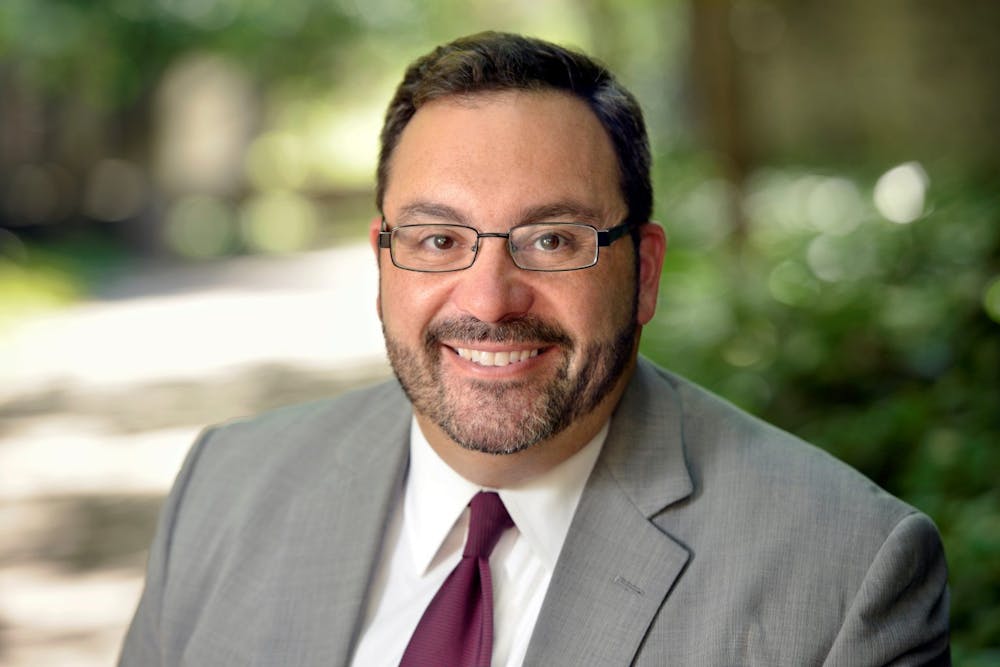
2005 Stuart Weitzman School of Design graduate and Associate Vice President for the Office of the Executive Vice President Tony Sorrentino was named the new chief executive officer of Philadelphia’s Fairmount Park Conservancy last week.
Sorrentino has been at Penn since 2000 and joined the Office of the EVP in 2006. The Conservancy's July 29 announcement noted Sorrentino’s “more than 25 years of experience advancing transformative initiatives,” as he is set to begin his tenure on Oct. 27.
“[Sorrentino’s] proven ability to build partnerships, drive innovation, and embrace diverse stakeholders will be invaluable in advancing our mission to make Philadelphia’s parks accessible and relevant for all,” 1979 Engineering graduate and Fairmount Park Conservancy Board Chair Carol Eicher said in the announcement.
Sorrentino spoke about his hopes for his role at the Conservancy in an interview with The Daily Pennsylvanian.
“We want young people to grow up in a city, feeling proud of their park, and then not just consume it and use it as a citizen, but also contribute back to it,” Sorrentino said. “I’m going to try my very best to apply that philosophy with Fairmount Park Conservancy.”
The Conservancy is a nearly 30-year-old private nonprofit that “exists to be the advocates, fundraisers, promoters, strategists for the Fairmount Park system for the city,” according to Sorrentino. The entire park system includes over 10,000 acres across the city, and acts as a “supplemental municipal service” for Philadelphia Parks and Recreation, assisting in “fundraising, advocacy, [and] analysis of how the parks are doing and performing.”
Sorrentino emphasized that a park “anchors the neighborhood” by drawing people to nearby businesses and being an “open space.” He noted how parks provide additional “socialization" opportunities for many different people.
“I think that for young people, they learn to socialize, and they learn to meet lots of different people from different walks of life,” Sorrentino said. “They learn sports, they learn music, they learn arts, they learn to appreciate a tree. Then, for senior citizens, as they get older, we do have an epidemic of loneliness, and if you're a senior citizen and you live close to a park, you’re going to increase your chance of socialization. I think it's wonderful when generations mix.”
RELATED:
Housing Initiative at Penn looks to confront Philadelphia’s affordable housing crisis
Johanna Burton named next director of Penn’s Institute of Contemporary Art
The Conservancy works to “develop new parks or refresh existing parks with new designs [and] new layouts to provide scientific data and analysis in the name of environmental stability,” Sorrentino said. He also discussed the Conservancy as a “public-private partnership,” noting that it works with the city to achieve its goals of raising “private money for the public good.”
His upcoming book, titled “Medicine for the City,” focuses on the importance of public-private partnerships in “reimagin[ing] Civic Center Boulevard into a thriving academic medical district,” according to Sorrentino’s website.
As CEO, Sorrentino wants to discover the “best practices” around “urbanism” by studying the most successful examples of public-private partnerships involving parks.
“I’m a Philadelphian and an urbanist at heart, and I consider beautiful green open space that’s well designed and well maintained as part of the urban experience,” Sorrentino said. “Smart parks planning may be the most democratic form of city planning that exists — and I’m a trained Penn city planner, [so] I take that very seriously.”
Helping Philadelphia students engage in acts of public good for the city results in “transformational change,” according to Sorrentino. He said he would “love to see the Conservancy and its partnership with the city be a convener of students.”
“Not just college students — I think high school students can get involved in this as well,” Sorrentino continued. “I think we have an opportunity to partner with the school district of Philadelphia.”
On the high school level, he noted fostering an interest in botany and ecology, and at the university level, getting colleges committed “to being the best possible neighbors and citizens they can be.”
“Collectively, if you have a lot of people doing this, ultimately the city gets transformed, socially, [and] economically,” he added. He highlighted how Penn students are “citizens of Philadelphia” while they are at school, and how “participating as a volunteer in a nonprofit that’s good for the public rounds you out as a person.”
“The best way to learn about how to be a citizen is to actually get your hands dirty,” Sorrentino said.
At Penn, Sorrentino has led teams that develop and execute programs, communication campaigns, and partnerships with the nearby community, strengthening the University’s role as a “national model for anchor institution impact,” according to the announcement. He has helped establish Penn as an “anchor institution” — defined by being “rooted in their localities” and not leaving in the face of “substantial capital flight.”
Sorrentino was also the leader of Penn & Philly, a campaign that highlighted the University’s socioeconomic impact on Philadelphia, and he contributed to Penn’s Climate Action Plan and sustainability efforts.
“The reason I’m excited about being with the Fairmount Park Conservancy is I consider Fairmount Park a great inheritance and every generation stewards it,” Sorrentino said. “It’s not just the physical passing of a thing to the next generation, but the lessons [that] can be passed down. If you care about it and you value it, then ultimately you'll find the right way.”
RELATED:
Housing Initiative at Penn looks to confront Philadelphia’s affordable housing crisis
Johanna Burton named next director of Penn’s Institute of Contemporary Art
Staff reporter José Carlos Serrano contributes to data and enterprise reporting and can be reached at serrano@thedp.com. At Penn, he studies English and political science.


