

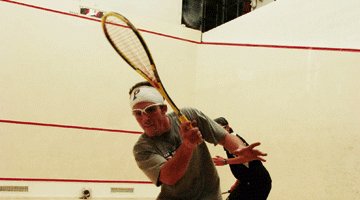
After graduating, many Penn students take some time to see the world. Usually, that travel ends after the summer, when graduate schools or careers take over.
For Gilly Lane, though, his career began but the traveling didn't stop. He opted to become a professional squash player.
Now, Lane trains out of Amsterdam, working with world-renowned coach Tommy Berden. He plays in tournaments across the globe, from New York to Finland to Ecuador.
And not only is he getting the experience of a lifetime, Lane is rapidly rising through the ranks of professional squash. After graduating from Penn last year, he was ranked No. 296 internationally. He now comes in at No. 91 in the most recent rankings.
But his career didn't get off to such a smooth start. After training in England for six weeks immediately after his graduation, Lane moved back to his hometown of Philadelphia. And though he continued training and competing, he felt his career began to stagnate.
"At that time I didn't really have any structure in my training and was just doing everything day by day depending on how I felt," he said in an e-mail. "It was at this time that I needed to make a choice of sticking to what I was doing and hoping for the best or to go out and search for a better situation."
He found what he was looking for in a discussion with the top Dutch player, Laurens Jan Anjema. The No. 16 player internationally told him about the upside to training in Amsterdam and so in January, Lane left to, as he puts it, "actually start my career."
Since then, Lane's ranking has quickly risen as he has worked with Berden, Anjema and others to better his performance on the court.
"We are continually working hard to make him fitter, faster and stronger physically," Berden said in an e-mail. "Two major targets for improvement in his game are his tactics and his mental strength. He likes to go at a hundred miles an hour, leading to over eagerness and unnecessary mistakes."
And that work has paid off. Lane topped higher-ranked opponents to make the semifinals of three $10,000 tournaments, including ones in Copenhagen, Denmark, and Atlanta in which he entered unseeded.
Lane also traveled to Ecuador, where he was a part of the first U.S. team to ever capture gold in the Pan-American Games. He currently stands as the No. 3 American player.
Even with the success, adaptation to life as a professional athlete has not been easy for Lane.
"I think that the professional athlete gets put in the limelight so often that people think that what they do is easy work," he said. "I can tell you it is a grind like any other job, and especially in my job where the financial rewards are nowhere near the likes of basketball, baseball, and football."
And that doesn't even take into account that Lane - who grew up in Philadelphia - is in a foreign country. He says that he's struggled to adapt to life on the road, especially coming out of such a warm environment as Penn. While most people in Amsterdam may understand English, Lane is relatively unfamiliar with the Dutch that natives use with each other.
"The biggest difference, however, and probably the hardest thing to deal with is being by yourself. You are in a country where everyone speaks the language you have known from an early age and can understand you but you cant understand anyone else."
But that doesn't mean that Lane's quitting anytime soon. Currently in the offseason, he is in training for next year, when he hopes to crack the top 70 internationally and top 2 for Americans. The skills are there, Berden contends, but it remains to be seen whether Lane's hard work and dedication will pay off on the court.
"I don't want to pin him down to a ranking target, but he has the capabilities to get to the top of the World Rankings," he said. "However it is a process, so it will take a good four to five years before he will be at his best."

