

If you watch the Summer Olympics, you've probably seen an enchanting water sport in which speed and strength take a backseat to style and choreography.
In fact, this esoteric competition seems more like a hybrid activity than anything else - swimmers incorporate technical elements of gymnastics and ballet while working together underwater.
Teams dazzle the audience with artistic fluidity, making the most refined of crafts appear to be a monolithic, aquatic dance routine.
And though most of the world has, at best, a superficial understanding of synchronized swimming - which didn't become an Olympic sport until 1984 - one student group at Penn caught on to the phenomenon long before the International Olympic Committee.
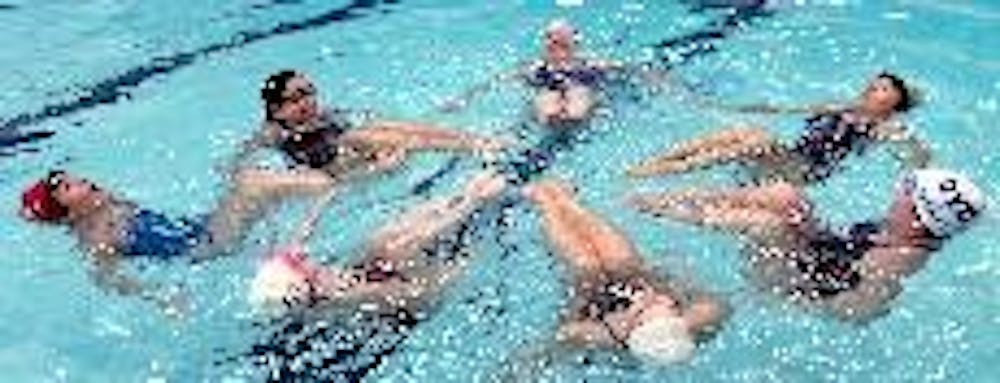
The Pennguinettes, Penn's all-female synchronized swimming club, have been on campus for over 50 years, making them the University's oldest women's student group. The team is also one of only two in the Ivy League.
Due to the lack of Ivy presence, the Pennguinettes compete at both club and varsity levels against schools on the east coast, as well as annually taking part in the ECAC championships and collegiate national championships.
According to team Vice President Michelle Aleong, the opportunity to swim against teams from across the region gives the club sport a more competitive feel and makes for an overall enjoyable experience.
"It's really a great way to travel across the country and see some amazing, Olympic-level swimming," she said.
In recent years, the Pennguinettes have been at meets with powerhouses such as Stanford and Ohio State, teams that practice 40-60 hours a week and receive much more funding than the Department of Recreation-sponsored Penn team.
Last year at nationals, the club recorded its best finish ever, placing 16th.
Prospective Pennguinettes
Because synchronized swimming is an relatively uncommon activity in colleges across the country - much less high schools - the Pennguinettes devote a lot of their time to recruiting.
In fact, the team attracts potential recruits in much the same way that any campus group would: Setting up a table at the club fair on Locust Walk at the beginning of the school year.
Neither Aleong nor team President Rachel Klein had any experience with synchronized swimming before coming to Penn, which is also the case for the majority of the team's nine members. While many of the Pennguinettes swam in high school, Klein played volleyball.
"Synchronized swimming is pretty easy to pick up, and it's fun," Klein said. "I also liked learning it."
Klein also stressed the advantage of being able to compete in major tournaments as an underclassman.
On the heels of the team's recent success, this year's freshman class includes two students that participated in synchronized swimming before coming to Penn and contacted the team before their arrival.
Even so, Aleong noted that the team "prides ourselves on the fact that no experience is necessary."
Taking care of business
The squad has plenty of time to train, write routines and find music to swim to, since the competitive season takes place during March. Practicing at Pottruck Fitness Center, the Pennguinettes spend anywhere from four to six hours per week in the pool and another five hours going over routines on land.
A coach from Temple comes in to watch the team practice and offers insight a few times per week, but the team doesn't have an official, full-time instructor.
Furthermore, given the nature of club sports, the team needs to take care of a slew of administrative matters, from booking hotels and flights when traveling to scheduling pool times for practices and meets.
This year, the team is trying to host the ECAC championships, a task that has proven difficult and time-consuming.
"Everything is student-run, and I have to put everything on my credit card," Klein said.
Since the team has been in existence for so long, it has built up a strong alumni network on which it relies frequently for monetary donations, since the University budget for the club sport is not entirely sufficient.
The rules of the game
Synchronized swimming is made up of many different events, ranging from big team routines to solos and duets.
The team routine - which includes up to eight people in the water at once - usually lasts three minutes and 45 seconds and is judged out of 10 points on technical and artistic merit. Routines are written to music, and the movements and tosses in the water are often comparable to those in ballet or figure skating.
The overall total also includes the top seven scores from a combination of trios, duets, solos and a technical event in which everyone participates.
Solo competitions emphasize the artistic element, forcing competitors to pay careful attention to presentation, emotion and timing technical components and form with the music.
Routines include lifts, throws and figures - in which the swimmers move as one unit in the pool. Swimmers are never allowed to touch the bottom of the pool for support, instead relying on kicks and sculling motions to keep them afloat.
"You have to practice everything a lot both in water and on land so that everyone can visualize what's going on and so that everyone's familiar with the routine," Aleong said.
The meets are usually full-day events, though nationals last for up to a week.
Team chemistry
Both Aleong and Klein agree that the most enjoyable part of competing for the Pennguinettes is spending time with the team members.
Even though synchronized swimming is a club sport, the many hours that students devote to it makes the activity a major part of social life for the members as well.
"It's really a great group of girls, "Klein said. "We're really fun, and we hang out and go out together all the time."
And if there was ever a sport in which a high level of camaraderie was essential, it would be synchronized swimming.
"You always have to be on the same page," Aleong said. "Spending a lot of time together makes it much easier" to do well in competition.
Ultimately, Klein said that the Pennguinettes are just another example of a group at Penn that lets students try something new.
"I wanted to come here and do something that I had never done before and probably wouldn't have the chance to do again," she said. "I'm very happy to have made this decision."

