

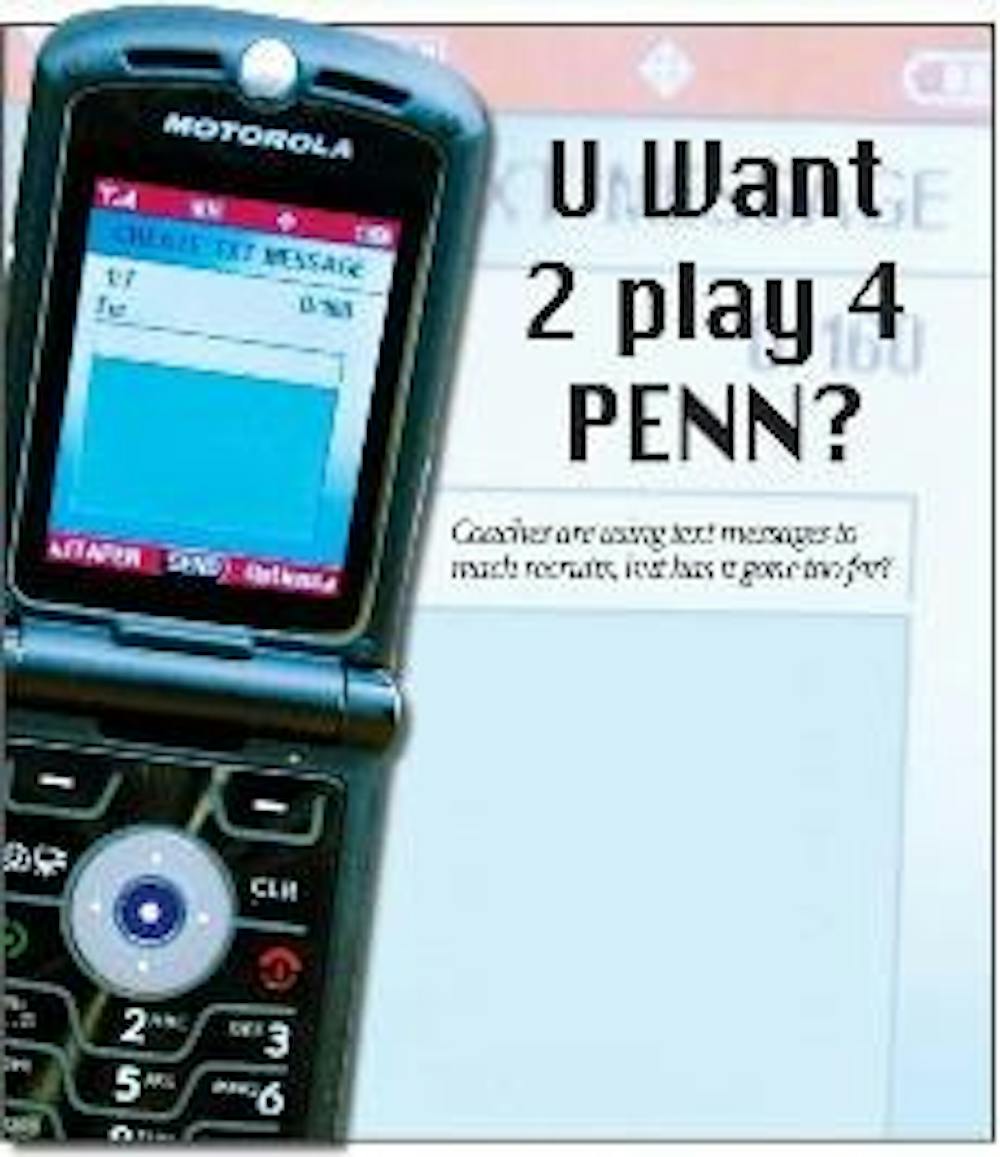
Penn basketball freshman forward Justin Reilly was a senior in high school when coaches from around the country started contacting him to play for their universities and sending him messages frequently - on his cell phone.
"I actually had to upgrade my text message plan to 2,400" messages, Reilly said. "Once I got 1,900 text messages, the majority from coaches, and it was a $700 bill."
In a world where a 17-year-old recruit's life revolves around new technology, coaches are now investigating new avenues of communication to reach prospective student-athletes.
But many coaches are taking it to new extremes, and some seem to be pushing the boundaries of good taste.
"A lot of it would be like if you were at recruiting camp and they couldn't call you, they would text you to say, 'Good game,'" Reilly said. "But they'd also send me text messages at 12 at night and be like, 'We're thinking about you night and day.'"
NCAA recruiting guidelines set a once-per-week limit for phone calls that coaches can make to recruits. But due to a loophole in that restriction, text messages, instant messages and
e-mails are currently treated the same under the policy as letters - which means there are no restrictions placed on them.
Various attempts have been made by individual conferences to limit the amount of messages coaches are allowed to send, but the Ivy League has taken the strongest stance in the matter.
Ivy officials recently submitted a proposal to the NCAA that would prohibit any communication between coaches and recruits via text messaging and instant messaging.
Ivy League Executive Director Jeff Orleans says such drastic measures are necessary in order to bring the NCAA's attention to what he feels is becoming a serious violation of future student-athletes' right to privacy.
"Text messaging seemed such a pervasive and, in many ways, intrusive aspect of high school recruits' lives," Orleans said. "It's the issue of trying to preserve space for the athletes with this new technology."
Text-messaging recruits has clear advantages for coaches. However, the rampant use of this method of communication by some athletic programs has brought this issue to the forefront of NCAA-recruitment policy debate.
Penn football coach Al Bagnoli defends the practice, saying that such alternative ways of contacting a potential athlete are very useful to programs that don't have access to the recruiting resources which other Division I programs have.
"It's 24-hour access to a recruit," Bagnoli said. "Everybody [text messages recruits]. It's very common."
Several issues have come up because of the volume of text messages sent, including concerns about a possible invasion of privacy and a distraction from academics.
An additional problem arises when coaches send recruits messages asking the student to call them back. This allows coaches to circumvent the phone call limit, as there is no limit to the amount of calls a recruit can make to a coach.
The recruit must then choose whether or not to call back and risk seeming disinterested or to call back and increase the likelihood that other coaches will adopt similar tactics.
An NCAA panel is currently discussing options to restrict text messaging, taking the Ivy League's proposal into account.
While some are in favor of prohibiting any text messages between coaches and recruits, others believe that a limitation of the amount of messages sent would be a better solution.
"I don't think a complete ban is necessary, but I do think it should be moderated," Bagnoli said. "You can't have a top recruit turning off his phone for football practice and turn it on afterwards to find 20 text messages from coaches."
While moderation seems to be an attractive option, Orleans, the Ivy executive director, notes that proposals which permit limited messaging raise additional issues that would be avoided if a complete ban were enacted.
"There would be the benefit of much less record-keeping and much less compliance worries," Orleans said. "The kids would have some time out from this process which can be very, very . intrusive."
But since the Ivy League's suggested ban would take up to a year to go into effect if passed, top recruits might still want to invest in unlimited text messaging in the meantime.

