The most celebrated moment in band history at both Stanford University and its archrival, the University of California at Berkeley, is a now famous mishap dubbed "The Play." According to Casey O'Hara, manager of the Leland Stanford Junior University Marching Band, ten years ago during the last game of the season for both teams, Stanford had just scored in the fourth quarter and led Berkeley by one point. Four seconds remained on the clock as the hollering Stanford band lined up right outside the endzone, ready to lead the victory charge onto the field. A confident Stanford punted. Berkeley received and started to run downfield. The first block came. But right as a Stanford defender was about to tackle his opponent, the runner lateraled back to another teammate. And as the new runner came within seconds of being tackled, he too lateraled back to someone else. This happened once again, and yet again, and then an astounding fifth time. Berkeley ran the ball into the endzone and won the game. But the clock had already stopped running, and the band swarmed into the endzone too early in a vain celebration. The scoring player sliced into the Stanford band, eventually colliding with a saxophone player and bowling over a trombone player and crushing his instrument. The warped trombone grew famous. So famous, says O'Hara, that after the game a band member combed area pawn shops for cheap trombones, banged them up a bit, and sold them as the actual mangled trombone to several Berkeley fans. · For years college marching bands have been the source of entertainment and amusement during football games. Many, like the Cornell University marching band, take pride in their crisp, impeccable military formations, while others, like the Stanford band, strive to be comical - and oftentimes end up embarrassing their schools. The latter kind, unofficially known as "scramble bands," aims to bring humor to its half-time show. "We run onto the field, running, scrambling, and running around in circles," O'Hara said. "We scatter into the next formation and break up and run around in circles again, and all of a sudden another shape forms again." As inept as scramble bands may appear, however, many do still strive for a "professional" look of sorts. "We take pride in sounding very good," said Wharton senior Patrick Matthews, vice president of the Penn Band. "On the field we look silly, but we are trying to make the formations clean and sharp. The scrambling is supposed to look ridiculous." Matthews admitted, however, that the loss of the "E" when the band spelled P-E-N-N in last month's Yale game was accidental and quite embarrassing to the band. "We try to make it so the audience can get the joke, but we realize that our formations look like nothing sometimes," O'Hara said. "Formations come out looking like nothing at almost every show. But we know what it is, so it's funny to us." But band shows are not always funny to everyone else. Three years ago the Penn Band barely escaped trouble when the group formed One Liberty Place - Center City Philadelphia's then newly-built skyscraper. When the formation was complete, the white tubas moved up the middle of the formation and out the top, "like elevators that have gone out of control," said Matthews. "If you have something white shooting out of something phallic, you can almost guess what that is," he added. And controversial shows are certainly not limited to the University. The Harvard band came close to extinction in 1984 after presenting what many fans considered a tasteless halftime show, said Harvard senior Victor Huang, manager of the Harvard band. The band reportedly outraged several fans by playing Billy Joel's hit "Only the Good Die Young" at a time when the shooting of the Korean Airline flight 007 over Soviet territory still lingered in the public's memory. The crowd was treated to further entertainment following the song, with the spelling of "P-U-K-E" on the field. Together, the two actions sparked numerous letters of complaints about the band's lack of taste. Harvard Band members approached the university administration and presented a list of improvements to avoid a harsh punishment. "We were very responsible about what we did," Huang said. And at other schools, officials have settled for censoring halftime shows as the only acceptable and workable compromise. Matthews said that in the recent past the Penn Band has generally observed good relations with the University administration. The good relations do not exempt the band from pre-game inspections of shows by University officials, however. "The University reviews our shows once a week, but it's more like self-censorship," Matthews said. "University officials ask, 'Why are you doing this?' or 'Is there a different way of doing this?' not 'Don't do this,' " he said. He explained that the band has found many times that the mere phrasing of a term dictates whether a certain joke can slip between the cracks or be scrapped altogether. "I know what we can get away with," Matthews said. Unlike the University, the Princeton band is "fairly heavily censored, and we have to run shows through a couple of censors," Princeton senior and band drill master Wolff Dobson said. The censoring is a result of a "horrendous" letter received two years ago from a Princeton alumnus demanding that the band be disbanded because he was offended by the band members' "lewd" dancing with the Princeton Tiger mascot, Dobson said. But censorship doesn't keep the Princeton band from occasionally straying from their script. Just ask the Harvard drum major, who got a dose of Princeton band humor while waving his flaming baton during last year's halftime show. According to Dobson, the Princeton band had used a fire extinguisher in its halftime show prior to the Harvard band's performance and felt an urge to finish the remaining foam. "We kind of looked at the extinguisher and looked at the baton and then rushed out onto the field and put [the baton] out," Dobson said. Although improvised incidents such as these frequently amuse halftime audiences, marching bands also keep themselves entertained with countless pranks against rival bands. A few years ago two Harvard band members managed to sneak into the lion's den - the Dartmouth bandroom - where they located several tuba covers in a locker. Making their way back to their side, they adorned their tubas with the Dartmouth covers and performed the entire show waving their opponent's insignia. After the show the Dartmouth band was asked over the loudspeaker to reclaim their covers on the Harvard stands. But the Penn Band has created an award named after an even more embarassing escapade. The Penn Band's Anthony J. Staglianl Horse's Ass Award has been presented each year since 1965 for "intangible services rendered" the Penn Band, Matthews said. Its name derives from a mishap that year in which a bass drum player from the band almost saved the football team from a disgraceful loss. Staglianl was standing near the sidelines with the rest of the band waiting to trample the field for halftime show. A player from the opposing team suddenly broke through Penn's defense with nothing between him and the endzone. A touchdown seemed certain. But in a brilliant display of school spirit, Staglanl threw down his drum, ran onto the field and tackled the player. The performances, and the rivalries, are not limited just to the football field. Dobson says his band has a tendancy to hit the libraries. "Every campus we go to we march into the library," Dobson said. "Usually the guards are so stunned they don't realize they should stop us." And at the Harvard Widner Library, workers called security to knab the 50- to 70-person band before they could make their grand entry. "So we had to sneak into the back onto the loading dock," Dobson said. "We ran by the guard somehow, played real quick and ran out," he said. Dobson added that the Cornell library is next on the band's list. Dobson acknowledged that the Princeton band has not invaded the Van Pelt Library in the recent past. "But we dressed the statue of Ben Franklin [in front of Weightman Hall] in boaters and an orange plaid jacket last fall," Dobson said.
The Daily Pennsylvanian is an independent, student-run newspaper. Please consider making a donation to support the coverage that shapes the University. Your generosity ensures a future of strong journalism at Penn.
DonateMore Like This

A history of the Penn presidency
By
Aidan Shaughnessy
·
8 hours ago

No — AI will not wipe out humanity by 2030, Penn experts say
By
Addison Saji
·
8 hours ago

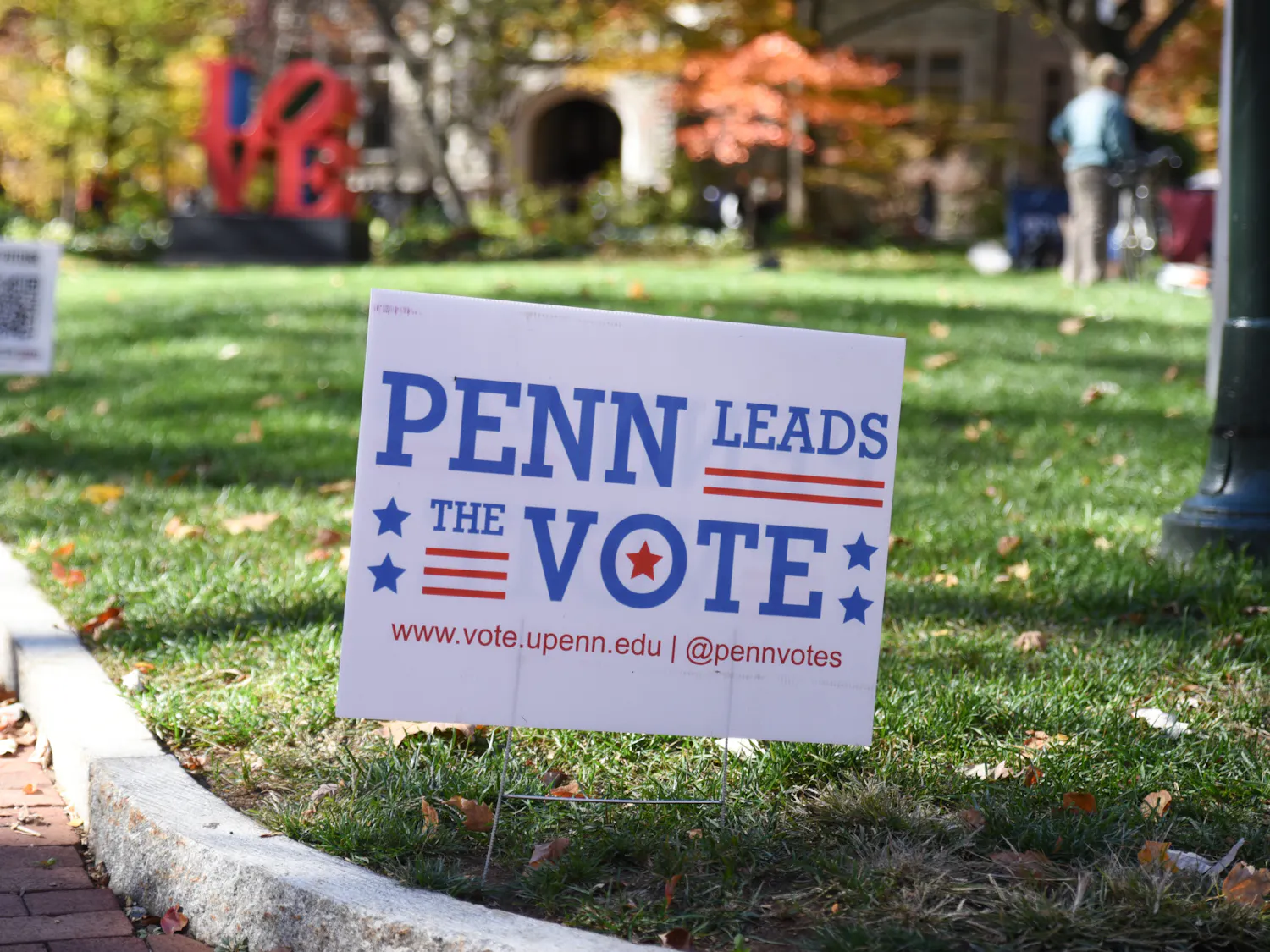
Penn student groups promote voter registration on Locust Walk
By
Mara Flores
·
8 hours ago