

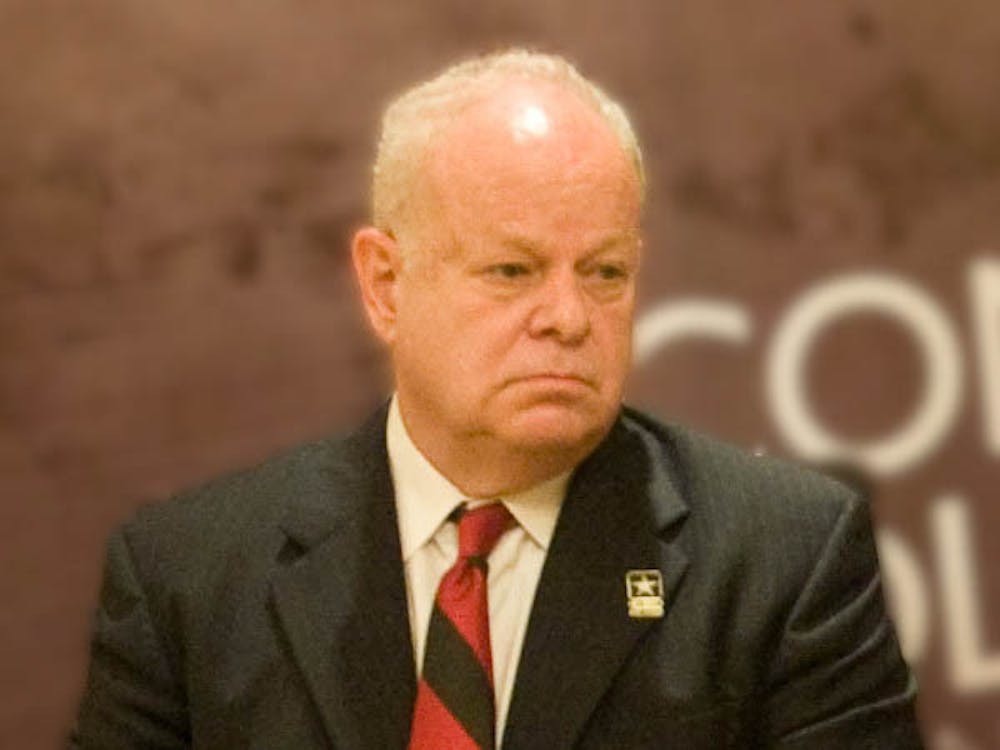
In the months after Jeffrey Epstein was released from a Florida prison in June 2009, he began to court several of the world’s top academics, including celebrated Penn Psychology professor Martin Seligman.
That year, he contacted multiple notable figures — including literary agents, professors, and authors — in an attempt to organize a series of academic gatherings. In a 2009 email exchange, Epstein referred to Seligman, now the head of Penn’s Positive Psychology Center, as a “core participant” of the proposed meetings.
In response to The Daily Pennsylvanian’s request for comment, Seligman wrote that he had met Epstein at a “Billionaire’s Dinner” event in 2004, hosted by the Edge Foundation.
In a 2010 email, Epstein wrote that Seligman had visited his ranch in New Mexico in the past.
“Marty has been at my ranch … he is great,” the exchange read.
Seligman told the DP that he attended a two-day seminar on evolution at Epstein’s ranch in either 2006 or 2007. The ranch is reportedly the site where Epstein planned to “seed the human race with his DNA” by impregnating women, a eugenics project Seligman clarified was not discussed at the seminar.
“I was never involved in such a conversation and I only heard of this bizarre notion recently in the press,” Seligman wrote. “The seminar I attended was highly technical and about the mathematics of evolutionary theory.”
A University spokesperson declined to comment. Seligman has not been accused of any wrongdoing in connection with Epstein or his crimes.
In a 2011 email, Epstein implied that he helped fund Seligman’s positive psychology research.
“You funded his Positive Psychology research, didn’t you?? It has to be you asking him ‘why don’t you come visit us in NY?’ Am I right???” the email read, referencing the first chapter of Seligman’s book, “Flourish,” in which he detailed how he received the first major funds for his research.
Epstein replied, “yes.”
In his statement, Seligman refuted that claim, writing, “Jeffrey Epstein never funded my research or the Positive Psychology Center directly or indirectly.”
In a 2009 email, Epstein wrote that he intended to “fully fund” seven meetings hosting academics in 2010. According to Epstein, the discussions would include “lots of interaction” and “cross pollination.”
A separate email sent to Epstein in August 2009 included previous notes on a “power symposium” that named Seligman as a participant they would like to invite “ASAP.”
The email also listed Stephen Hawking, former Israeli Prime Minister Ehud Barak, and Harvard Law School professor Alan Dershowitz as possible invitees.
Although it is unclear whether the gatherings ever took place, Epstein attempted to associate himself with Seligman several times in the following years.
In September 2010, an individual reached out to Epstein, asking if he would like to attend a symposium with Seligman.
Epstein replied that he’d “always” had “interest in symposiums.”
In June of 2011, Epstein’s assistant attempted to arrange two calls between Epstein and Seligman. Both times, Seligman said he was unavailable and asked Epstein to email him instead.
Seligman wrote in a statement to the DP that Epstein did not email him and that he did not recall any conversations that followed the requests from Epstein’s assistant.
“I have no idea what he wanted,” Seligman added.
Although Seligman had referred to Epstein as “Jeffrey” in the past, he maintained that the two of them were not close.
“I have never had a personal relationship with Epstein and had no contact of any kind with him after 2007,” he wrote.
Aside from his responses to Epstein’s assistant in June 2011, Seligman’s last correspondence with Epstein, according to the files, occurred on Sept. 10, 2007, when he forwarded information to Epstein about a conference he would be attending.
While there is little communication between Seligman and Epstein following that point, Epstein continued to reference Seligman in his correspondence in the years afterward.
He discussed Seligman’s research with at least two individuals and attempted to help one individual enroll in Seligman’s psychology class at Penn in 2013.
Seligman wrote that he does not have any record of that woman enrolling in the class.
According to a 2024 DP analysis, Seligman — with almost 300,000 citations — was the most cited researcher at Penn at the time. The list includes previous and current professors, graduate students, and other researchers with a Penn affiliation on Google Scholar.


