
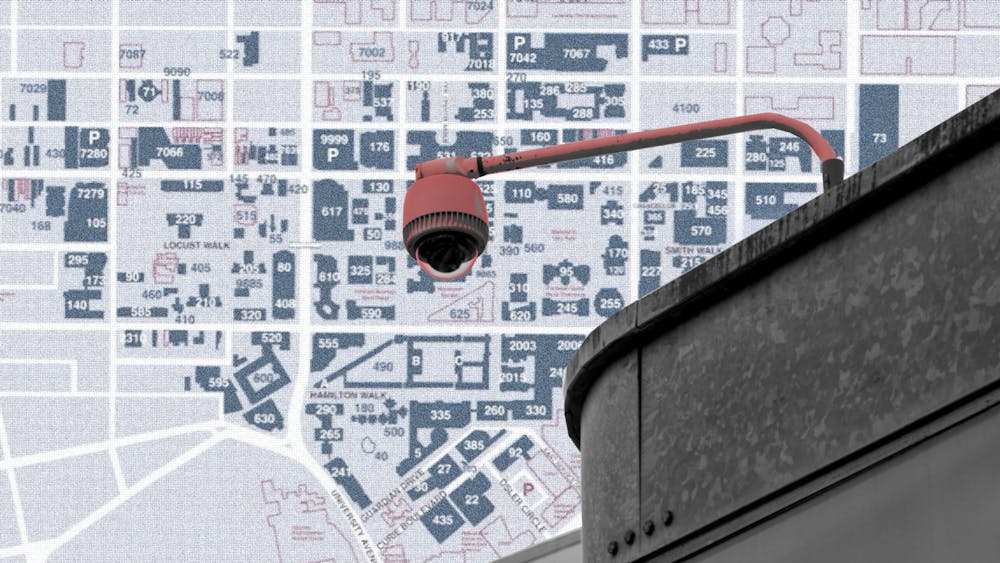
If you look up while walking on Penn’s campus or one of the surrounding streets, chances are you’ll spot one of the more than 1,300 cameras operated by the University — part of its sprawling surveillance network.
Under Penn’s “Closed Circuit Television Monitoring and Recording of Public Areas for Safety and Security Purposes” policy — first adopted in 1999 and later updated in 2008 — the University’s Division of Public Safety is required to publish the locations of all outdoor CCTV cameras it monitors in semiannual updates. Over the past five years, the number of locations with cameras monitored by Penn has increased by roughly 20%.
As of January, Penn reported operating more than 145 pan-tilt-zoom cameras and more than 1,200 fixed cameras across campus and within its patrol zone. While outdoor camera locations are publicly listed, the University is not required to publish a list of indoor camera locations.
Penn publicly disclosed a total of 309 outdoor camera locations this year, including 178 “University of Pennsylvania Cameras.”
According to the CCTV policy, camera installations must serve “legitimate safety and security purposes,” including protection of buildings and property, criminal investigation, pedestrian safety, and compliance with government requirements. The policy specifies that cameras may monitor public streets, intersections, parking lots, bike racks, and building perimeters, among other locations.
The policy also establishes limits on Penn’s surveillance capabilities. CCTV monitoring must not violate a “reasonable expectation of privacy,” and cameras are not permitted in residential hallways or lounges. Recorded footage is automatically deleted after 30 days unless retained for criminal investigations or litigation purposes.
RELATED:
Despite Division of Public Safety warning, Penn students report confidence in campus safety
Outdoor camera installations require review and approval from an eight-member CCTV Monitoring Panel — composed of faculty, students, staff, and a representative from the Office of Audit, Compliance, and Privacy. Proposed outdoor camera locations must be reviewed by the panel and published in Penn’s Almanac before installation.
Requests for new cameras can originate from multiple sources, including various departments across Penn, and installations must be justified to the CCTV Monitoring Panel based on “operational needs that are safety driven,” Vice President for Public Safety Kathleen Shields Anderson explained in an interview with The Daily Pennsylvanian.
“Some reasons are crime related while some are safety related,” Shields explained.
“It might not prevent crime, but it can increase solvability rates,” she added, citing previous examples in which cameras detected rooftop fires or allowed dispatchers to respond to individuals experiencing mental health crises.
According to Shields, expanded coverage has also improved Penn’s ability to resolve low-level theft cases, including bike and scooter theft.
The DP’s review of Almanac publications showed that the most significant increase in recent years occurred in 2021, when 23 additional outdoor cameras were added to the Hospital of the University of Pennsylvania. In total, the number of outdoor locations with Penn-operated cameras has increased by 18.8% since then.
The increase came soon after the October 2021 opening of the $1.6 billion, 1.5 million-square-foot Penn Medicine Pavilion, now renamed the Clifton Center for Medical Breakthroughs — a 17-story expansion of HUP that houses more than 500 private patient rooms and a two-story emergency room. The Pavilion significantly expanded the medical campus’ physical presence, prompting additional perimeter and intersection monitoring in the surrounding area.
Shields noted that the opening of the Pavilion was likely one reason for the marked increase in camera locations in recent years. She clarified that due to the nature of “health system regulations” and the sensitivity of the services provided — such as medicine prescribed and sold at pharmacies — hospitals are required to have “cameras in specific locations.”
Shields additionally cited an uptick in crime rates after the COVID-19 pandemic as another possible explanation for the increase in camera locations. Requests to install new cameras can be motivated by “crime trend analysis,” according to Shields.
While DPS centrally manages outdoor cameras, Shields clarified that different schools and centers typically have their own interior camera requirements.
Senior reporters William Grantland and Jack Guerin contributed reporting.
Senior reporter Phoebe Anagnos covers student life and can be reached at anagnos@thedp.com. At Penn, she studies architecture and earth science. Follow her on X @phoebeeanagnos.





