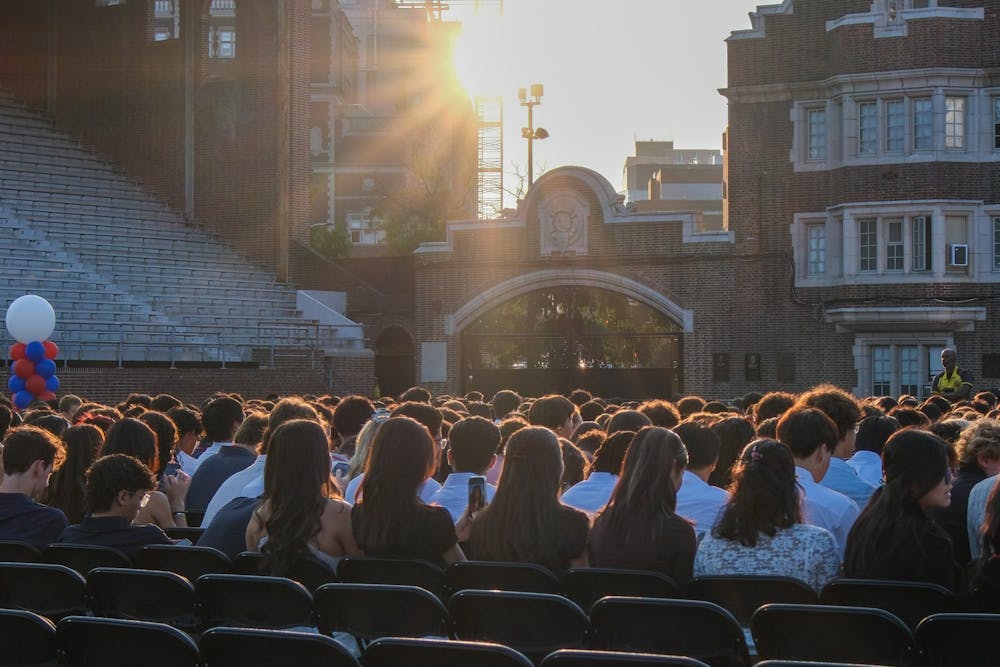
First years are often at the center of campus life each fall, flocking to orientation events, club fairs, and other festivities as they begin their Penn experience.
But they are not the only students navigating a major transition. Transfer students are similarly adjusting to a new campus, classmates, and academic environment.
Penn’s Office of New Student Orientation and Academic Initiatives — along with the Transfer Student Organization — hosted events from Aug. 17 to Sept. 4 aimed at helping transfer students find their footing on campus.
College senior Clara Shin, who is one of the presidents of TSO, explained that the events focus on creating opportunities for transfer students to “find both community as well as connection to the school in itself.”
She added that “a lot of transfers come in feeling like they’re already behind because they miss their freshman year.”
Shin — who transferred to Penn as a sophomore because she felt that it “offered the most support and a more tight-knit community of transfers” — emphasized that transfer student orientation is tailored toward a specific environment while regular New Student Orientation programming focuses on “acclimation to college itself.”
“We’re aware that transfer students typically come in with a lot of information and knowledge already,” Shin said.
This year’s orientation for transfer students included a welcome dessert reception, information sessions, and a transfer-specific student activities fair — with events aimed at both building community among transfer students and introducing them to Penn’s resources and traditions.
Information sessions covered topics ranging from research and course registration to campus safety, public transportation, grocery shopping, and student organizations. Penn also hosted guided tours of Rittenhouse Square and Chinatown.
College sophomore Yaman Albittar said that transfer orientation “made Penn feel smaller” by providing valuable information and support from TSO leaders — easing his transition from a small liberal arts school.
Albittar added that “the biggest benefit” of attending orientation was not necessarily a specific event, but rather “having a group of people who had already gone through the exact transition I was going through.”
“Older transfers made it feel like we had our own orientation experience rather than just being added into the freshman one,” he said.
While Albittar highlighted a mentorship event and small group dinners as particularly beneficial, he noted that orientation was less relevant to the academic transition. He explained that transfer students “don’t really know what [their] classes or workload are going to feel like.”
Wharton sophomore Dorian Glogovac similarly described transfer orientations as “really good” opportunities to “connect with new people.” One of his early concerns was how he would be able to “fit in as a transfer student.”
Glogovac pointed out that while parts of the programming were designed to help new transfers meet one another, the orientation also connected them with upperclassmen who could offer advice.
“They were in our shoes,” he said.
While Gloglovac appreciated that the programming showcased “a lot of the value and a lot of the opportunities that Penn has,” he added that an event dedicated to student-athlete transfers would have been helpful.
College sophomore Imani Gaskin — who transferred from a “super small school” — said she appreciated the chance to join a community “before everything started getting super busy with classes and everyone else moving in.”
Gaskin explained that as a transfer student, “it definitely feels like you’re in a bubble sometimes.”
“I’m excited to just feel like a Penn student and not like a Penn transfer,” she said.
College senior and TSO Co-President Nataley Kim reminisced on her own experience with orientation — especially that it “didn’t make us feel like freshmen.”
“We already experienced what that first year of college is like,” Kim said. “Instead of feeling like we’re a year behind, they made us feel like we’re right on track.”
Looking ahead, both Kim and Shin hope TSO will receive more funding after budget cuts limited this year’s programming and led to several traditional events being cancelled.
“Sometimes there was only one event planned for each day just because we didn’t have enough funding,” Kim said.
She added that fewer events meant fewer opportunities to meet orientation leaders and other members of their incoming class.
“We come to school a whole week early because we want everyone to not feel alone and that we’re always there for them in any way,” Kim stated. “I just hope that every year it keeps getting paid for.”
Senior reporter Amy Liao covers student life and can be reached at liao@thedp.com. At Penn, she studies philosophy, politics, and economics. Follow her on X @amyliiao.