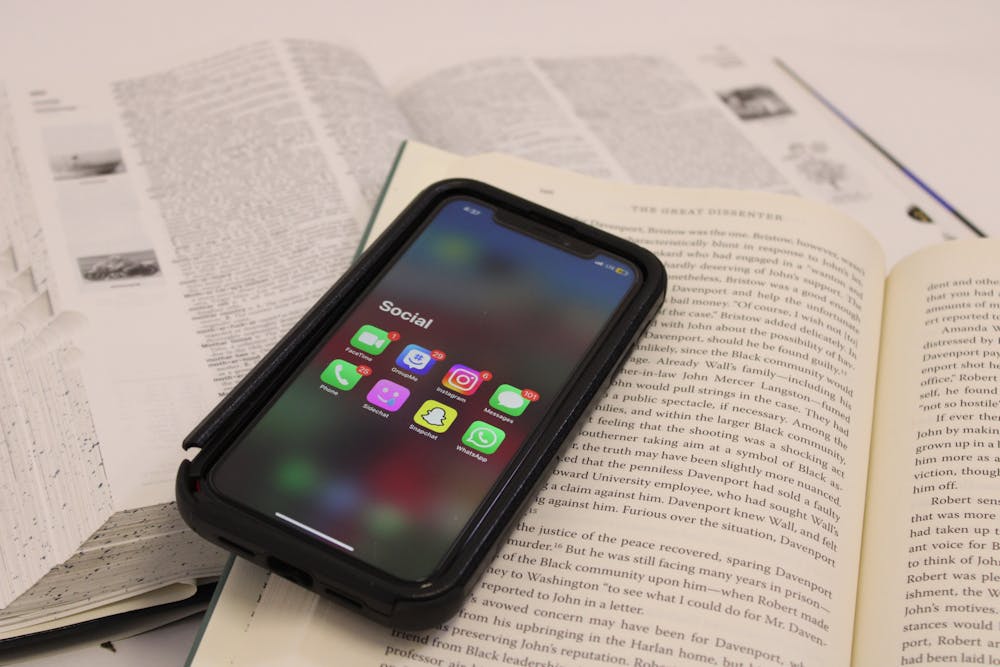
A 10-hour screen time can be justified, a five-hour screen time isn’t too alarming, and having two hours is impressive. But the hours spent online are only half the story — the most alarming aspect is the content a user can consume in one “doomscroll” session.
The prevalence of social media among young professionals is linked with higher rates of depression and low self-esteem. TikTok’s launch in 2016 fueled the popularization of short-form content, inundating consumers with a loop of instant gratification through scrolling. This constant is even clearer in professional forums such as LinkedIn — under the guise of job searching. The uploads, reels, and stories all aim to serve one purpose: attention.
Whether it’s through monetization or for personal gratification, students at Penn are certainly no exception.
Within Penn’s preprofessional culture, it feels like a baseline to publish accomplishments, trips, and every highlight of one’s life. But what you may not know is that every photo a student posts creates a clearer path for hackers to access personal information, and once your data is on the internet, it will stay there forever.
This isn’t a blaring warning to delete every account and stay completely off social media. Many Penn students are just not aware of the dangers that come with posting real-time photos because of the normalcy of being “casual” on social apps. But there are some common trends of Penn students on social media and guidelines from the Penn Pipeline Programs and Annenberg School for Communication that can help students have a safe and enjoyable time online as the “lines between personal and professional accounts may become more easily blurred.”
Number one: posting in real time. A quick photo of the perfect, gradient sunset in the background while strolling around Locust Walk seems like no big deal. You pause for a minute to upload it to your story. Then, you resume walking for another 20 minutes. Within that small window of time, one hundred people have seen your story.
While it may seem that this photo is being shared with only friends and family, your location was just exposed, and anybody could find out where you are. A story is gone after 24 hours, but a screenshot that any viewer can take is a digital footprint that cannot be erased. Additionally, routines that are posted online can create a dangerous situation where potential stalkers can seek out a student’s location. Campus safety should be of utmost importance, and it’s imperative to take the proper precautions.
Number two: LinkedIn and stalking. Almost every Penn student utilizes this platform — for good and bad reasons. The average profile features one’s exact graduation year, major, internship, and work experience. Penn’s preprofessional culture often turns a LinkedIn page into an accidental data dump. Especially when the “Excited to announce” posts reveal the company and location before the student accepts the offer — it becomes a security hazard.
LinkedIn feels like a natural extension of Penn’s culture. It’s great to broadcast important milestones, but it’s important to have discretion when posting. A habit of oversharing for students who are heading into the recruiting pipeline is highly discouraged but, unfortunately, can feel like a professional expectation to have every accomplishment posted on a bulletin. Penn’s expansive alumni network feels inherently trustworthy because of its breadth. However, it’s worth pausing to think: is the person actually safe, or is it just the Penn logo?
Number three: capturing every moment. Annenberg School professor Joseph Turow wrote in Penn Today that “it is a part of life today” and that phones and cameras make it extremely accessible to see the “context of a person and their relationships with others.”
The reality is that students don't always control their own footprint. Metadata embedded in original image files — also known as “geotagging” — can carry GPS coordinates and device information. Deleted posts can persist in cached search results and third-party archives long after the original is gone.
Social media is not going away, and neither is Penn’s culture of ambition and achievement. The goal is not to stop sharing. It’s to share with cautious intentionality. Right now, internet safety goes beyond switching an account setting from public to private. Wait before sharing to think about the post and act as if anyone can view and share, for your own safety.
SEOJIN LEE is a rising College first year from Michigan. Her email address is seojinl@sas.upenn.edu.