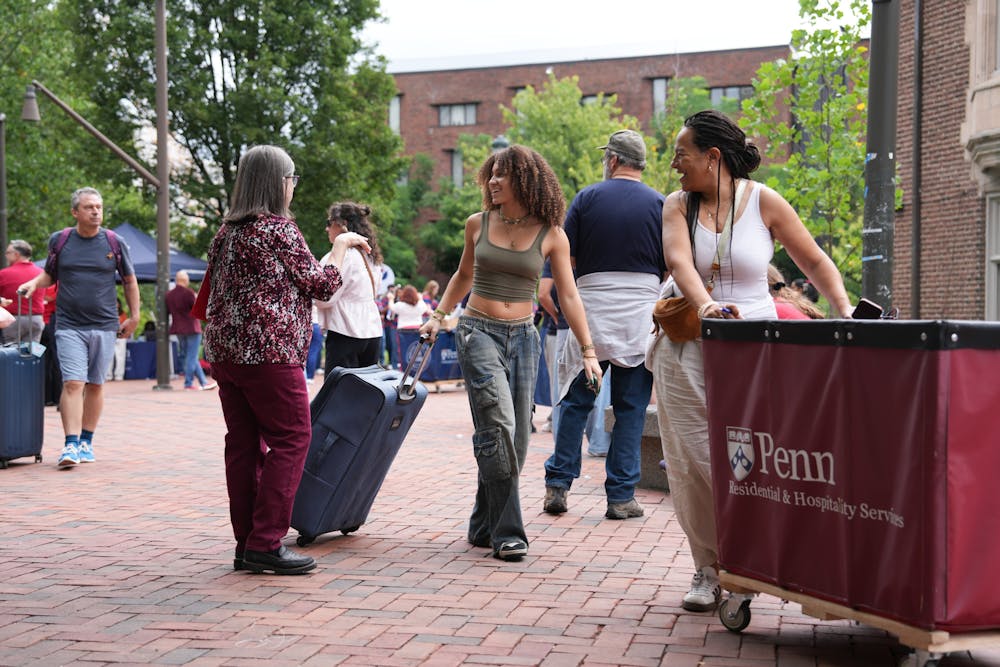
The classic Hollywood montage of college move-in day is a cultural staple: minivans bursting with luggage, parents wrestling mini fridges upstairs, and nervous first years shaking their roommate’s hand for the first time.
For decades, this day marked the beginning of a college student’s adulthood. But for the Class of 2030, this tradition has become a myth. Long before my family packs a single box for Philadelphia, my college experience has already begun — not on Locust Walk — but from the soft glow of my phone screen.
Today, college starts the moment we see confetti on our admissions pages. Immediately, the social sphere activates. On Instagram, pages such as “UPenn Class of 2030” become hubs for incoming students to introduce themselves, while WhatsApp group chats buzz constantly.
James Thunström, rising Wharton first year and creator of the UPenn Class of 2030 WhatsApp Community, explained his motivation behind launching the platform: “I created the UPenn Class of 2030 WhatsApp Community so our class has a safe place to connect, make friends, ask questions, and feel a sense of belonging, before, during, and after our time at Penn. With over 800 of my peers already part of the WhatsApp Community, I hope it continues to inspire the Class of 2030 to collaborate, communicate, and be involved with everything Penn has to offer.”
These student-led spaces are already being recognized, and Penn’s staff have even reached out to Thunström to help notify students about University events. But at a place as preprofessional as Penn, this experience shifts from social to professional and academic.
Long before setting foot in a lecture hall, we feel expected to package ourselves into the model job applicant. We build our LinkedIn profiles, send connection requests, and draft resumes for fall club recruitment. From my childhood bedroom, I am writing for The Daily Pennsylvanian, already embedding myself into campus culture from afar.
On paper, this overpreparation is a secure foundation. For introverted students who dread introducing themselves in a dining hall, or international and marginalized students looking for micro-communities before arrival, these platforms are a lifeline.
Sara Ilieva, a rising Wharton first year and international student from Bulgaria, shared, “[H]aving talked to people who are also going through the same change as me, helped me see that everyone is trying to figure it out just like me. And honestly finding people with similar interests even before getting to campus has helped me feel a little less alienated from my class … knowing who I’ll be living with during the year has provided some security too.”
Technology replaces uncertainty with a sense of belonging. We no longer arrive at Penn wondering if we will fit in. Instead, many of us already do.
But in conquering the anxiety of the unknown, we have also inadvertently killed its magic. This endless summer of networking trades a defining moment of young adulthood for a curated experience. The college transition used to be defined by a universal equalizer: On day one, everyone was lost and terrified. Today, that vulnerability is replaced by an unspoken pressure to flaunt a flawless friend group and a perfect resume before ever stepping onto campus.
Rising College first year Steven Linkh experienced this, noting, “I’ve definitely felt some pressure to make some friends before moving into Penn … I’ve seen kids from other schools already make huge friend groups and … it can create this [sense] of feeling behind.”
Krishiv Shah, a rising College and Wharton sophomore, recalls experiencing this anxiety when he arrived at Penn. “Throughout the year, looking at Instagram and seeing who was hanging out with who, what parties everyone was going to, etc., wasn’t necessarily helpful for me,” Shah reflects. “Places like LinkedIn were also similar, where it can feel overwhelming, especially at such a preprofessional school like Penn/Wharton.”
The stream of curated milestones eventually led him to delete Instagram for a few weeks to escape the urge to doomscroll. The result? A boost in confidence, a restored attention span, and a realization that social media is largely just a mirage. For incoming students suffocating under the weight of early comparison, Shah offers a crucial reminder: “My advice to incoming freshmen is that you are not behind. Everyone’s graph in life, specifically throughout college, is very different … It is always going to seem like everyone is one, or many, steps ahead of you, but on the inside, everyone is also struggling to find their path.”
We can’t turn off technology — but we can change how much power we give it. When I finally step onto Locust Walk, my goal will not be to meet up with the “profiles” I have spent the summer chatting with on a phone screen. Instead, the real challenge of our generation will be to consciously step back into the unknown: to leave our curated profiles behind, prop our dorm rooms open, and allow ourselves to be beautifully, authentically lost. Together.
TRACY XIE is a rising first year studying philosophy, politics, and economics from Syosset, N.Y. Her email is tracyxie@sas.upenn.edu.