

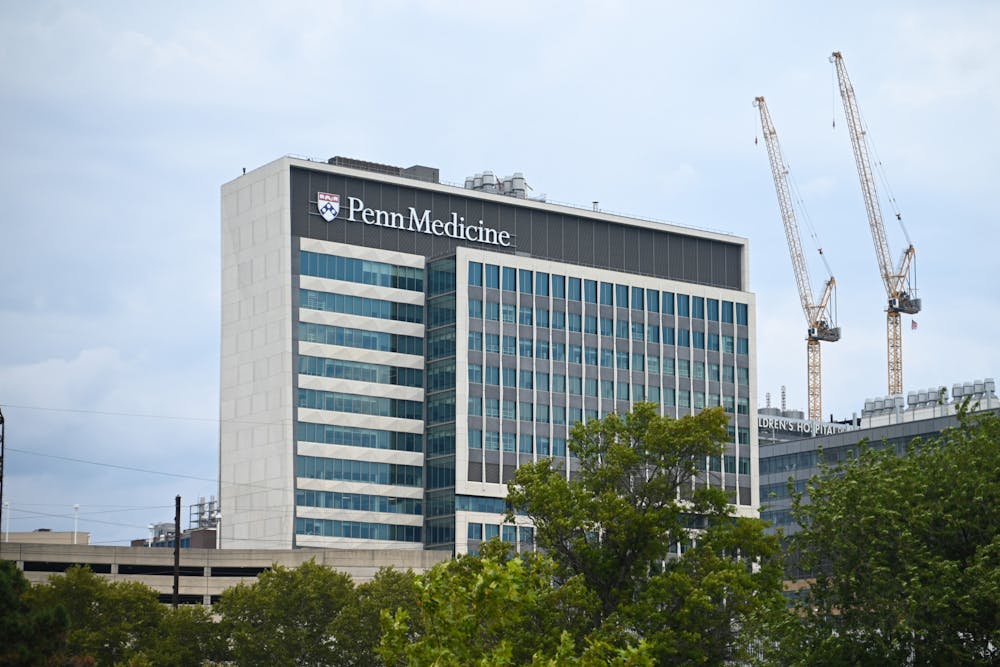
A Perelman School of Medicine professor and doctoral candidate received a $110,000 Google grant for their work to improve international health equity.
Radiology professor Farouk Dako and radiology doctoral candidate Satvik Tripathi were awarded the grant for their work at the Penn Center for Cancer Care Innovation, according to an April 1 release. Their project will implement Google’s MedGemma artificial intelligence model to increase access to medical imaging technology in Botswana.
The release stated that access to “essential medical imaging” is currently “a major barrier to care in many parts of the world.”
In an interview with The Daily Pennsylvanian, Tripathi explained that an uneven distribution of medical resources exacerbates the problem.
“If you want a CT scan, a MRI, it’s really hard because only bigger towns are able to afford these machines,” Tripathi said, adding that even the areas with access to imaging technologies are “super burdened.”
He said that many hospitals lack the latest technology, which reduces the efficiency of triage and treatment.
Consequently, Tripathi explained, people in underserved areas with chronic conditions delay seeing a physician.
“If it gets too chronic, it might be too late to get imaging,” he said.
RELATED:
Penn researchers develop predictive AI model for antibiotic discovery
Penn Vet launches AI-powered livestock behavior lab
Dako and Tripathi hoped to address this disparity by using MedGemma to identify lung disease earlier, improve the workflows used by physicians, and translate complex imaging data to be more accessible to patients. They plan to pilot the project in Botswana — in conjunction with Penn Radiology and the Botswana–UPenn Partnership.
Researchers from RAD-AID International, a nonprofit organization working to “improve radiology in the low- and middle-income countries,” serve as partners on the Google grant.
Google.org — the company’s philanthropic arm — connects nonprofits across the world with the technology, resources, and funding of Google.
Tripathi’s general AI model is based on Google’s own, he said, which is “trained on a huge number of languages and has translation capabilities.” However, he explained that Google’s model is not adequately trained on languages frequently used in many African countries, which he called “a huge bias in AI.”
At the moment, Tripathi said that the team is working to take the paper records used in Botswana and digitize them into a format AI models can use.
According to the release, a central part of the initiative will focus on training local health care teams to use and sustain the technology independently. The Penn Center for Cancer Care Innovation added that the project’s findings could offer a model for expanding equitable access to AI-assisted health care beyond Botswana and lung disease.
Last year, Penn’s Graduate School of Education received a $1 million donation from Google to expand a program promoting the use of AI.
The program — which is named Pioneering Artificial Intelligence in School Systems, or “PASS,” — was launched in January 2025 as a professional development initiative aimed at helping school systems understand and adapt to AI technology. With the donation, Penn GSE planned to expand PASS to five school districts across Pennsylvania, Delaware, and New Jersey.
RELATED:
Penn researchers develop predictive AI model for antibiotic discovery
Penn Vet launches AI-powered livestock behavior lab
Staff reporter Cathy Sui covers politics and can be reached at sui@thedp.com. At Penn, she studies finance and statistics.


