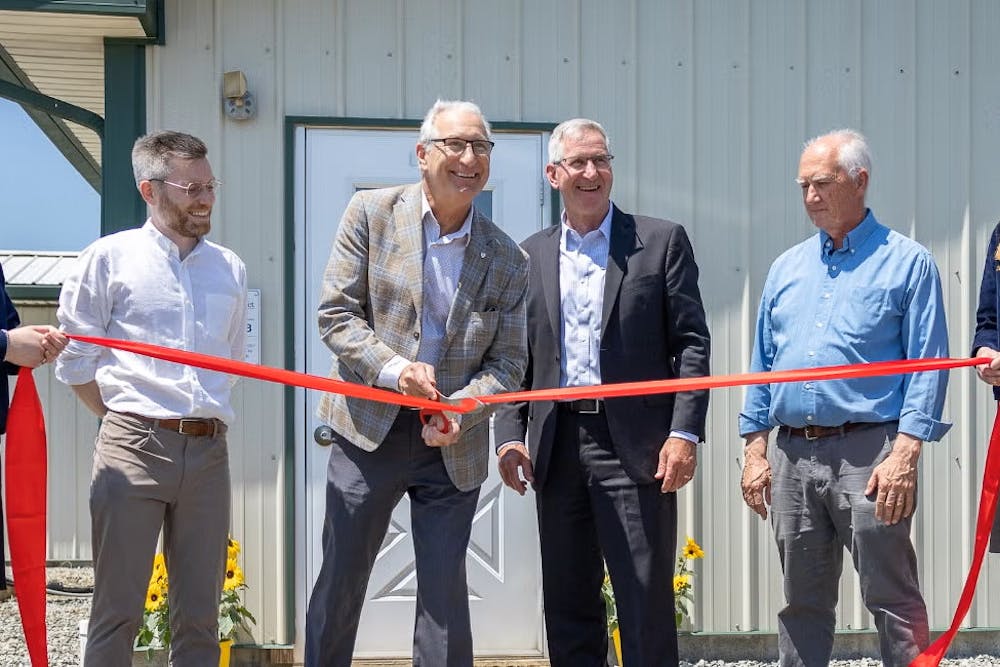
The School of Veterinary Medicine launched a new laboratory that uses artificial intelligence to study the behavior of livestock animals.
The Data, Analytics, and Technology for AI in Livestock Animal Behavior opened at Penn Vet’s New Bolton Center on May 20. The lab is led by Daniel Foy — co-founder and CEO of agri-tech firm AgriGates — and Swine Production Medicine professor Thomas Parsons.
In a statement to The Daily Pennsylvanian, Parsons wrote that “DAT-AI-LAB is a central home for the large-scale data” that the team collects to train their behavioral models.
“It’s right there in our name (DAT-AI-LAB): the Data we need, the Analysis we have to run for accuracy, and the Technology, the compute and hardware, that powers AI for livestock animal behavior,” Parsons added.
Using data collected and analyzed with the assistance of AI and machine-learning technology, DAT-AI-LAB can “make better and more timely decisions about important areas like animal health and welfare,” according to a May 28 press release.
Initially, the lab’s findings will support farmers caring for swine and dairy animals, but may expand to other species.
“Animal behavior remains one of the most underappreciated and underutilized metrics for detecting the clinical signs of a problem and for diagnosis,” Foy wrote to the DP. “Our lab is about building the tools, the proverbial hard hats and the picks, that can be handed to the industry to help mine for new insights, efficiencies, and value, whether the person holding them is a farm hand or a veterinary practitioner.”
In the release, Parsons expressed his belief that the DAT-AI-LAB’s opening presents a “tremendous opportunity with this new technology to really allow us to become much more efficient” for the “extremely labor-intensive task” of “studying animal behavior and trying to understand the implications for animal health, animal welfare, and animal productivity.”
RELATED:
Penn Vet partners with national scholarship program to provide tuition aid
Penn Vet professors receive national awards for virology and cancer research
“The DAT-AI-LAB is helping us prepare for that future by developing practical, decentralized AI systems that work where animals are raised and cared for, while training the next generation of veterinarians,” Gary Althouse — Penn Vet’s Associate Dean of Sustainable Agriculture and Veterinary Practices — wrote to the DP.
DAT-AI-LAB hopes to serve as a “global center of excellence” by “connecting experts in veterinary medicine, ethology, data science, and engineering” dedicated to its mission of “advancing digital behavior intelligence in livestock with objective measurement.”
“We want to make Penn and Philadelphia a global leader in livestock behavioral intelligence,” Foy wrote.
To that end, the team employs AI in a manner distinct from conventional, resource-intensive applications.
“The DAT-AI-LAB is taking a different approach by bringing AI to the farm rather than sending farm data elsewhere for processing,” Parsons wrote. “In practical terms, that means much of the computing can happen on local equipment, such as a laptop in a barn or farm office, without constantly relying on external processing power.”
Regarding practical applications, Foy wrote to the DP, the lab’s projects range from a “‘Fitbit’ for animals to computer vision, as well as regenerative energy harvesting on the farm to help power the computational needs of these new tools, all ultimately meant to end up on the commercial farm.”
According to Pennsylvania’s Department of Agriculture, the lab was supported by a $31,000 Agricultural Innovation Grant — a state program that “helps farmers and other agriculture businesses implement new agricultural technologies, conservation, and renewable energy innovations” — and a $90,000 grant from Pennsylvania’s Center for Poultry and Livestock Excellence.
The opening of DAT-AI-LAB comes after Penn Vet announced plans for a separate $94 million laboratory earlier this year — also supported by state funding — and built a $17 million educational center, both located at New Bolton Center.