It’s the end of May. The last competitions are wrapping up, and slowly but surely, student-athletes are heading home for the summer. As student-athletes spend the season off campus, they leave behind their coaches, who finally get well-deserved time to relax after a full academic year of practices, competitions, and recruiting.
Sounds nice, doesn’t it? It couldn’t be further from the truth.
“I think there’s a misconception in higher ed[ucation] that when students leave and the seasons are complete, that there’s like this long time period for vacation and to catch your breath,” Penn baseball coach John Yurkow explained.
Even when student-athletes are no longer on campus, the work doesn’t end for Penn’s coaches — it shifts. Instead of focusing on current players and Ivy League standings, their focus shifts to potential recruits from around the world.
The summer acts as a transition period between two recruiting classes. Coaches are finishing up their talks with the high school class of 2027 while preparing to bring in top talent from the class of 2028. Depending on the sport, coaches can contact prospective student-athletes between June 15 and Sept. 1 following their sophomore year of high school.
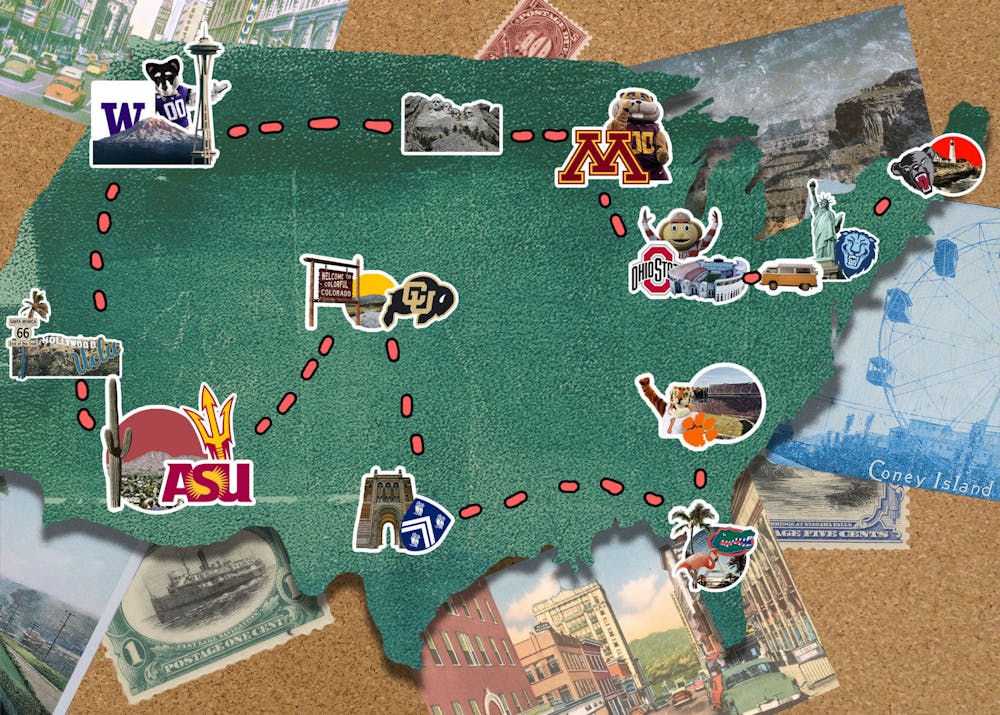
“We don’t really have that many weekends or weeks off where there’s not something valuable for us to be going and watching players play. There’s various different leagues across the country, and so we’re pretty organized with trying to get ourselves to those events,” Penn men’s soccer coach Brian Gill said.
“Some of those players might be committed to us, so it’s watching them as a form of continuing to evaluate them, or it’s going out there and trying to see players that maybe we’re making decisions on or learning about, and so that travel obviously requires a lot from us,” Gill added.
Recruiting is a full-staff effort for baseball as well, with the head coach and his three assistant coaches logging significant miles throughout the summer.
“It’s very rare that all four coaches are on campus at the same time. It always feels like somebody’s out of town in Atlanta or Texas or Florida or somewhere in the Midwest, so it really does take up quite a bit of time,” Yurkow said.
However, at least for baseball, the NCAA recently implemented measures to ensure that coaches don’t spend the entire summer on the road.
“They actually mixed in a few more what they call dead periods throughout the summer, where we’re not allowed to recruit,” Yurkow said. “For instance, … Father’s Day weekend … is a dead period, so no one’s allowed to be out at games, and then there’s a quiet period in August too, where from the middle of August till the middle of September, you can’t be on the road recruiting.”
Aside from recruiting, another part of summer is staying in contact with current student-athletes. The baseball season often wraps up after classes end, and the staff tries to hold individual meetings with all of their players before they leave campus. Some of these players even end up in summer leagues while keeping in touch with Yurkow.
Preparing the incoming freshman class is yet another task coaches must tackle over the summer. Even though the baseball team plays its season in the spring, giving the freshmen some time to adjust to college life, Yurkow still wants “to try to get those guys up to speed a little bit, so that they feel comfortable when they arrive for orientation.”
It’s a different story for men’s soccer. Freshmen arrive on campus and have to hit the ground running — their first match is often played before classes start in the fall.
“Getting the incoming class ready; that takes its own time. You have these players who are finishing their senior years in high school, [and] they are then transitioning into a world that they don’t really know much about,” Gill said. “So we’re trying to take our time and our due diligence with our current players … to help us with making sure that these incoming players have a better understanding of what college is going to somewhat look like once they arrive on campus.”
Gill and his staff work tirelessly over the summer to ensure everything runs smoothly once players return to campus, in part because the men’s soccer season starts so early in the fall semester. This includes taking stock of team equipment, planning season travel, and preparing training sessions.
“We do keep some levels of regular hours at the office and try to make sure that we’re preparing what we need to for the coming season. Because we’re a fall sport, we need to make sure that things logistically are ready for the team,” Gill said.
As if that wasn’t enough work, many Penn coaches also hold camps in the summer. For baseball, that can mean anything from two-day clinics for individual players to team camps.
Men’s soccer hosts two types of camps: youth and ID camps. The former are geared more toward young players from the community, while the latter are for high school players and can help form first relationships with potential recruits.
“We take those pretty seriously with regards to try and make sure that kids that are coming to visit us have a quality experience,” coach Gill said.
“[The youth camps] are like eight to 12-year-olds, so it’s an opportunity for kids in our community to come. … It’s more of a structured opportunity for us to work with younger kids on the field. It’s nice, because it has almost more of a grassroots initiative,” he added.
Besides recruiting, preparation, and camps, is there any time left for coaches to relax or spend time with family? The answer depends on the sport.
For baseball, true downtime doesn’t arrive until November or December. The fall season goes until October, and coaches then have around two months to relax and regroup before they dive headfirst into the spring season.
Men’s soccer operates under a different calendar, which means that Gill looks for “windows of time — where we can find it — for myself and the staff to take some levels of a break for ourselves too.”
“It’s not a traditional sort of nine-to-five occupation, or Monday-to-Friday occupation,” Gill added.