

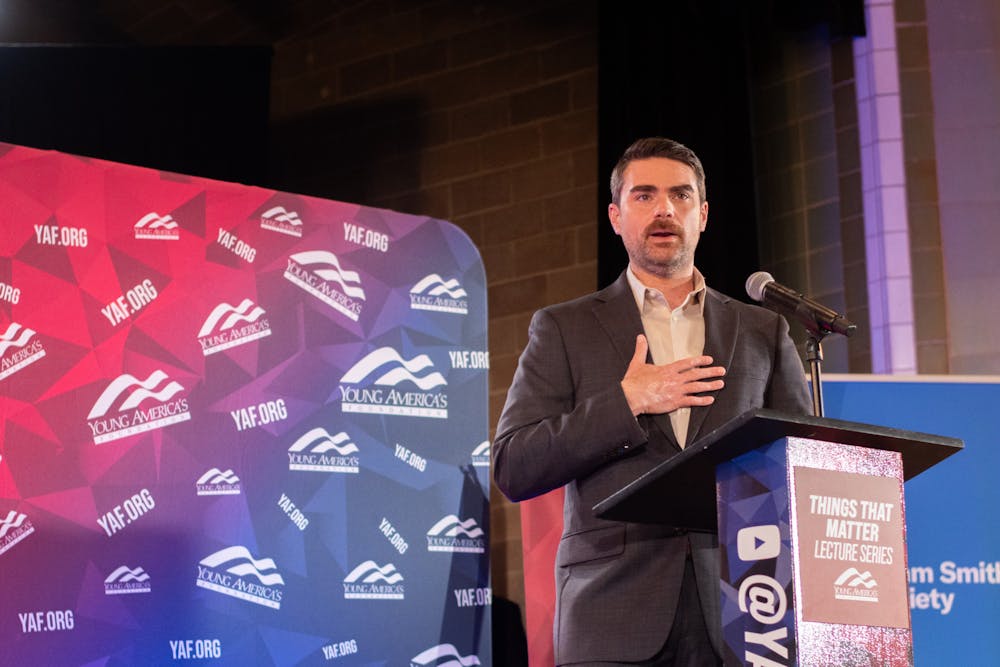
Political commentator Ben Shapiro visited Penn on Tuesday to discuss capitalism, conservatism, and affordability in his first appearance on a college campus this year.
The April 14 event — titled “Why Capitalism Makes America Great” — included a keynote speech and a series of audience questions. As Shapiro spoke to a crowd of over 600 attendees inside Penn Museum’s Harrison Auditorium, hundreds more waited in line outside.
The event was hosted by the Wharton School’s Adam Smith Society chapter, an association for MBA students and professionals at Penn. Second-year Wharton MBA student Colin Duffy, who serves as the organization’s president, delivered opening remarks for Shapiro.
“It’s one thing to argue anonymously in the comments section, and it’s a whole other to put yourself directly in the line of fire. As we saw with the tragic murder of Charlie Kirk — who considered Ben both a mentor and a friend — this job comes at a very high cost,” Duffy said.
As Shapiro walked across the stage, half the audience rose to their feet in a standing ovation. Throughout the event, a noticeable portion of student attendees refrained from clapping when the conservative commentator paused for applause.
Shapiro began by distinguishing between “high-IQ conservatism” and “low-IQ grievance politics.”
The former, he said, relies on “free minds, free markets, public virtue, and a properly constructed government,” while the latter category “rejects all of these essential principles.”
Shapiro listed certain “pseudo” conservative commentators — such as Tucker Carlson, Candace Owens, Megyn Kelly, and Alex Jones — as those within the “low-IQ” category.
RELATED:
Conservative pundit Ben Shapiro in talks to appear at Wharton MBA club event
Steven Crowder debate at Penn canceled after producers back out of contract
“What they have in common is a grievance-based view of the world in which they and those like them are perennial victims of the American system, in which they’ve been betrayed by the very ideas and institutions that make America the greatest place in world history,” he said.
Shapiro added that “high-IQ conservatism will win the day when Americans recognize the inestimable bounty that we’ve been given: a unique country in human history that values free minds and free markets and public virtue.”
He also used the event to reference Penn’s history of controversies surrounding pro-Palestinian protests and the University’s response to allegations of campus antisemitism.
“It’s wonderful to be here at the University of Pennsylvania, a place that now apparently recognizes that calls for genocide against Jews are bad,” Shapiro said.
“Congrats on that,” he said to the applauding crowd.
In December 2023, then-Penn President Liz Magill faced widespread backlash for a congressional testimony in which she said that whether calls for the genocide of the Jewish people violated Penn’s code of conduct was “context dependent.” On Dec. 9, 2023, Magill announced her resignation.
Outside the venue, nearly 25 protestors held up signs — one of which read “smash fascism” — and sounded whistles, drums, and bells.
Many protesters repeated “anti-worker, anti-gay, Ben Shapiro go away” while urging those in line to exit.
According to an April 9 social media post, the protest was coordinated by the Coalition of Workers at Penn, an organization established in 2023 to bring together University workers and local labor representatives.
The post — made jointly by Labor Jawn and the Philadelphia Jewish Labor Bund — described Shapiro as “an anti-union, anti-immigrant, bigoted leader of the far-right.”
During the question-and-answer portion of the event, Shapiro was asked about his stance on the 2010 Affordable Care Act, which aimed to “make affordable health insurance available,” expand Medicaid, and support “innovative” delivery care.
Shapiro explained that if he organized a health care system, he would have created a “free market system” where “people gather by social institution and actually help insure each other more at the local level.”
When asked about the 2028 presidential election, Shapiro said that his “beliefs align much more strongly” with United States Secretary of State Marco Rubio than with Vice President J.D. Vance.
“I think Rubio would be more likely to win,” Shapiro stated.
According to Shapiro, this was his first event on a college campus “since the tragic murder of our friend Charlie Kirk” in September 2025. Responding to a question about political violence and “the role that debate politics has in spurring on a lot of this division in politics,” Shapiro said Kirk’s assassination created “a permission structure for violence.”
“It’s that kind of stuff that’s truly dangerous,” Shapiro said. “You don’t try to shoot somebody because you think that their ideas are low IQ. You try to shoot somebody because you believe that they are a full-scale danger to you and your family and are going to harm you.”
After the event, Duffy told The Daily Pennsylvanian in that he was “very encouraged and inspired by how well the Penn community came out tonight,” describing the discussions as “very respectful and civil.”
He added that Shapiro “did a great job” discussing “the debasement of some areas of politics into grievance politics.”
“Penn has a lot of opportunities to teach people those foundational elements of capitalism and virtue,” Duffy said.
Tickets for the event were first made available on March 31. Before Shapiro’s speech was publicly announced, Duffy wrote to the DP that the event had been planned for months but faced repeated “roadblocks” from University administrators.
Duffy stated that Penn’s requests included “limitations on access, live streaming, and the potential for open-ended security fees tied to anticipated protests.”
At the time, a University Life spokesperson wrote to the DP that “the group has not completed the required steps to obtain a cost estimate and move the event forward.”
Duffy also described the planning “roadblocks” in his opening remarks.
“For months, our team went through bureaucratic delays, shifting requirements, and more roadblocks that should ever stand in the way of a student group trying to host a nationally acclaimed speaker on a college campus,” he said. “At times, it felt like this event was being potentially slow walked by the Penn administration rather than supported. But our team stuck with it because we believe this night was worth fighting for.”
Due to a similar disagreement over live streaming and security costs, a planned debate featuring conservative commentator Steven Crowder — initially set for April 10 at Penn Live Arts — was canceled last week.
Shapiro’s speech at Penn comes after several similar events at other peer institutions — including 2024 addresses at Yale University, Cornell University, and Vanderbilt University.
Duffy said he hoped the audience was able to take away a greater willingness to engage with people “you disagree with.”
“People should be encouraged to have conversations like this with their classmates and bring that pressure level down so that people feel more comfortable to have honest, important conversations across campus,” he added.
RELATED:
Conservative pundit Ben Shapiro in talks to appear at Wharton MBA club event
Steven Crowder debate at Penn canceled after producers back out of contract
Senior reporter James Wan leads administration reporting and can be reached at wan@thedp.com. At Penn, he studies communication and computer science. Follow him on X @JamesWan__.
Senior reporter Arti Jain leads politics reporting and can be reached at jain@thedp.com. At Penn, she studies economics and political science. Follow her on X @arti_jain_.


