

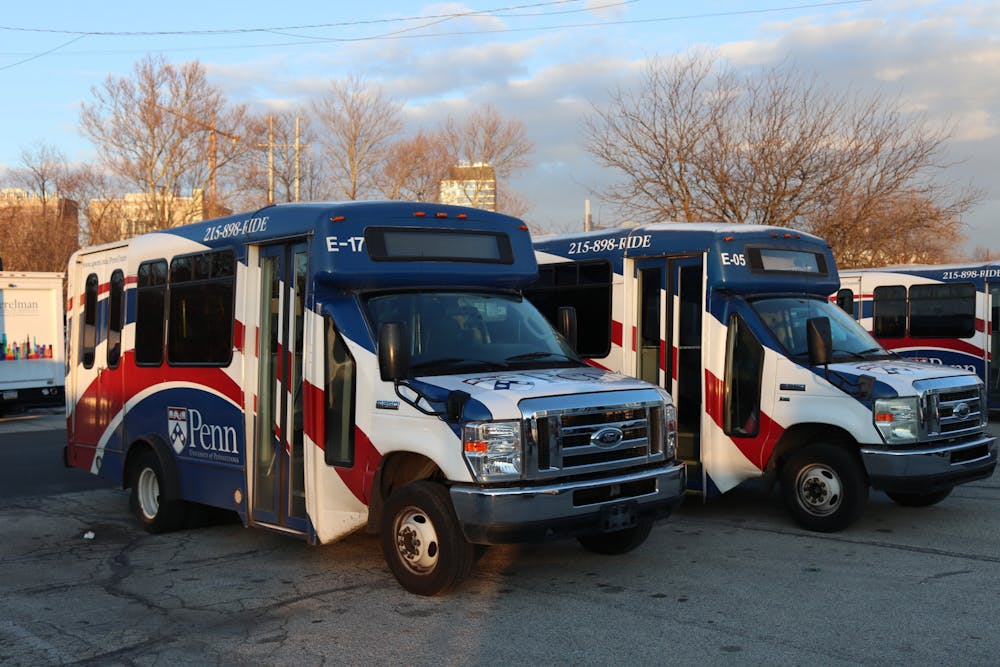
Penn Transit recently redesigned its evening safety shuttle system, swapping custom pickups for designated stops to reduce wait times, but not all students are convinced the new model is working.
The shuttle — a free ride-share service available to students between 7:30 p.m. and 3 a.m. — now requires students to use at least one pre-set stop for each trip rather than inputting fully custom pickup and drop-off locations. Penn students can request or reserve a ride with the “Trip Planner” feature in the Penn Transit app.
“We conducted a student survey last spring and learned that riders were looking for shorter wait times, more efficient service, and more convenient pickup locations,” Director of Communications and External Relations for the Division of Business Services Courtney Dombroski explained in a statement to The Daily Pennsylvanian.
“Based on that feedback, we implemented the stop-based evening safety shuttle model for trips starting or ending on campus,” she added.
According to Dombroski, the shift to a stop-based model cut average wait times by about five minutes and reduced rider cancellations.
“The change was informed by ride analysis showing that most on-campus trips were already starting and ending within a block of established bus stops, which helps improve efficiency by reducing overlapping ride requests.”
Joe Russo, the senior director of the Division of Business Services who oversees Penn Transit, described the change as a shift toward a “donut” model. Students traveling within campus — or the inside of the donut — must now start and end rides at designated transit stops, while those traveling between off-campus areas within the map still receive door-to-door service.
“All we did is take the pre-existing map and section it off,” Russo said.
RELATED:
Penn launches campus parking improvement project with modernized payment, access options at garages
Penn students reflect on SEPTA trolley tunnel closure, renovation efforts
Dombroski echoed Russo’s sentiment, emphasizing that the shuttle’s scope has not changed.
“It’s not that we’ve shrunk where we’re servicing,” she said. “It’s still the same places that we’ve been servicing, it’s just a different methodology.”
Russo explained Penn Transit strategically placed stops to minimize walking distances, aiming for a “two-minute maximum” walk from any pickup origin. After analyzing “heat maps of the on-demand system” — which track the concentration of ride requests by location and time — the department added five additional stops.
In an interview with the DP, College sophomore Erica Jiang described the evening shuttle as a “great service.” She still expressed some frustration with the wait times, claiming that “it does take a while to actually get a car or van to you and to your location.”
“A lot of the time it’s just not worth it for me to have to wait that long,” Jiang said. “It’s easier to just walk or take SEPTA.”
Jiang said she did not experience a noticeable difference in service since the transition to the new model, adding that if Penn Transit “found a way to reduce the wait times” and “make the rides more efficient,” they could “encourage more use” of the service.
Wharton sophomore Mihika Jain also described “huge issues with the wait time” for evening shuttles.
“I call it maybe 30 minutes before I actually have to go, because it almost always gets delayed, and I don’t know for how long,” Jain said. “Sometimes it gets canceled.”
Jain told the DP that “as long as the stops are frequent” in the new model, she thinks the change is “fine.” However, she argued that if the stops were “more than 0.2 miles apart from each other,” that would “kind of defeat the purpose” of the shuttles.
College junior Srijani Datta explained that she regularly uses the Penn evening shuttle to navigate campus safely, because she lives farther away from her classes and laboratory than most students.
“I am not sure how many students use Penn Rides, but I appreciate Penn Transit for the service and rely on it to get home, especially since my dance team’s practice usually ends later than I am comfortable walking home,” Datta — who is also pursuing a master’s degree in bioengineering — said.
Like Jiang and Jain, Datta expressed frustration with the evening shuttle’s “long wait times,” which she described as “frustrating,” adding that recent service changes have not resolved the issue.
“They say you can reserve rides, but there have been many times when my ride time comes, and they extend the wait time,” Datta said. “Now that I can only customize one half of the journey, I usually have it drop me directly home, but the inconsistent wait times and last-minute delays mean I am usually waiting at the set stop for a while before my ride arrives.”
Dombroski described open avenues for student feedback on Penn Transit’s services.
“We regularly work with student groups to review service and will continue to do so this semester through focus groups on ride experience and app usability, and we encourage students to participate,” Dombroski wrote. “More information about participating in the focus groups will be shared with the Penn community soon.”
In her interview with the DP, Jiang suggested that Penn Transit “continuously update” the evening shuttle’s designated pickup spots “based on patterns … so that it’s more relevant to the actual traffic each night.”
She added that while she hasn’t yet tried to share this with Penn Transit, she “definitely would be interested if there’s an easy, accessible way” to do so.
“Students are always welcome to reach out directly with questions or concerns by emailing transit@upenn.edu,” Dombroski wrote.
Staff reporter Anjali Kumar contributed reporting.
RELATED:
Penn launches campus parking improvement project with modernized payment, access options at garages
Penn students reflect on SEPTA trolley tunnel closure, renovation efforts
Senior reporter Christine Oh leads coverage of student life and can be reached at oh@thedp.com. At Penn, she studies English and philosophy. Follow her on X @ChristineOh_.


