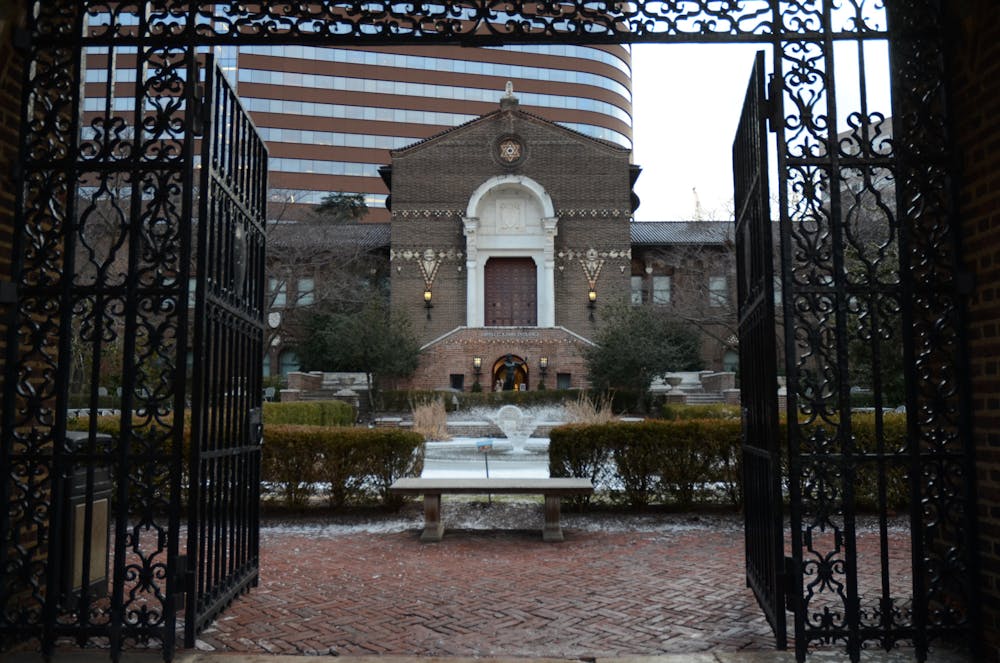
Penn Museum unveiled an exhibition featuring century-old paintings of an ancient Egyptian burial ground last month.
The display, which opened to the public on Feb. 28, includes artifacts and watercolor paintings of tomb artwork that were created during Penn Museum excavations from 1921 to 1923. Chair of the Department of Middle Eastern Languages and Cultures Josef Wegner was the collection's lead curator.
In an interview with The Daily Pennsylvanian, Wegner described the exhibition as “retrospective” and explained that it grew out of efforts to revisit Penn’s archaeological archive from its excavation at Dra Abu el-Naga as its record were never published in full.
“We’re involved in a project to return to these archival records and collections and really do justice to the importance of them,” he said.
According to Wegner, the curation team wanted to highlight watercolors produced by Ahmed Yousef, an Egyptian artist hired by archaeologist Clarence Fisher during the Penn Museum's excavations in the 1920s. He added that Fisher’s decision to commission watercolor copies of the tomb artwork stemmed from the fragility of painted plaster surfaces inside tomb’s chapels.
“Opening these structures often causes atmospheric changes; humidity and air circulation can lead to damage,” Wegner said. “At some of these tombs, we’re pretty sure the decoration no longer exists.”
The exhibition, titled “Ancient Egypt in Watercolors: Paintings and Artifacts from Dra Abu el-Naga,” will remain on view through November. It includes multimedia components such as projection screens with interactive fly-throughs of two tombs, which were produced using photogrammetry, photographic documentation, and 3D modeling.
Tamara Mkheidze, a third-year Ph.D. student in the Department of Middle Eastern Languages and Cultures concentrating in Egyptology who served as one of the exhibition’s student curators, explained that Dra Abu el-Naga’s significance stems in part from its location within the Theban Necropolis and nearby the Karnak Temple complex. The site includes tombs of elite officials such as Egyptian viziers — whom Mkheidze described as “a prime minister in our modern world.”
RELATED:
Penn Museum terminates youth summer camp program, cites ongoing hiring freeze
Pennsylvania Hospital opens museum to commemorate medical legacy ahead of 275th anniversary
She added the exhibition offers access to material that has rarely been seen publicly — including the watercolors, which have been in the museum’s archives for about 100 years and have remained unseen in the United States until now. According to Mkheidze, the watercolors are a “glimpse into the past” because many of the depicted tombs are no longer accessible.
After comparing Yousef’s paintings to other archival sources, including photographic negatives and field notes, Mkheidze has found that the depictions are “not epigraphic drawings.” The paintings were created by “somebody who would sit in the tomb and copy the scenes, but there are some discrepancies between the photographic evidence … and those drawings,” she explained.
Mkheidze added that the discrepancies matter when researchers attempt to reconstruct tomb scenes accurately, but also highlighted the watercolors’ historical context, as a local Egyptian artist was working with a U.S. expedition.
Wegner expressed hope that the exhibit will serve as an entry point for students and visitors to engage with Penn Museum research and its Egyptian collections.
“It’s not just a little pocket museum at the corner of the campus,” he said. “It’s one of the most important archaeological museums in the world.”
Wegner hopes that the watercolor exhibition will “segue into” the team’s larger project — “Egypt Galleries: Life and Afterlife” — which is set to open on Dec. 12.
RELATED:
Penn Museum terminates youth summer camp program, cites ongoing hiring freeze
Pennsylvania Hospital opens museum to commemorate medical legacy ahead of 275th anniversary
Staff reporter Can Doga Bolukbasi covers science and health and can be reached at bolukbasi@thedp.com. At Penn, he studies biochemistry. Follow him on X @cdbolukbasi.