

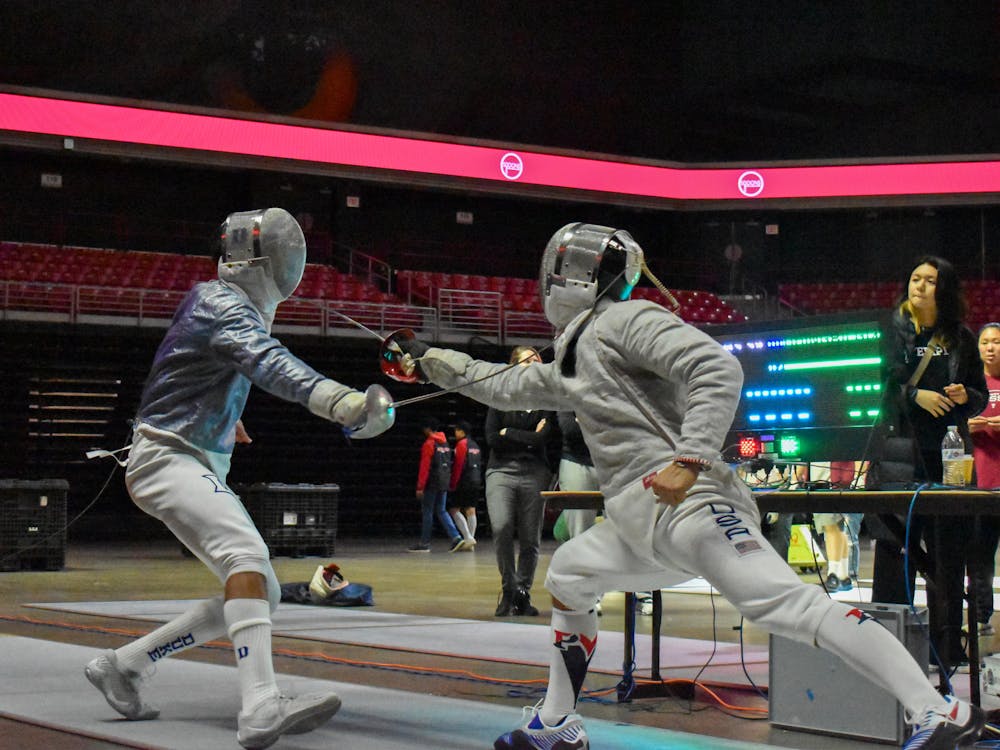
Penn fencing couldn’t convert metals to medals.
Last weekend, Penn fencing faced the best of the conference and came up short at Ivy League Fencing Championships. Both squads walked away with a fifth-place finish — last on the men’s side, while the women outperformed their sixth-place seed.
Penn women’s fencing
The No. 8 Quakers entered competition eager to prove themselves after a season of contentious non-conference matches with key victories over No. 10 Penn State and No. 9 Yale.
On Saturday, the women faced an onslaught of defeats from the top four seeds in the Ivy League tournament, losing to Princeton (6-21), Columbia (9-18), Yale (11-16), and Harvard (10-17). Despite the team losses, junior epeeists Grace Hu and Victoria Kuznetsov led the charge in the epee, creating narrow margins of victory against Columbia and Yale. The Quakers also picked up an event victory in the saber against Harvard.
Trailing 0-4, Penn women’s fencing entered the final day of the Ivy League tournament eager to put some points on the board. Strong performances in the saber and epee supported the Quakers’ journey to back-to-back victories against Cornell (19-8) and Brown (18-9). Foil proved to be the weakest blade across the tournament, as the Quakers only picked up a victory against Brown in their final match of the tournament.
Although no one from the women’s team took home All-Ivy accolades, Hu and Kuznetsov tied for seventh place in the epee, while freshman saber Lila Paul finished ninth overall in the saber. Freshman foilist Kimberley Jang finished the highest of the foil specialists, going 7-11 to tie for 11th place.
“Competing at Ivies was super thrilling, the energy that every school was putting in was insane, and it was definitely a lot of fun to compete at such a high level,” Hu wrote in a statement to The Daily Pennsylvanian. “Everyone poured their hearts out and cheered as hard as they can for one another, and I think the mutual support was definitely a strength on our team.”
Penn men’s fencing
The No. 7 Penn men’s fencing team settled for the bronze at last year’s Ivy League tournament. After a successful regular season campaign, it seemed like the Quakers were primed to take the conference title. However, fate had other plans.
The Quakers suffered a narrow 10-17 defeat against No. 5 seed Princeton to open competition on Saturday. Each blade was decided by two points or less, with the Tigers ultimately prevailing 5-4 in the foil and 6-3 in both the saber and epee.
Upsets and defeats followed the Quakers to the end of the tournament, where they finished 0-4 with losses against Columbia (8-19), Harvard (11-16), and Yale (10-17).
“Everyone had their own stresses showing up to the tournament, and it didn’t result in the best performances from most,” freshman standout epeeist Simon Lioznyansky wrote in a statement to the DP. “I truly believe we could’ve won as a team, but we were just lacking in strength, both mentally and physically, I think.”
Although the Quakers suffered narrow defeats against most of their opponents, they picked up 5-4 victories in the saber against Harvard and the epee against Yale. These individual victories translated to All-Ivy accolades for two of the Quakers’ finest.
Lioznyansky earned first-team All-Ivy honors with his third-place finish in the epee, posting an 8-4 record over the course of the tournament.
“The energy was super hype,” according to Lioznyansky. “I got to fence a lot of strong opponents, and that’s always a good time … It was honestly really cool to make first team All-Ivy honors.”
Junior epeeist Joseph Wu earned second-team All-Ivy honors for the second time in his career, finishing fifth in the epee behind Lioznyansky.
The Quakers will conclude the regular season across the Schuylkill River at the Temple Invitational on Feb. 22. But the biggest meet of the season so far — NCAA Regionals — lurks just around the corner.
“I am really excited for the second half of the year,” senior captain Simon Kushkov wrote in a statement to the DP. “The team has transformed into a well-oiled machine since my freshman year. I believe we laid down the groundwork for the generations of Penn fencing to follow and succeed in the long run.”


