

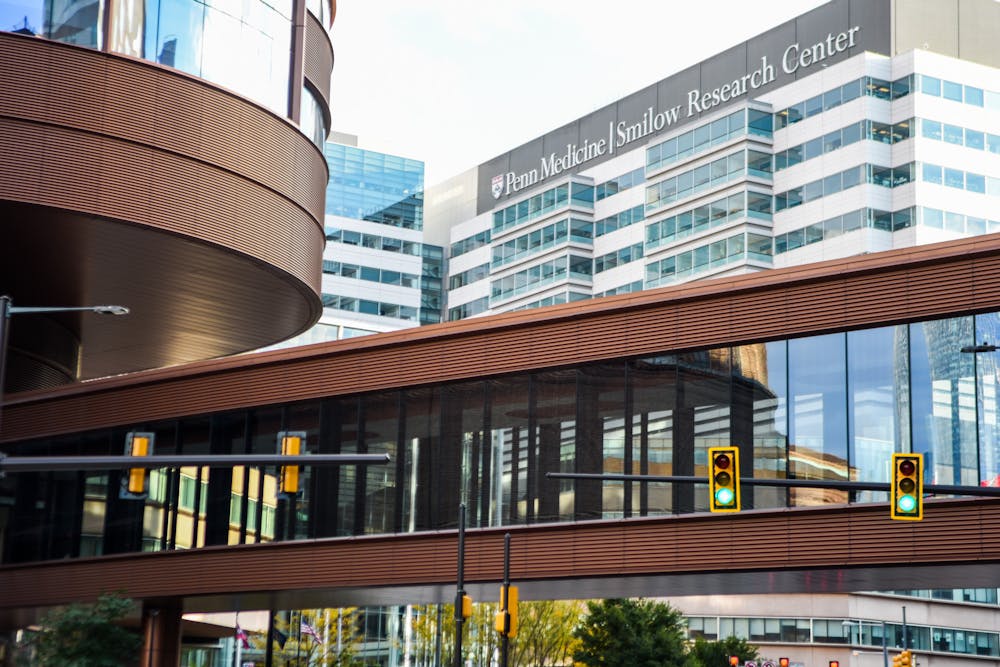
Four Perelman School of Medicine studies are set to receive the Clinical Research Forum’s Top Ten Clinical Research Achievement awards.
From projects examining healthcare initiative impacts to groundbreaking medical developments, the forum — which annually recognizes ten research accomplishments in the United States — will acknowledge Penn Med’s innovative researchers. The Daily Pennsylvanian spoke with investigators about their findings, motivations, and the broader implications of their work.
Lewis Chodosh, chair of the department of cancer biology at Penn Medicine, collaborated with Angela DeMichele, a medical oncologist and professor of breast cancer research, on a study to prevent recurrent breast cancer by preemptively detecting and eliminating dormant tumor cells in patients.
Chodosh said that he “stumbled” onto the phenomenon of tumor dormancy as a result of a “failed experiment” when testing genetically engineered mouse models — a result that laid the groundwork for his recognized research. The newest experiment, he explained, is something that “hasn’t been attempted before.”
The clinical trial led to “a large proportion” of patients staying disease-free for nearly seven years, according to DeMichele. The team is currently in the process of confirming their positive findings.
“The goal is really to change the standard of care for breast cancer patients and to provide more certainty for them about their prognosis,” Chodosh said.
Professor of Biostatistics and Founding Director of the Center for Health AI and Synthesis of Evidence Yong Chen was recognized for his study examining the impact of post-acute sequelae of SARS-CoV-2 infection — otherwise known as long COVID-19 — outcomes on “relatively understudied” children and adolescents. Chen explained that the project was inspired in part by his role as a father to two children.
The research team had access to Electronic Health Records databases of more than 40 children’s hospitals, covering about 10% of the entire U.S. pediatric population, according to Chen. The data revealed that COVID-19 reinfection significantly increases the risk of developing long COVID-19 for children and adolescents, which could be indicative of a “memory system” in the body.
RELATED:
Penn Med, CHOP cardiovascular director named 2025 American Heart Association Distinguished Scientist
Penn Med researchers find psilocybin can relieve depression, chronic pain with single shot
“Through team science, we can be in the driver’s seat to tackle important policy and real world clinical problems,” Chen said.
Rebecca Ahrens-Nicklas and Kiran Musunuru’s study developed the world’s first custom gene-editing therapy for an infant subject, successfully treating his rare metabolic disease.
At one week old, KJ Muldoon was diagnosed with severe carbamoyl phosphate synthetase 1 deficiency — which results in approximately half of the infants with the disorder dying within the first week of life. KJ then received the first-ever custom gene-editing infusion at six months old and began to improve, even reaching critical developmental milestones for his age.
“The promise of gene therapy that we’ve heard about for decades is coming to fruition, and it’s going to utterly transform the way we approach medicine,” Musunuru, a professor of translational research at Penn Med, said.
Musunuru and Ahrens-Nicklas — assistant professor of pediatrics and director of the Gene Therapy for Inherited Metabolic Disorders Frontier Program at the Children’s Hospital of Philadelphia — opened the door to the possibility of individualized treatments for a wide variety of rare genetic disorders.
Eric Roberts, associate professor of general internal medicine at the Perelman School of Medicine and senior fellow at the Leonard Davis Institute of Health Economics, was recognized for his paper examining the consequences of structural fragmentation between Medicare and Medicaid — and its impact on the health of low-income older adults.
“Access to health insurance and affordable drug coverage through health insurance saves lives,” Roberts said.
Roberts acknowledged the uncertainty surrounding research funding and stressed the importance of continuing to pursue policy research.
“There’s always a need for passionate people who want to make a difference in the world through evidence and communicating that evidence to decision-makers that need it for research,” Roberts said. “Research remains a vibrant and integral part of what universities do and what and what society needs to make better decisions.”
The award recipients will be honored at the forum on May 11 in Washington, D.C.
RELATED:
Penn Med, CHOP cardiovascular director named 2025 American Heart Association Distinguished Scientist
Penn Med researchers find psilocybin can relieve depression, chronic pain with single shot
Staff reporter Danna Cai covers climate and sustainability and can be reached at cai@thedp.com. At Penn, she studies biology. Follow her on X @dannaacai.


