Black first-year student enrollment at the University of Pennsylvania Carey Law School hit a record low in 2025.
Demographic data released last month revealed that only 10 Black students enrolled in Penn Carey Law’s Class of 2028 — a 50% drop from the previous class. The Daily Pennsylvanian found that Black first-year enrollment in 2025 was the lowest at the school since the American Bar Association began mandating annual 509 disclosures in 2011.
“Penn Carey Law is committed to complying with the law and fostering a community that reflects a wide range of ideas, experiences, and perspectives,” a Penn Carey Law spokesperson wrote in a statement to the DP. “Our first-year class exemplifies the academic excellence, collegiality and collaboration, and ethos of service that define our community.”
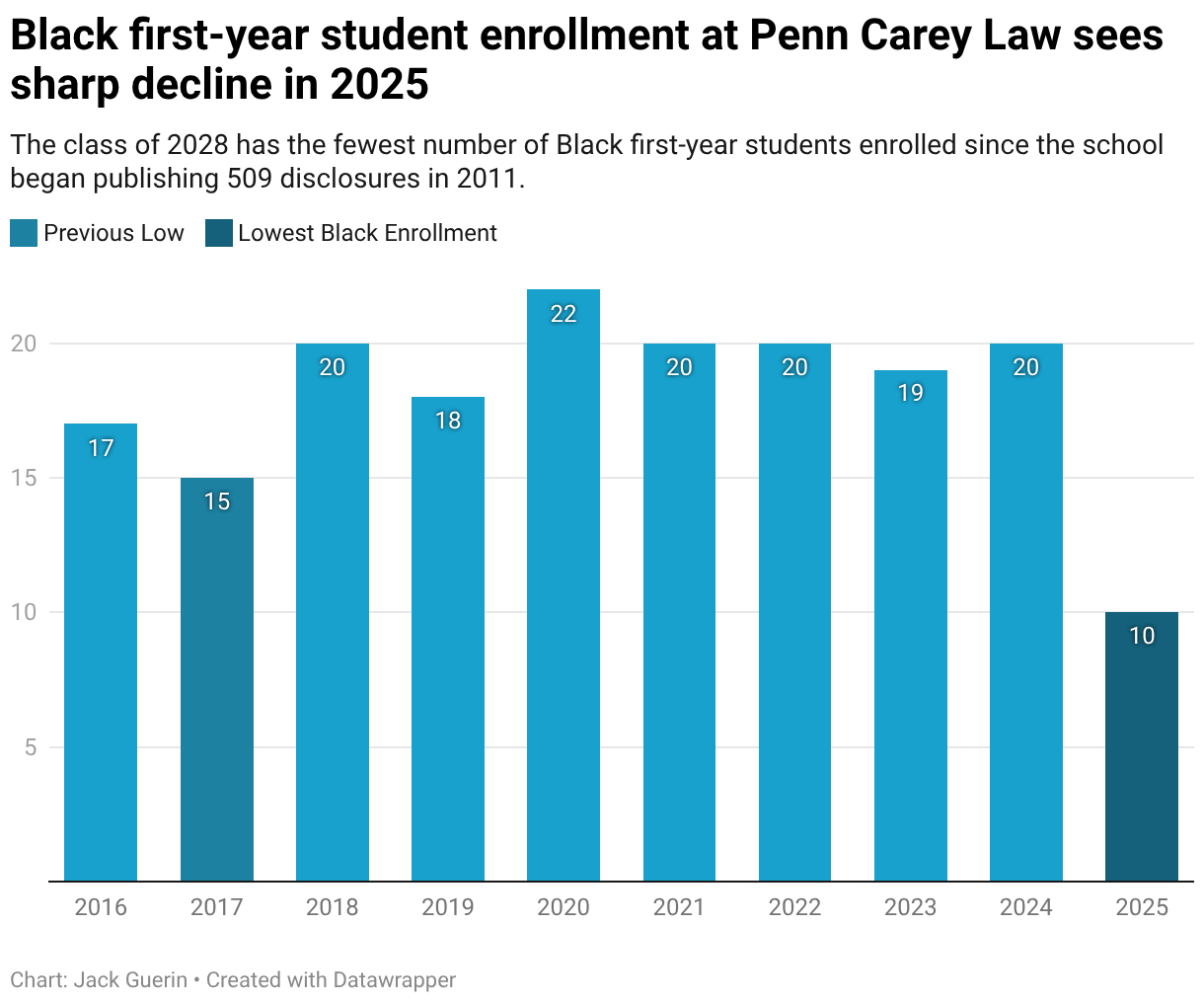
Penn Carey Law had consistently enrolled roughly 20 Black students each year since 2011. Before the Class of 2028, the lowest number of enrolled Black first-year students on record was 15 in 2017.
The recent decrease in Black first-year student enrollment at Penn Carey Law coincides with a nationwide trend. A New York Times analysis of Penn Carey Law and 17 other peer law schools found that only four of the surveyed institutions reported an increase in Black first-year enrollment in 2025.
For the Class of 2027 — the first admissions cycle impacted by the United States Supreme Court’s overturning of affirmative action — Penn Carey Law did not experience a decrease in Black first-year student enrollment. Instead, the data showed a slight uptick from 19 Black first-year students enrolling in 2023 to 20 enrolling the next year.
RELATED:
Penn Carey Law launches Justice Lab clinic for social justice, legal reform
Penn-affiliated groups motion to intervene as defendants in federal antisemitism lawsuit
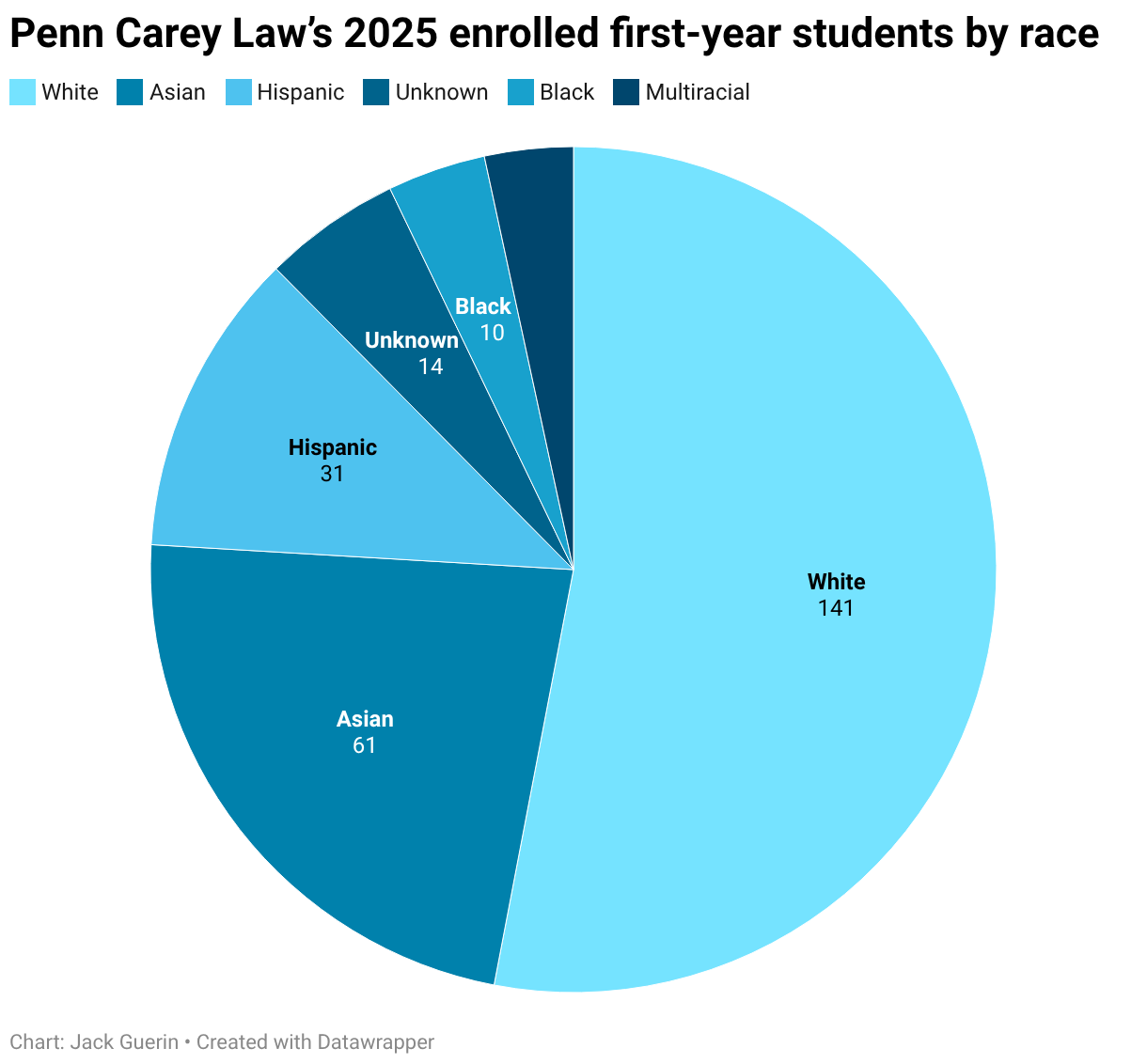
The number of first-year Hispanic students enrolled at Penn Carey Law increased by 10 students in 2025. The increase followed a previous decline in Hispanic enrollment, which dropped from 34 students in 2023 to 21 students in 2024.
The Class of 2027 was the first group of students admitted after the ABA removed the “U.S. nonresident” classification from 509 disclosures and recategorized nonresident students by race. Following that change, the number of first-year Asian students enrolled at the law school more than doubled from 31 in 2023 to 63 in 2024. In 2025, the number of first-year Asian students enrolled at Penn Carey Law decreased by only 2 students from the year prior, for a total of 61 students.
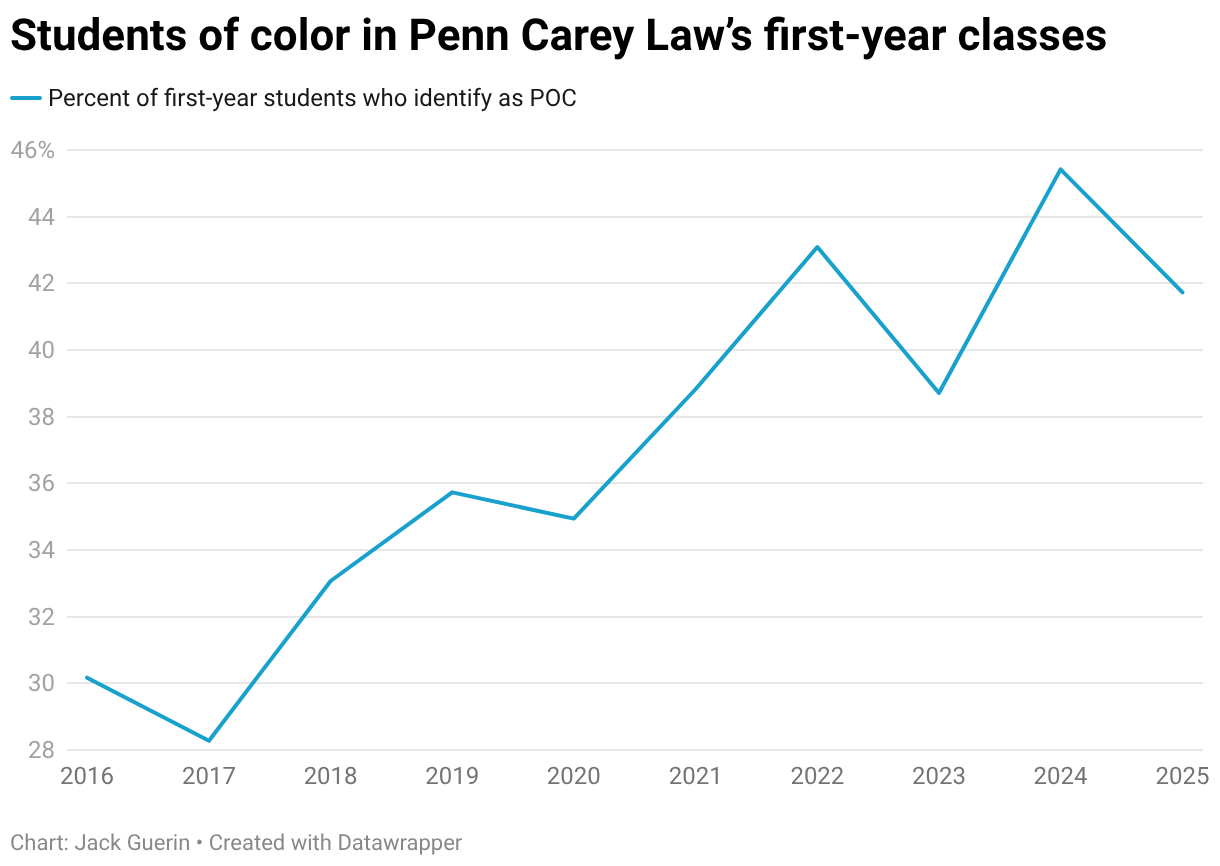
First-year students categorized as “people of color” — which the ABA defines as anyone not identified as “White” or “Race and Ethnicity Unknown” — comprised almost 42% of the Class of 2028, a slight drop from 45% the year prior. Over the past decade, the percentage of Penn Carey Law classes represented by students of color has trended upward.
The sudden drop in Black first-year student enrollment comes after Penn Carey Law eliminated several programs during a University-wide rollback of references to diversity, equity, and inclusion.
In August 2025, Penn Carey Law shut down its Office of Equal Opportunity and Engagement and paused a full-tuition scholarship program honoring Sadie Alexander, the school’s first Black female graduate.
A month later — as the school’s decision faced mounting criticism — Penn Carey Law established the Dr. Sadie T.M. Alexander Fellowship. The new program, scheduled to launch this fall, will provide two years of funding to Penn Carey Law graduates who are pursuing work that advances civil rights.
RELATED:
Penn Carey Law launches Justice Lab clinic for social justice, legal reform
Penn-affiliated groups motion to intervene as defendants in federal antisemitism lawsuit
Jack Guerin leads data reporting and can be reached at guerin@thedp.com. At Penn, he studies philosophy, politics, and economics. Follow him on X @JackGuerin_.