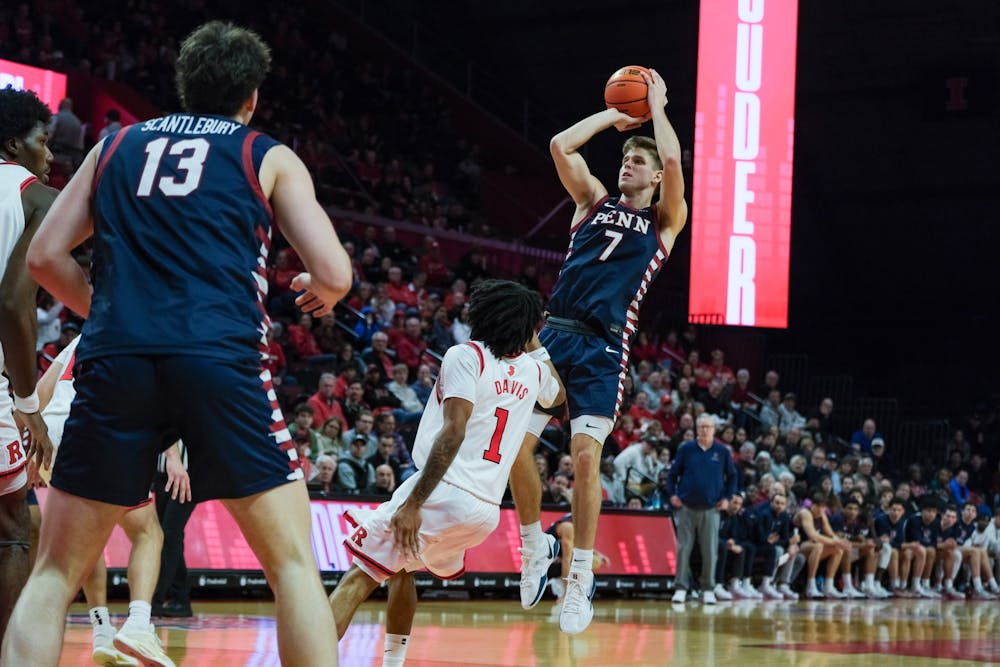
PISCATAWAY, N.J. — On Saturday night, Penn men’s basketball came inches away from authoring a stunning upset win over Rutgers before a series of late miscues that resulted in a one-point defeat.
As the Quakers look ahead to their final two nonconference games and the start of Ivy League play, let’s break down some overreactions from the matchup.
Even with a new coach, Penn still can’t be trusted in late-game situations.
Verdict: Overreaction
Last season, then-coach Steve Donahue’s Quakers went 3-9 in games decided by 10 games or less, a major factor in the team’s 8-19 finish. After Penn squandered a six-point lead with under two minutes to go on Saturday, the loss conjured memories of those costly clutch mishaps.
Junior forward TJ Power’s 1-for-4 accuracy from the free throw line in the final 23 seconds was backbreaking, but the team’s inability to defend without fouling was the more persistent issue. The Scarlet Knights shot 26 free throws in the second half, including 14 in the final five and a half minutes. Rutgers’ Tariq Francis, who led all scorers with 34 points, went 15-for-19 from the free-throw line.
In the postgame presser, coach Fran McCaffery shifted focus from Power’s struggles at the line to the team’s procedural errors.
“You can talk about the missed free throws, that happens,” McCaffery said. “We just kept fouling and stopping the clock. That was a mistake.”
McCaffery’s focus on process over outcome has helped the Quakers shake some of their late-game demons. Penn now sits at record of 3-2 in single-digit matchups this season, including a gutsy home win over Saint Joseph’s and a comeback triumph over La Salle. Those games are meaningful in their own right and showed a version of the Quakers not seen in previous seasons.
At Rutgers, much of the team’s foul trouble stemmed from their inability to stay in front of the Scarlet Knights’ athletic guards. It proved costly in the end, but against a more talented Big Ten opponent, many may have expected Penn to wilt long before the final minute. Instead, the Quakers continually produced timely offense, even without senior guard Ethan Roberts — senior guard Michael Zanoni, senior guard Cam Thrower, and freshman forward Dalton Scantlebury all came up with crucial baskets in the final five minutes.
Yes, Penn will need to be better from the line if it wants to close out tight Ivy League games. Yes, Power, as the team’s second option, will need to be more reliable at the line (it’s also worth noting that Power was wearing a thick bandage on his forehead from a cut suffered earlier in the half). But as McCaffery said, shooting anomalies happen, and Penn will not face another team with Rutgers’ athleticism again this season. This year’s Quakers have already proven themselves capable of executing in the clutch, and that remains true even in the wake of Saturday’s collapse.
Without Roberts, Penn has a serious on-ball creation problem.
Verdict: Not an overreaction
Roberts, Penn’s leading scorer, missed his second straight game after suffering a concussion in the Quakers’ Dec. 6. loss to Villanova. McCaffery declined to offer a timetable for his return, leaving his status for the start of conference play up in the air.
The Red and Blue are now 1-1 in Roberts’ absence, and though they played well enough to win against the Scarlet Knights, their shooting splits raised concerns about the state of the offense moving forward.
Penn has shot under 43% from the field in both games without Roberts, an issue that starts with personnel. Simply put, the Quakers are built around Roberts’ ability to generate his own offense, and playing without him has stretched others thin.
The team’s guard rotation of sophomore AJ Levine, freshman Jay Jones and sophomore Alex Massung are all capable ball-handlers but lack either Roberts’ dribble penetration or threatening jump shot at this stage of their young careers. Thrower, who has filled Roberts’ place in the starting lineup, can attack the lane and gets to his spots well, but is not as twitchy and shot 2/9 from the field against Rutgers. Zanoni has been used primarily as a catch-and-shoot threat.
Even Power, who has inherited the bulk of Roberts’ offensive-creating duties and possesses elite body control, isn’t at his best when forced into prolonged isolation situations. He’s adept at generating space for his jumper and uses his spin move to probe the defense, but he’s most effective off a kick-out or with another ball-dominant player to balance the floor. Power led the Quakers with 19 points on Saturday but also committed six turnovers.
McCaffery has adjusted accordingly, dialing up more on-ball screens in an effort to get Penn’s players going downhill. It’s worked to a degree, but the Quakers have struggled to generate open shots from beyond the arc — Penn shot 23.8% from three against Rutgers and 31.6% against Lafayette, and though that percentage is bound to improve, the quality of the looks has fallen.
There’s a chance Roberts is back in time for Penn’s Ivy opener against Princeton on Jan. 5, in which case, these concerns are moot. With him, the Quakers’ offense has run like a well-oiled machine. But until then, the team will be forced to find a new dimension.
Competing with a Power Four team is a sign Penn’s program is on the upswing.
Verdict: Not an overreaction
Despite their defeat, the Quakers entered Jersey Mike’s Arena as double-digit underdogs and gave the Scarlet Knights everything they could handle. In year one of the McCaffery era, the effort is a step in the right direction for the team.
Though Rutgers is 6-6 and was picked to finish second-to-last in the Big 10, Penn’s near-upset win without its leading scorer remains a growth marker for the program. While Power, Scantlebury, and others have been meaningful newcomers, McCaffery is helming a roster that is fundamentally very similar to the one that placed seventh in the Ivy in 2025. While it’s too soon to say for certain, it seems this year’s group will improve on that finish.
“I think in the Ivy League they’ll be right there challenging for the title,” Rutgers coach Steve Pikiell said of Penn. “Harvard, Yale, [or] them will be one of the winners.”
McCaffery has already gone to work securing the program’s future, nabbing commitments from three stars Ethan Lin and Isaiah Carroll in recent months. But his ability to get the most out of Penn’s current roster is perhaps the best indicator that the program made the right choice in hiring him last March. Now, the Quakers will look to translate that improvement to closing nonconference play and chasing for an Ivy League title.