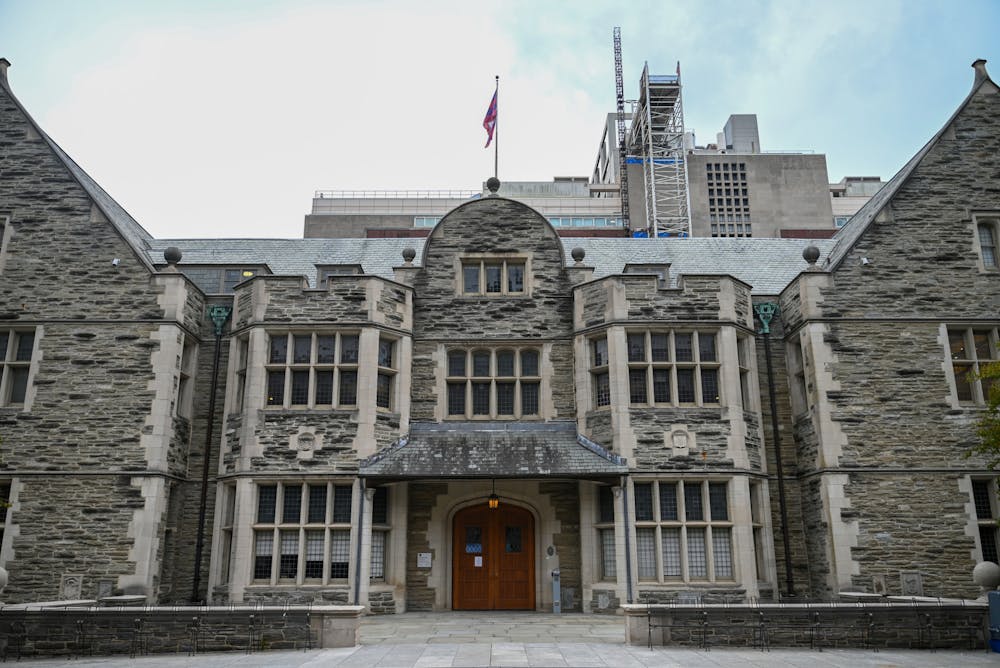
Penn’s Veritas Forum hosted New York Times columnist Ross Douthat and Penn political science professor Damon Linker for a discussion on faith at the Hall of Flags in Houston Hall on Nov. 10.
The event, titled “Is Religion for Everyone?," featured a conversation moderated by Law and History professor Karen Tani on the role of religion, doubt, and the search for meaning. Throughout the 90-minute conversation, which drew an audience of students, faculty, and community members, Douthat and Linker discussed their personal and intellectual experiences with religion before answering audience questions.
At the event, Tani opened by discussing the undergraduate age, adding that she is “reminded every day of both the wonder and the hardship of this phase of life." She described how students are “coming into [their] own people” as their futures unfold, and because of this, their “capacity to do good and capacity to do harm” are greater than ever before.
College and Engineering senior Carson Fisher opened the evening by describing how the Veritas Forum aims to “model the best of what can happen at a university — a generous and rigorous dialogue with all viewpoints considered in their best light.”
The Veritas Forum describes itself as a network that “invite[s] scholars and students from diverse viewpoints to dialogue about life’s big ideas and seek truth together.” Founded at Harvard University in 1992, the organization partners with more than 200 universities to “engage with openness, curiosity, and imagination.”
Fisher also noted that students often avoid talking about religion because it can seem “outdated, close minded, or just irrelevant.” He told attendees that organizers wanted the forum to explore the relevance of religion and its historical origins.
“Should religion still matter today, and is it simply a coping story or could point to something more real?” Fisher said at the event.
Douthat began the conversation by describing his path to Catholicism, which he said included a childhood in southern Connecticut, early years in the Episcopal Church, and his family’s later involvement in a healing ministry where he witnessed prayer services in high school auditoriums.
RELATED:
Penn alumnus Jonah Platt records 'Being Jewish' podcast episode live at the Weitzman Museum
Penn Museum makes strides in Buddhist mural conservation project
Those experiences, he said, convinced him that “there is just a lot of stuff that happens in the world … that just doesn’t fit at all within the kind of official, secular, academic Ivy League paradigm.”
His family eventually converted to Roman Catholicism, and he told students he has remained Catholic in adulthood.
Linker presented a contrasting perspective as a self-described “quirky agnostic.” He said he was raised by secular Jewish parents with “no Hebrew school education, no bar mitzvah, [and] no synagogue attendance,” and grew up in “a world where there is no God and it’s not even something you think twice about.”
After graduate study deepened his skepticism, he briefly converted to Catholicism — influenced in part by his Catholic spouse and work at the religious journal First Things — but publicly repudiated that faith and now identifies again with secular Judaism.
“I have come full circle,” he said, adding that he is unsure if “I’m done with my journey.”
The panel then turned to questions about how scientific understanding intersects with faith.
Douthat said that he does not see evolution and the Bible as fundamentally incompatible, adding that “the book of Genesis very clearly does not present as a kind of detailed historical analysis.”
He added that Christianity’s teachings about the fall of man and death are “more difficult” to reconcile with modern science, which raises “the problem of evil,” a moral rather than scientific challenge for believers.
Linker said that, for him, questions about truth are inseparable from philosophy rather than theology.
“My main motive always is to understand as best I can … the truth of the world that we live in,” he said.
During a question and answer session submitted through the online platform Slido, audience members asked about pluralism, colonialism, and how to evaluate competing truth claims. In response to a question about which religion has the most evidence, Douthat said that, if all religions are considered equally, “maybe a kind of Hindu conception of the world might have the strongest claim.”
He added that he remains Christian because he finds the Biblical story “more incredible and more credible” than others.
In their closing remarks, the speakers were asked about what steps those curious about faith but unsure where to start can take.
Linker urged attendees not to disengage from questions about faith and meaning.
“If there is a sin, it is indifference,” he said. "Don't not care."
RELATED:
Penn alumnus Jonah Platt records 'Being Jewish' podcast episode live at the Weitzman Museum
Penn Museum makes strides in Buddhist mural conservation project
Senior reporter Ananya Karthik covers central administration and can be reached at karthik@thedp.com. At Penn, she studies communication and economics. Follow her on X @ananyaakarthik.