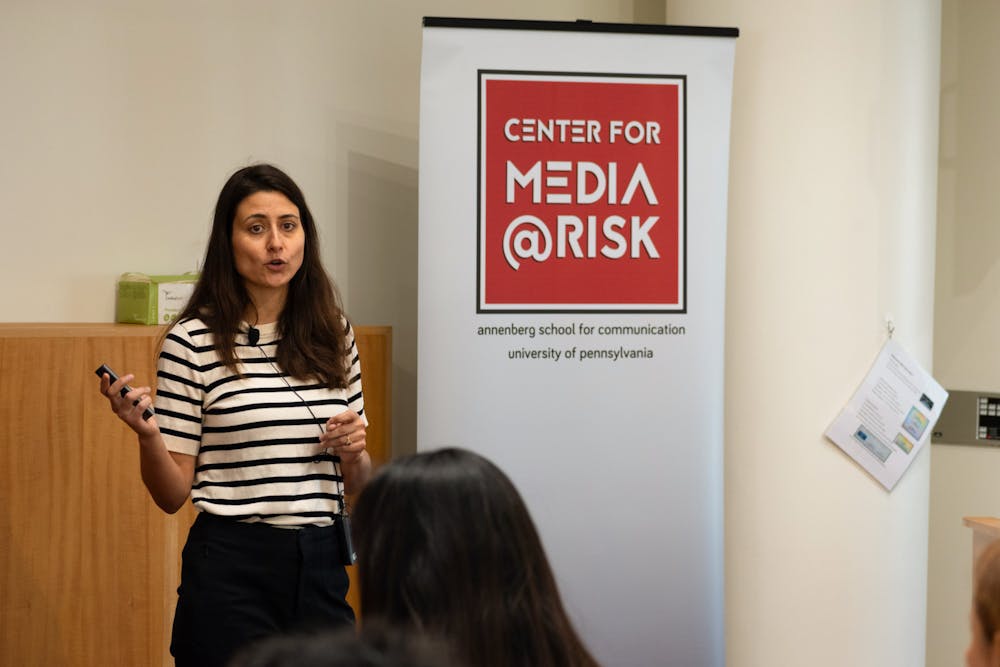
The Center for Media at Risk at the Annenberg School for Communication hosted a talk on self-censorship and harassment in media on Wednesday.
The colloquium, titled “Networked Incitement and the New Politics of Censorship” was led by Center for Media at Risk visiting practitioner and The Guardian columnist Arwa Mahdawi. During the talk, Mahdawi spoke about her personal experiences with harassment while working as a journalist, particularly while reporting on the Israel-Hamas war.
She referenced Camera UK, an organization “dedicated to promoting fair, accurate and balanced coverage of Israel in the British media,” according to its webpage.
Mahdawi claimed that the organization “target[s] journalists.” In June 2024, Camera UK released a “correctional piece” about Mahdawi’s own reporting.
“Even though The Guardian was good about the abuse from the Camera UK, it did create a chilling effect in the newsroom,” Mahdawi said. “They were very much weary about how they talked about genocide.”
Mahdawi also used case studies in her talk to discuss harassment in media, referencing Indian journalist Srishti Jaswal and Australian journalist Antoinette Lattouf, specifically. Both women, according to Mahdawi, were “humiliated” and “harassed” for their reporting through threatening emails and were fired from their jobs.
Mahdawi added that such practices “push people out of journalism.”
She also spoke about Canary Mission, which “documents people and groups that promote hatred of the USA, Israel and Jews” according to its website.
RELATED:
Annenberg School graduate students host panel on future of presidential endorsements in journalism
“It is very, very vicious, and it also creates this chilling effect,” Mahdawi said.
In the talk, Mahdawi introduced statistics regarding perceived freedom of speech from the broader community, stating that 13% of people said they didn’t feel free to speak in 1954, a number that is now 48%.
Center for Media at Risk Research & Outreach Director Sophie Maddocks told The Daily Pennsylvanian that such talks are common practice for visiting practitioners.
“It made sense — given the context of censorship — to include in our programming, our visiting scholars, and our visiting practitioners a journalist who is speaking out on topics that are often censored,” Maddocks said.
Liz Hallgren, a fifth-year doctoral candidate and member of the Center for Media at Risk’s steering committee, told the DP said she had been looking forward to listening to a “journalist who has Palestinian origin, as well, who can speak directly to the unique kinds of censorship that come with that conflict.”
At the center, Mahdawi plans to make a “playbook” of procedures that media outlets can abide by if one of their members is harassed for their reporting.
“I want to do more of a quantitative study of trying to understand more about how it’s actually impacting people’s coverage,” Mahdawi told the DP. “I think that those dots aren't being connected by the media — they’re not understanding that harassment has this spillover effect onto the world.”
Barbie Zelizer, communications professor and Center for Media at Risk director, told the DP that Mahdawi’s work was “right at the core of the center.”
“It's very much a part of us thinking about media at risk,” Zelizer said. “You can’t think of media at risk without thinking about the people who are practicing in the media, as well as people studying the media. It’s really about strategizing across the board.”
RELATED:
Annenberg School graduate students host panel on future of presidential endorsements in journalism
Senior reporter Arti Jain covers state and local politics and can be reached at jain@thedp.com. At Penn, she studies economics and political science. Follow her on X @arti_jain_.