

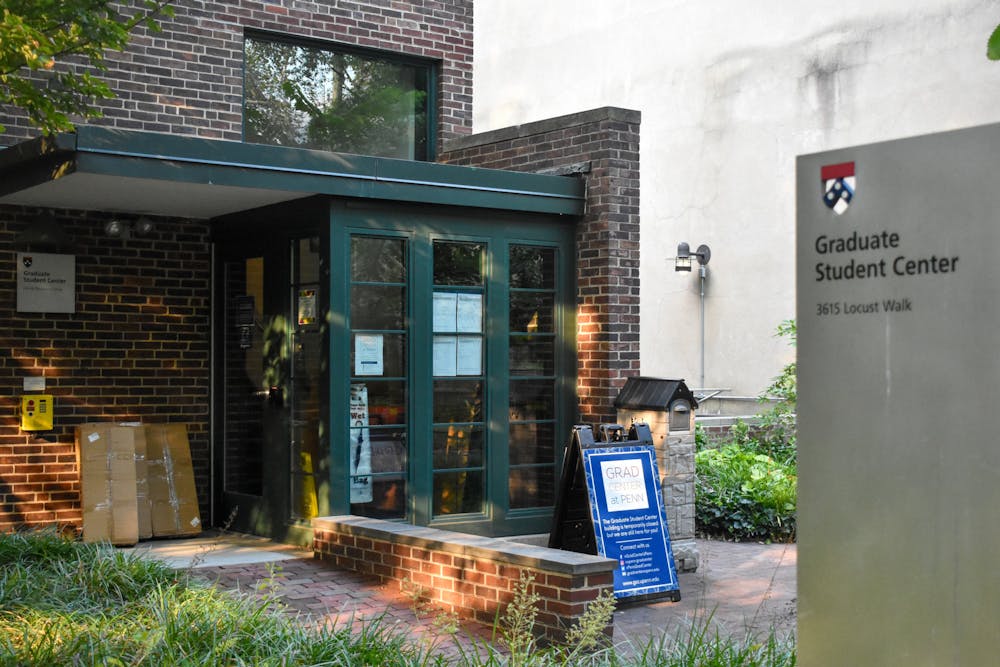
Penn’s Graduate and Professional Student Assembly is supposed to serve as the official student government representing graduate and professional students at Penn. But in interviews with The Daily Pennsylvanian, former members alleged that University officials encroached on the organization's independence and damaged its ability to advocate for its students.
Former GAPSA executive board members described an “overarching infiltration” at the hands of administrators, citing unreasonable performance expectations and a lack of respect for shared governance. As a result, the members alleged that Penn officials created a toxic student environment.
According to the group's website, GAPSA’s primary focus is to “empower the graduate student body through funding, programming, and academic resources.” While formally and financially tied to Penn, GAPSA maintains its own governance system with constitutions, bylaws, and standing rules.
However, members say that Penn administrators sought to “override” their independent policies and practices.
Multiple GAPSA members interviewed for this piece requested anonymity, citing fears of professional retaliation.
One former executive board member described an incident where an Office of Student Affairs administrator complained that students were “harping” on the GAPSA’s constitution “as if it’s something [staff members] are going to follow.”
“There was this bifurcation in terms of governance between how Penn viewed GAPSA and how GAPSA viewed itself,” they said.
The member also said that GAPSA’s efforts to advocate for students were met with resistance from administrators. Another GAPSA official, who served from 2022 to 2023, stated that when the group petitioned for a student representative on Penn’s Board of Trustees, they received an email from then Penn President Liz Magill which they felt expressed “disappointment” with the organization.
RELATED:
GAPSA executive board members resign, deny allegations of improper spending
GAPSA, Career Services launch funding program for graduate students' unpaid summer internships
Magill, according to the official, refused to meet with GAPSA representatives for the rest of the year. The former president did not respond to a request for comment.
“[Penn does] not view GAPSA as an advocacy organization. They view it as a programming entity for administration,” they said. “If you do any [advocacy], even on good terms, you get frozen out, criticized and punished.”
Former GAPSA President and 2024 Engineering Ph.D. graduate Joe Rummaneethorn said that he found it difficult at times to understand the reasoning behind Penn’s judgment when dealing with GAPSA.
“There were moments where I was unsure what [Penn’s] motivations were,” Rummaneethorn said. “I was pretty sure that our motivations were the improvement of graduate student life, but it felt like there were uncommunicated restrictions and motivations from their side that I am frankly unable to parse out.”
In a statement to the DP, Graduate Student Center executive director Meredith Wooten maintained that Penn does not intrude on GAPSA’s position within the University community.
“My impression is that University leadership sees GAPSA’s role as a representative body as a vital part of University governance and does not want or seek to interfere with its ability to fulfill that role,” Wooten wrote in the statement.
A current GAPSA spokesperson similarly emphasized the group's joint commitment with the University to improve graduate and professional student life.
“While the relationship is dynamic and sometimes requires us to navigate our differences, GAPSA and Penn’s administration share a strong and ongoing commitment to supporting graduate and professional students,” GAPSA wrote.
Still, multiple members who have interacted with the University allege that administrators regularly interfere with GAPSA’s ability to properly advocate for students. For example, members said that University officials would offer academic and professional perks to students who “sold GAPSA short to gain traction personally.”
“Getting good with the administration meant that you get awards, you get letters of recs, you get access to jobs,” one former GAPSA president said.
This, in turn, attracted students who were motivated to “appease” the administration, he told the DP, which led to GAPSA becoming “complacent” and overly deferential to the Penn administration.
“GAPSA would be teeter-tottering about how they would run the student government based off of what a Penn administrator would say,” another board member said. “The constitution would get forsaken in order to appease Penn administrators.”
Members also say that administrators would work to limit the independence of the organization. The 2022-2023 executive board member described how Penn administrators “completely cut off” GAPSA’s access to surplus funds during their year in office.
“[Penn] would say that they were hearing concerns from students about how money was being spent,” they said. “They would use that as a leverage point to take full control of everything.”
Another board member — who was heavily involved in the organization’s finances during their time at GAPSA — stated that it was a regular occurrence to “get locked out of accounts.” They also recalled multiple incidents of “blatant attempts [by administrators] to gain access to accounts that people did not have the permission or authority to share.”
“If there was a finance account that someone outside of finance also had access to, then an administrator would usually go to the person outside of finance and swoon them to give them the credentials to log in,” the board member said.
They also noted an incident where the Graduate Student Center seized access to the Eventbrite server used by GAPSA.
The spokesperson for GAPSA recognized the frustrations experienced by its members when interacting with the administration, but attributed it to “structural factors” — including limited support staff for graduate students and the decentralized nature of Penn’s administration.
Board members said that the stresses of dealing with Penn’s administration contributed to a culture of “coercion and toxicity.” The former president alleged that administrators would work to “exploit or create personal conflict[s]” to prevent GAPSA members from fulfilling their role.
“It felt like they were doing everything in their power to prevent GAPSA from advocating for anything meaningful,” the former president said. “Maybe it was all benign, but what I can tell you is that it never felt benign.”
Another former board member — who resigned during their term — described GAPSA’s relationship with the University as “incredibly challenging.” In particular, they pointed to student unionization efforts as an especially controversial issue."
“Certain GAPSA leaders were scared to even say ‘union’ in a meeting or write it in our emails or Slack messages because of the fear of retaliation,” they said.
This, combined with the “absurd” workloads for board members, has led to regular resignations in GAPSA. Multiple members said that resignations are a near annual occurrence, and multiple individuals interviewed by the DP say they themselves resigned before finishing board terms.
“There are so many incredibly talented and passionate individuals who come into GAPSA but end up becoming incredibly burnt out by the compounded impacts of the approach to the administration,” the member who resigned said.
RELATED:
GAPSA executive board members resign, deny allegations of improper spending
GAPSA, Career Services launch funding program for graduate students' unpaid summer internships
Jack Guerin leads data reporting and can be reached at guerin@thedp.com. At Penn, he studies philosophy, politics, and economics. Follow him on X @JackGuerin_.
Senior reporter Christine Oh leads coverage of student life and can be reached at oh@thedp.com. At Penn, she studies English and philosophy. Follow her on X @ChristineOh_.


