“I feel like a bug trapped in a spider’s web that is too small for the spider to even eat.”
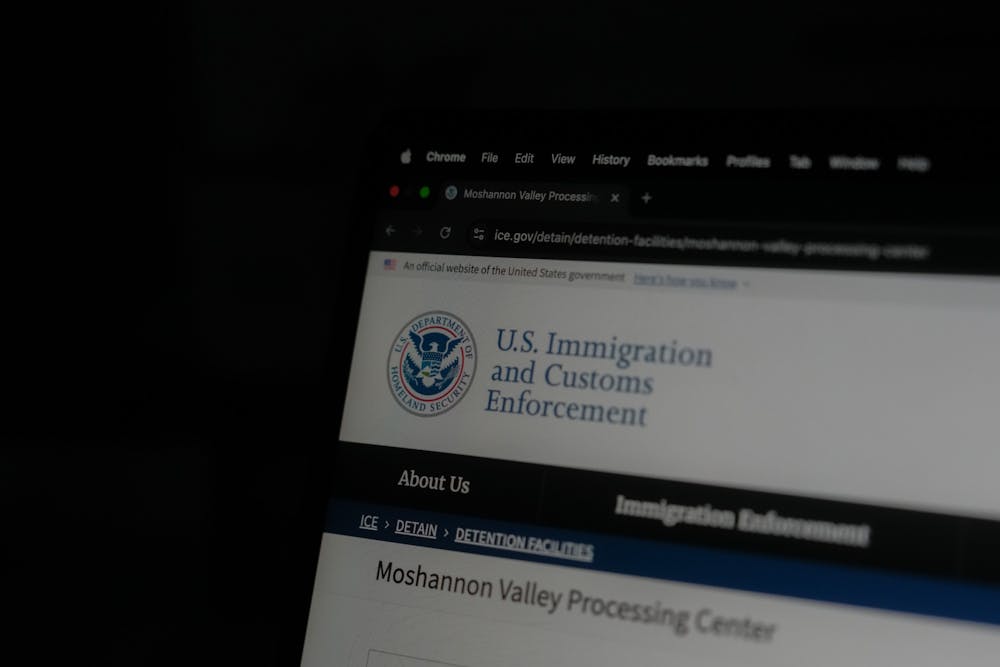
This is Alvan’s personal account of his detention in Moshannon Valley Processing Center, a facility in central Pennsylvania dual-operated by Immigration and Customs Enforcement and GEO Group. Last summer, the Transnational Legal Clinic at the University of Pennsylvania Carey Law School interviewed Alvan and five other participants as part of a joint federal complaint against GEO and ICE. It alleges that the center failed to provide adequate medical care, language access, and a discrimination-free environment.
GEO is a private prison hegemon that has benefited from federal contracts with the American government since the 1980s. After the 2024 reelection of Donald Trump, stocks for GEO and another main federal prison contractor, CoreCivic, skyrocketed, even surpassing shares for Elon Musk’s Tesla. Stock observers were eager to cash in on the private prison companies certain to benefit from a mass deportation plan promising to rival an Eisenhower-era initiative that forcibly expelled hundreds of thousands of people with suspected Mexican ancestry. Officially known as “Operation Wetback,” the Eisenhower administration’s deportation campaign repurposed a racist slur used to refer to those who risked their lives to cross the Rio Grande.
The militaristic deportation scheme — allegedly “voluntary” — was unprecedented in its scale and impact. Citizens and non-citizens alike were packed into overcrowded trains, trucks, and ships to the southern border. Historian Mae Ngai has documented the deaths of many individuals who did not survive such journeys, including 88 people who died of heat exhaustion after being abandoned in the Mexican desert. The unconscionable realities of such a dark episode in American history made Trump’s pledge plainly abhorrent.
Investors who understood the implications of Trump's immigration platform reaped the rewards shortly after his reelection, as GEO Group and CoreCivic have since received a boom in new contracts and have solidified an industry-friendly network in the Trump White House. Attorney General Pam Bondi has lobbied for the company, and recently, news outlets revealed that before his selection for “Border Czar,” Tom Homan served as a consultant for GEO.
This month, GEO has reentered the limelight. In 2021, a federal jury decided that GEO owed the people it detained in the state of Washington $17.3 million for GEO’s “voluntary” work program. The program paid just $1/day for immigrant detainee labor — from waste management to janitorial services. GEO’s lawsuit in Washington is one of many in recent years. On Monday June 3, the US Supreme Court agreed to review GEO’s right to appeal in the state of Colorado. The private prison company claims immunity from state minimum wage laws, citing its contracts with the federal government.
One cannot help but draw historical parallels to the question the Court considers today. In 1896, an immigrant named Wong Wing appealed to the Supreme Court when he was charged under the Chinese Exclusion Acts with imprisonment and 60 days of “hard labor.” In a unanimous ruling, the Court found that the detention of immigrants did not qualify as criminal punishment, but it ruled that it was unconstitutional to impose “infamous punishment at hard labor” upon workers such as Wing without a judicial trial.
Over a century has passed since Wong Wing v. United States, and immigrant detention has evolved into a multi-billion-dollar industry. In her book “Shadow of Liberty,” historian Ana Minian articulates the exceptional design of these facilities: “Immigrant detention centers, where individuals can be incarcerated without rights or legal protections, are nothing less than legal black sites. They function as spaces outside the law.” Today, corporations such as GEO are asking the courts for a longer leash.
A comprehensive overview of the human rights abuses occurring in GEO/ICE facilities lies beyond the scope of this article. I invite anyone to read the slew of lawsuits that have been filed in the last decade over documented cases of solitary confinement, sexual exploitation and retaliation, forced and unpaid labor, shortages in hygiene products, and medical neglect, among many others. In GEO facilities, people have reported rat infestations, black mold, and live cockroaches in their food. Testimonies provided by individuals such as Alvan and Rümeysa Öztürk also provide a window into patterns of systematic abuse.
After Öztürk, a Tufts graduate student, was de facto kidnapped on the streets of Massachusetts by ICE agents in plainclothes, she was sent to a GEO-run facility in Louisiana. Following her court-ordered release, Öztürk has since shared that she suffered four asthma attacks while inside the facility, for which she received minimal medical attention. She says she was also forced to share a filthy, cramped cell with 23 other women and detailed how the staff mocked her Muslim faith.
In Pennsylvania, GEO’s Moshannon facility is just over 200 miles away from Penn’s campus. It may seem far away, but its remoteness is by design. It is meant to feel isolated, inaccessible, and, ideally, rendered invisible.
These black sites are often absent from our media algorithms and from the priorities of our elected officials, so they may feel removed from our everyday lives. But they are not. Individuals in GEO facilities are not simply “detainees.” They are our neighbors. Öztürk’s experience demonstrates that they could also be our classmates and our friends. GEO’s reach does not stop at our doorstep. It is past time to pierce its veil of impunity.
If you are looking for ways to stay informed, support Pennsylvania’s immigrant and refugee communities, and exercise your right to protest, you may find starting points below:
Know your rights: https://immigrantjustice.org/for-immigrants/know-your-rights/ice-encounter/
Juntos (Philadelphia): https://www.vamosjuntos.org/.
HIAS Pennsylvania: https://hiaspa.org
Ask your representatives to visit and investigate GEO facilities: https://www.house.gov/representatives/find-your-representative
CAROLYN VAZIRI is a College junior from Ohio studying history and political science. Her email is cvaziri@sas.upenn.edu.