Penn has spent much of the past year — which was marked by a presidential election, funding cuts, and visa revocations — at the center of the political landscape.
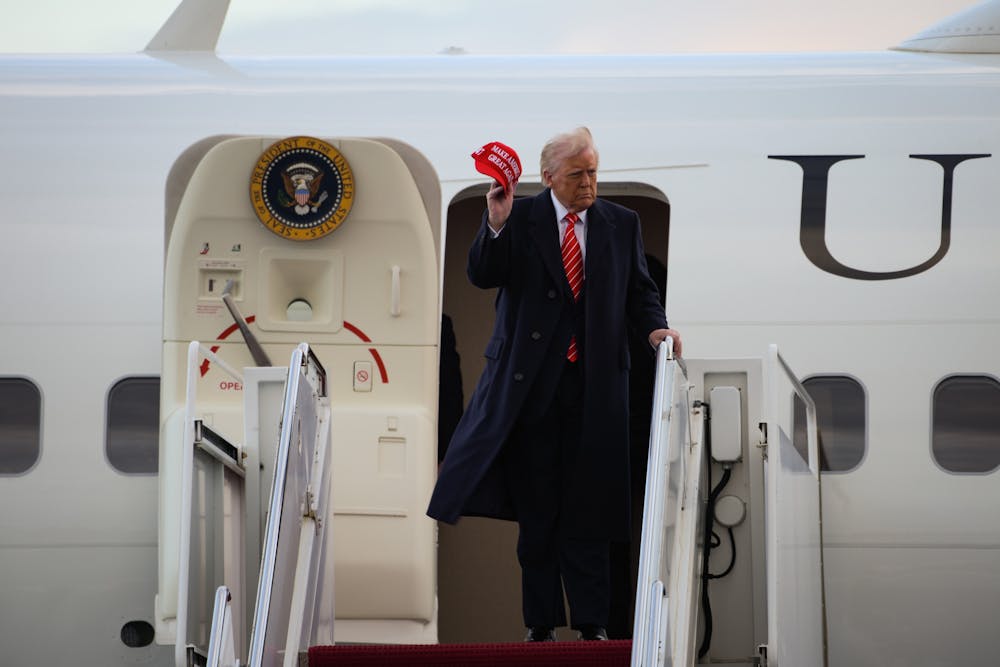
Penn was thrust into the national spotlight leading up to the 2024 United States presidential election, due to the University’s strong ties to 1968 Wharton graduate and now-President Donald Trump and former Benjamin Franklin Professor of Presidential Practice and former President Joe Biden.
In the months following Trump’s inauguration, Penn has remained a target of federal scrutiny leading to widespread changes in University policies.
The presidential election
In July 2024, Biden withdrew from the 2024 presidential race, an unprecedented instance marking the first time the presidential nominee of a major party has dropped out during the general election campaign.
Biden went on to endorse former Vice President Kamala Harris to be the Democratic nominee.
Pennsylvania, a key swing state in the election, and Penn both received national attention during the 2024 presidential race.
Penn’s campus spent much of the fall semester anticipating Election Day. The University’s Office of Government and Community Affairs led nonpartisan initiatives to increase voter turnout in partnership with student-led organizations, such as Penn Leads the Vote.
RELATED:
Federal government reactivates immigration statuses for remaining four Penn affiliates
Penn, peer institutions sue National Science Foundation over indirect costs funding cap
Both of Penn’s largest student partisan political organizations, Penn Democrats and Penn College Republicans, noted increased participation and membership as election approached. Both groups hosted various events throughout the election cycle, including debate watch parties, tabling sessions, and discussions with political figures.
Penn College Republicans hosted Sen. Dave McCormick (R-Pa.) for a fireside chat shortly before he was elected. Penn Democrats also hosted political figures and notable alumni, such as 1984 Penn Carey Law graduate Rep. Mary Gay Scanlon (D-Pa.), Jack Schlossberg — grandson of former President John F. Kennedy — and 1999 College graduate and singer John Legend to stump for the Harris-Walz campaign and promote youth voter participation.
Both major-party presidential candidates — Trump and Harris — crisscrossed the state several times in the months leading up to Nov. 5.
On Election Day, students reported long lines and increased wait times around campus as they prepared to cast their votes.
Penn voted overwhelmingly in favor of Harris, receiving 81.6% of the votes cast on Election Day across four locations, whereas 16.3% voted for Trump. The distribution marked a slight decrease in support for the Democratic party from 2020, where about 83% of Penn students voted for Biden.
Soon after the polls closed at 8 p.m., students flocked to watch parties hosted by residential college houses and various organizations, with mixed feelings of uncertainty, nervousness, and excitement about the possibilities of the election.
Trump’s electoral win, which was officially called on the morning of Nov. 6, 2024 by several mainstream media outlets, came as a shock to many Penn students and faculty, who shared concerns about the country’s future in interviews and statements to The Daily Pennsylvanian.
Following the election, some conservative Penn students expressed hesitation to voice their support for Trump, pointing to the “hostility” and “alienation” they experienced during open discussion.
The Pennsylvania senatorial election, which was a far tighter race, was not decided until two weeks after Election Day, when Democratic incumbent Bob Casey conceded to Republican candidate McCormick.
Federal policy changes
Penn has been the target of numerous federal funding cuts and freezes over the past few months.
In February, $240 million of Penn’s funding from the National Institutes of Health was jeopardized after the NIH issued a directive capping “indirect costs” — which fund overhead expenses including laboratories and support staff — at 15%.
In an announcement to the Penn community, Penn President Larry Jameson said that the University was working to “identify solutions to minimize the impact” of the funding cap. On Feb. 10, Penn and 12 other universities nationwide filed a lawsuit against the policy, which resulted in a judge temporarily halting the cut.
Later that month, the U.S. Senate Commerce Committee flagged over a dozen Penn research grants totaling nearly $11 million in funding, alleging that the initiatives promoted diversity, equity, and inclusion.
The federal funding uncertainty influenced the decision of several Penn schools to reduce graduate school admissions for the upcoming year. Faculty at the Perelman School of Medicine were instructed to reduce admissions for the fall 2025 Ph.D. cohort by around 35%, according to documents obtained by the DP.
In an email provided to the DP, Interim School of Arts and Sciences Dean Jeffrey Kallberg cited the NIH funding cap as the reason behind the school’s reduced graduate admissions.
In March, an additional $175 million of Penn’s federal funding was frozen by the Trump administration. The decision, according to the White House, was due to Penn’s “policies forcing women to compete with men in sports.”
In the following week, Jameson announced that faculty across seven of Penn’s schools were notified that their federally contracted research was halted. The frozen research grants totaled approximately $175 million.
On April 28, the Department of Education found Penn in violation of Title IX for allowing 2022 College graduate and transgender woman Lia Thomas to compete on the women’s swimming and diving team during the 2021-22 season, giving the University 10 days to “voluntarily” respond to a set of three demands or risk losing federal funding.
As of the May 8 deadline, the University has remained silent.
On May 5, Penn joined 16 universities and higher education organizations in filing a federal lawsuit against the National Science Foundation, arguing that its proposed 15% cap on indirect cost reimbursements threatens the financial foundation of university-led research.
Changes to DEI Policies
Trump’s election marked several changes on Penn’s campus, most notably, a complete overhaul of the University’s DEI initiatives.
Trump signed an executive order in January requiring universities that receive federal funding — such as Penn — to terminate any DEI programs that could be in violation of federal civil rights laws. In response, Penn scrubbed the University’s main diversity and inclusion website — renaming it to “Belonging at Penn” — and revised longstanding University policies. The University removed references to DEI initiatives and programs from the websites of all four Penn undergraduate and 12 graduate schools.
On Feb. 25, local lawmakers met with senior Penn administrators, including then-interim Penn President Jameson, to address the University’s rollback of DEI policies. They criticized Penn for its failure to defend DEI policies in response to recent federal actions and alleged the University lacked accountability.
Penn also renamed Wharton’s undergraduate DEI concentration and MBA major to leading across differences.
Visa revocations
Penn students have also been impacted by changing immigration statuses due to the Trump administration’s actions.
On Jan. 29, Trump signed an executive order directing federal agencies to identify and deport non-citizen participants — including college students — in pro-Palestinian protests.
On April 7, the International Student and Scholar Services informed international students that the federal government had revoked visas and terminated immigration statuses for “at least three” Penn students. ISSS claimed that these revocations were due to “immigration status violations and not connected to the 2024 campus protests.”
Later that month, a University spokesperson told the DP that eight Penn affiliates had been affected by ongoing visa revocations and immigration status terminations. Of the eight total affiliates, seven had their Student and Exchange Visitor Information System status terminated, including one undergraduate student, five graduate students, and one alumnus on a sponsored visa. One additional Penn affiliate had their visa revoked.
On April 25, a University spokesperson told the DP that the federal government had reactivated the visas and immigration statuses of all seven Penn affiliates whose statuses had previously been terminated.
RELATED:
Federal government reactivates immigration statuses for remaining four Penn affiliates
Penn, peer institutions sue National Science Foundation over indirect costs funding cap
Isha Chitirala is a News Editor at The Daily Pennsylvanian and can be reached at chitirala@thedp.com. At Penn, she studies economics and political science. Follow her on X @IshaChitirala.