

Since its formation in 1954, the Ivy League has been perhaps the most stable conference in Division I. It has enjoyed a remarkable level of parity and is still the only D-I league whose membership has never changed.
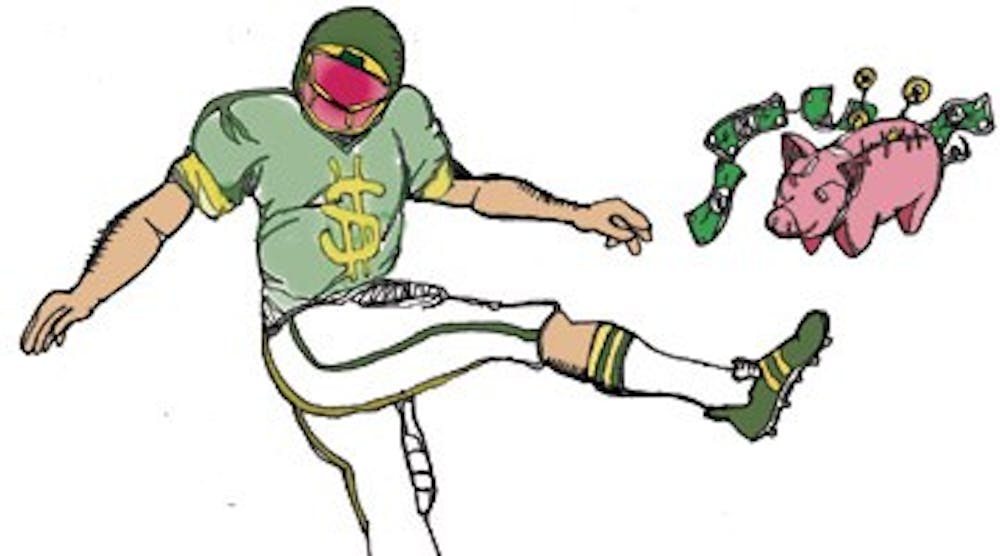
But the distribution of financial aid money - and its effect on athletics - is threatening to upset that balance. The richest Ivy League schools are offering more and more money to students and are gaining an insurmountable advantage in recruiting, Penn Athletic Director Steve Bilsky said.
"What's inevitably going to happen is that there's going to be a divide in the league," he said. "Not based on philosophy, but on resources."
Harvard announced the most generous financial-aid program in the country on Dec. 10, and its peers have been rushing to catch up since. So far, they have been unable to, and some question whether the gap between the top and bottom tiers will ever close.
"Our coaches and other coaches around the league are talking about unfair advantages that the schools that have more resources have," Bilsky said. "So it's brewing. And it's not something that people will be comfortable with.
"Nobody's going to want to be 0-10 in football when somebody else is 10-0, year in and year out, especially if the reason for that happening is recruiting advantages tied to financial aid."
Harvard's sweeping new initiative was hailed as a step toward greater accessibility in higher education. Penn, Yale and Dartmouth have all announced new programs since then.
To Bilsky, the announcements are a signal of an intractable problem within the league.
The financial-aid arms race has officially begun.
A changing landscape
Going to an Ivy is becoming cheaper. By how much depends on the money allocated for financial aid. In that category, the richest Ivies - Harvard, Yale and Princeton - hold a huge lead over the rest.
The Ivies have always committed to offering aid only to applicants with demonstrated need.
But there are many ways to tinker with what 'need' means. Is home equity considered income? How much are students expected to contribute themselves? How rich is too rich to deserve any aid?
Given more freedom to define financial need, the Ivies are constructing guidelines that reduce student expenses. There are significant differences within league policies already.
Harvard has said that, under its initiative, 90 percent of American families would be eligible for aid. Harvard currently spends $98 million on aid for an undergraduate student body of 6,715. The new program, which will take effect in September, will outlay $120 million per year on undergraduate aid. By comparison, Penn currently spends $90 million for an enrollment of 10,160.
While families with incomes below $60,000 will pay nothing to send a child to Harvard, Penn has not made the same commitment, and it will not eliminate all loans from aid packages - as Harvard and Princeton have already done - until 2009.
And just as Harvard is outstripping Penn, Penn - which is in the middle of the Ivy financial-aid pack at the moment - is beating the Ivies that have even fewer resources.
"It's always natural that within an athletic conference, there's [an] element of competition," Dartmouth deputy athletic director Robert Ceplikas said.
Actually, not quite.
The old system
Two decades ago, league-wide competition over financial aid would have been impossible. Before 1991, if a student had been admitted to more than one Ivy, the financial-aid package from each school would have been identical.
Admissions officials from every university met regularly to ensure that differences in the aid packages were reconciled before sending out letters of admission. In theory, financial considerations within the Ivy League were removed from the students' decision-making process. Each Ivy offered the same package to an individual.
The U.S. Justice Department took aim at that practice in 1989. It sued the eight Ivy colleges and the Massachusetts Institute of Technology, alleging that equating financial-aid rewards violated the Sherman Antitrust Act as an illegal restraint on interstate trade.
The court fight dragged on until May 1991, when the Ivy institutions signed a consent decree agreeing to stop the collusion. They said the cost of fighting the case any more was prohibitive; then-Penn president Sheldon Hackney said at the time that the University had spent more than $400,000 in legal fees.
Under the ruling, the League preserved the right to some collective actions - such as the collective decision to prohibit athletic scholarships.
But "overlap meetings," the M.I.T. News Office reported after the settlement, "are a thing of the past."
M.I.T. alone continued the legal fight, winning in Dec. 1993 when the government dropped its case.
Since 1991, each Ivy has been free to define financial need by itself. The schools went by essentially the same standards until recently, Bilsky said.
"Now, over the last couple of years, starting with Princeton and now with Harvard, particularly, changing the focus," he added, "You're getting into this potential conflict."
Following the leader
The idea of making education more affordable is not new, according to admissions experts.
"There's [been] a bubbling issue of college costs going back for at least 10 years, and it has sort of gotten to a boil in recent years," said James Boyle, president of the advocacy group College Parents of America.
Dartmouth, the most recent Ivy to go public with a new initiative, said on Jan. 22 that families with incomes below $75,000 will not pay tuition. Starting this semester, Columbia will substitute grants for loans for households with incomes below $50,000. Princeton in 2001 was the first to eliminate all loans, and Yale and Dartmouth have made the same commitment recently.
But such advances have required sacrifices. Dartmouth increased its annual draw from its $3.8 billion endowment last year from 4.7 percent to six percent, in part to pay for the aid initiative. Some schools can make more sacrifices than others.
"Harvard seems to have many ingrained financial advantages," said Tom McManus, a college counselor at the elite Tatnall School in Delaware and a former Penn admissions employee, in an e-mail. "They could surely offer a free undergraduate education to their entire freshman class each year and still remain profitable."
Boyle said that elite colleges like Harvard can still do much more.
"Harvard [could] really make everybody sweat if they take [a] radical step. What they did was take an incremental step," Boyle said.
"This is just started," Bilsky said. "Two years from now, schools will do another round of [reforms], and who knows what the future might be."
The great unknown
"So what will people do with that?" Bilsky asked.
He suggested that some might focus on the benefits of granting continually more generous aid. And relative to peer conferences, the recruiting power of the Ivy League will likely grow, as the gap between an athletic scholarship and a need-based aid package decreases.
The Ivies also predict that the reforms will widen the financial-aid pool and bring more social diversity into the student body - and the athletic ranks.
But officials are unsure whether the process of cheapening an Ivy education will ever reach a stopping point.
One possibility, Bilsky said, "is that schools will continue to try to do more, commit more financial resources.
"But the schools that have more [money], since it's an arms race, will always have more," he said. "So you're not going to be able to catch up.
"It's like being on a treadmill; it would just never end to do that."
There is a more ominous possibility, Bilsky said.
"Schools will say, well, we're not willing to accept being a have-not, and so therefore we'll have to look at ways to counter that. And those ways might be in conflict with some of the other Ivy principles that have existed for 50 years."
Bilsky suggested a "radical" solution that would be a contradiction to the Ivy League's founding premise. He said that an athletic grants-in-aid model - a system of athletic scholarships - might end up being the best way to eliminate inequity. Bilsky did not endorse such a change, but said that it should be strongly considered.
Others do not see the need for action yet. Ceplikas, of Dartmouth, said that a full recruiting cycle should pass before judging the effect of the new aid programs. He added that each school exploits its own edge in recruiting - location and academics, for example.
"But the reality is that this advantage dwarfs all other advantages," Bilsky said.
"A disparity in financial aid programs between different schools may lead to a lack of competitive balance within [the] Ivy League," Columbia athletic director Dianne Murphy said in a statement. "For our athletics conference to continue to operate within our guiding principles, we must be vigilant."
It is not clear where such vigilance might come from. Bilsky suggested that the leadership could come from a university president, an athletic director or from the league office itself. Ivy League executive officer Jeff Orleans declined to comment until the issue can be reviewed at the next Ivy Presidents' meeting, to be held in June. Athletic department officials from Harvard, Yale, Princeton, Brown and Cornell declined to comment for this article.
Penn, for one, is keeping an eye on the issue. Women's basketball coach Pat Knapp also declined to comment, but noted that Bilsky will be keeping him and other Penn coaches updated on financial-aid developments in the near future.
In the meantime.
The Ivy Presidents' 1979 Statement of Principles said that member schools should "measure success or failure in competition with each other."
As the race to cheapen education intensifies, that competitive balance faces a new challenge.
"It only stands to reason that colleges interested in bettering their athletic teams will use whatever incentives are available," said McManus, the Tatnall counselor.
Bilsky said, "So that's why I think it's so important to do something now, because at some point, when it gets really out of control, it will be much harder to correct."
The financial-aid arms race has officially begun.
The question is, where will it end?

