

For those nervous about studying abroad, take some advice from a seasoned expert.
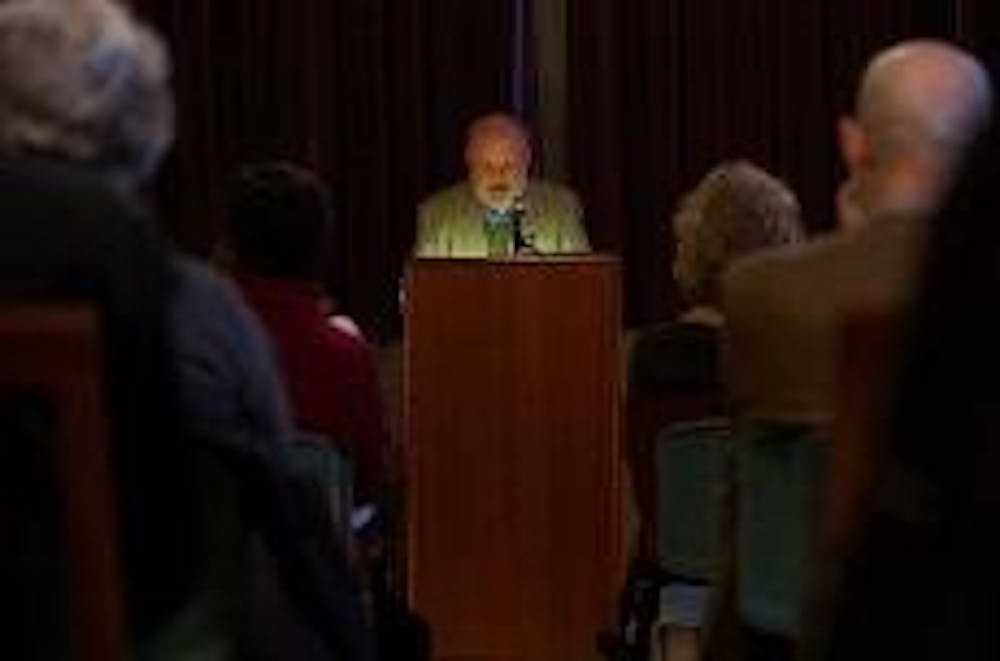
Leonard Barkan transported a crowd of 30 gathered for a Penn Humanities Forum event yesterday evening to Italy during a reading of his book, Satyr Square. His recent travelogue, published last October, evolved from what he deemed his "love affair with culture" - a yearlong sabbatical in Italy.
After a welcome from Forum Director Wendy Steiner and an introduction by English Department Associate Chairwoman Margreta de Grazia, Barkan detailed his experience as foreigner learning from the many people he met while abroad.
Barkan, a comparative-literature professor and director of the Society of Fellows at Princeton University, admitted he "knew not a living soul in Rome" when he arrived but had over 50 close friends to invite to his farewell dinner a year later.
The road to acceptance, however, was not so easy.
Despite authoring four books about Renaissance literature, no amount of artistic knowledge prepared Barkan for Italian society.
His knowledge of German and French gave him only a rudimentary understanding of the Italian language and caused both humorous mix-ups - such as calling his father "monkey" when he intended to say "chemist" - and friendship-ending blunders.
Lamenting that "I didn't have the undertones or subtleties" of the language, Barkan recalled having to apologetically tell his friend that he did not have enough food for his wife to join them for dinner by crudely saying, "No-she-can-not-come."
Through such anecdotes, Barkan described the laborious process of making friends, one that was made much more interesting once he joined a wine-tasting group affectionately referred to as the "Communist Gourmet Club."
Reiterating the multifaceted nature of his stay in Italy, Barkan said that he "realized that the encounters at Satyr Square were not only academic or erotic, but also gastronomic."
Barkan added that only after living in Satyr Square for a year did he realize how what he knew beforehand was "a little bit true - a little bit fabricated - but it [was] mostly the attempt to understand a culture I was hardly born into."
Only through his experiences in Italy could Barkan realize the importance of tolerance and how little he really knew about the nuances of a foreign culture.
Professor Wendy Steiner lauded Barkan's international approach, saying that "it's wonderful to see academics branch out, treating their expertise as part of their lives."
The reading was part a yearlong series exploring the theme of travel, promoted by the Penn Humanities Forum. Every year since 1999, Penn Humanities Forum has chosen a different theme to spark cultural conversation and discussion of the human experience.

