

Women earn well over half of all bachelor's degrees every year, and one researcher is attempting to find out why.
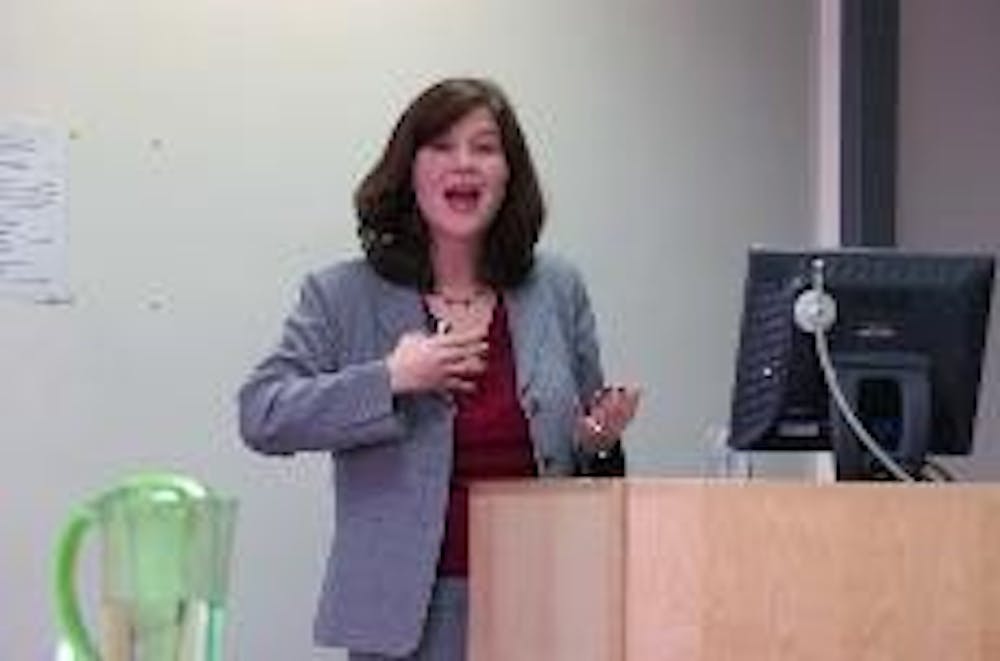
Yesterday afternoon, before an audience of 40 people in the McNeil building, Claudia Buchmann discussed her recent paper - published in the American Sociological Review - in which she analyzes the resources and incentives that have put women in a favorable educational position.
Buchmann, a professor in the Ohio State University sociology department, spoke about the "shifting and complex" issue of gender inequalities in higher education.
Over the past decade, Buchmann explained, a role reversal has taken place in college education. Today, women make up over half of college attendees and constitute 58 percent of bachelor's degree recipients.
Having worked with the National Education Longitudinal Study from 1988 to 2000, Buchmann said that "women's superior academic performance explains a large portion of the gender gap in college completion."
She added that women are increasingly achieving better grades and are graduating in higher numbers, a trend of superior achievement that can be seen as early as grade school.
Buchmann said it is unclear exactly why women are outperforming men.
She suggested incentives such as higher wages would encourage women to complete a four-year college program.
Other socioeconomic factors, like the sex of elementary-school teachers or the absence of fathers in single-parent households, could also have an influence on the gender gap, Buchmann said, but the research at this time is inconclusive.
Buchmann is particularly interested in how gender gaps differ among various racial groups - especially the gap favoring black women over black men.
Economics graduate student Dionissi Aliprantis was also intrigued by the racial discrepancies. Appreciating the wide range of possible causes and results of women's success in post-secondary education, Aliprantis said that "it is very much a puzzle as to why women are doing better."
Buchmann's speech was part of Penn's Population Studies Center Spring Colloquium Series.

