

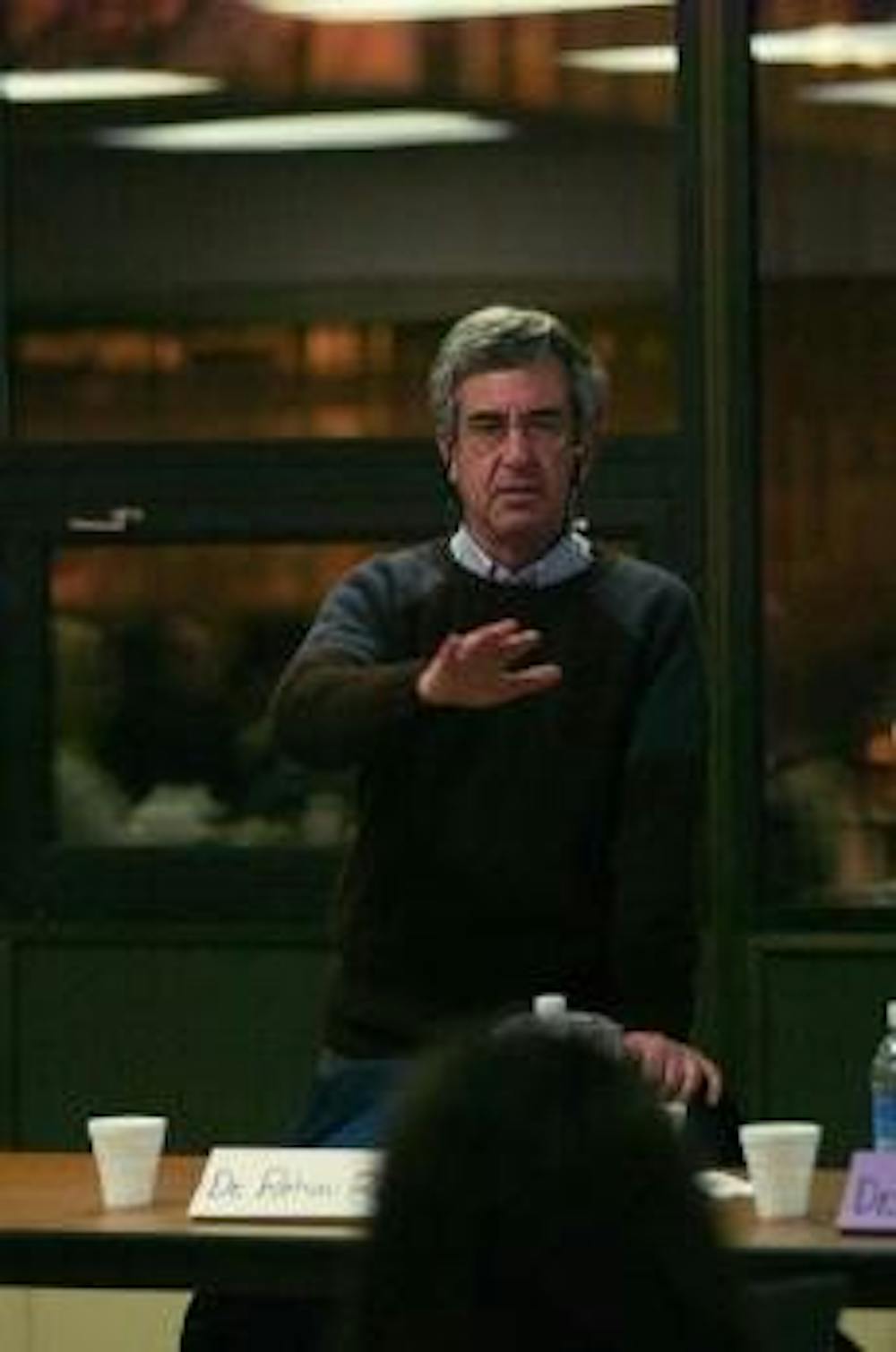
After feasting on falafel, 40-some audience members sat down with satiated stomachs and open minds to listen to a discussion entitled "Jerusalem: One City, Three Religions" last night at the Penn Newman Center.
Panelists included visiting scholars David Johnston and Rehav Rubin, as well as Religious Studies professor Guy Stroumsa.
The speakers covered the historical, cultural and religious significance of Jerusalem to Islam, Judaism and Christianity, as part of an attempt to foster inter-faith communication on campus.
Rubin, a Geography professor at Hebrew University, spoke from the viewpoint of a geographer and historian.
He traced the origin of Jerusalem as a prominent religious center to each of the monotheistic faiths and displayed several slides of Jerusalem's landscape that showed the geographic proximity between the Church of the Holy Sepulchre, the Wailing Wall and the Dome of the Rock - three key sites in each religion. He showed the rivalry through the skyline of the city.
"The competition is visible. It's a living thing," Rubin said.
Stroumsa, who teaches comparative religion at Hebrew University, addressed the Christian relationship with Jerusalem.
"One can argue that Jerusalem has no real place in Christianity, that the real Jerusalem is the heavenly Jerusalem. But we see it in the liturgy, memory, Gospels, Old Testament and practice of pilgrimage. . Religion is not only beliefs - it is also culture and history," he said.
He emphasized the current predicament of Christians in Jerusalem, lamenting that, in the midst of the Arab-Israeli conflict, there is very little place for them in its future.
"I would prefer to live in a pluralistic society rather than a monolithic" one, he declared. "It's easier to live in tolerance when the spectrum of religion is broader."
Johnston, a Christian theologian who specializes in Islamic studies, provided the Muslim view of Jerusalem. He traced the first biblical reference of Jerusalem to Malki-Tzedek, the "King of Justice," and noted the irony that this city intended for peace and justice has become a hotbed of religious and political tension.
"Our hope and prayer is that Jerusalem really will be the city of peace" he concluded, receiving applause from the audience.
"It's cool that we have all these groups who don't usually work together. . This was such a perfect venue," said College sophomore Miguel Garces.
"Bringing together different religious groups on campus sparks educational and provocative discussion, yet also helps form friendships," said Aviva Halperin of Hillel House.

