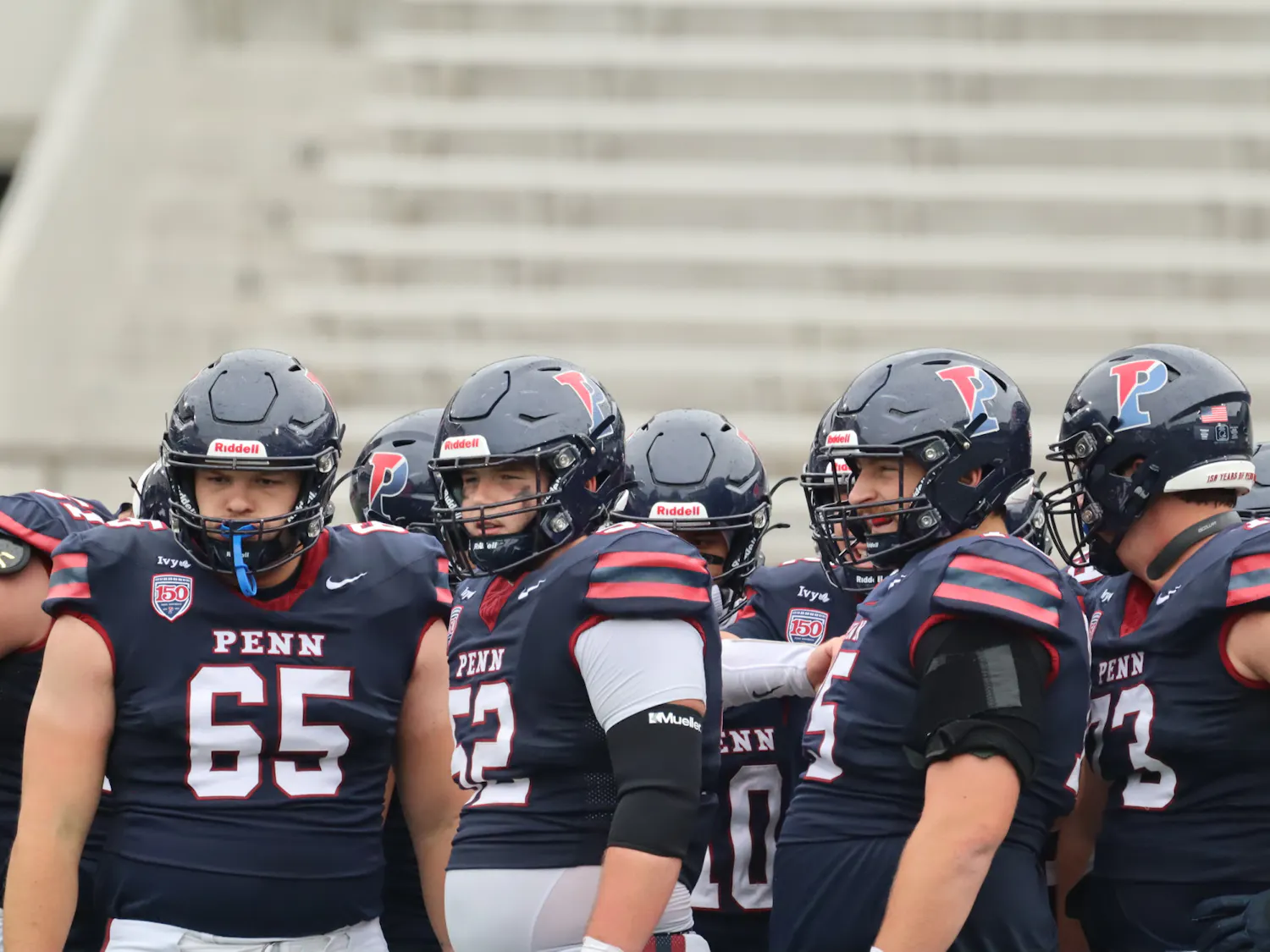
For the first 48 minutes, 40 seconds of Saturday's 34-31 overtime victory against Yale, Penn's pass defense appeared to be as stingy and impregnable as usual.
The Quakers, leading 31-10, had held Yale quarterback Alvin Cowan to 15 completions on 22 attempts for just 126 yards with two interceptions and no touchdowns -- commendable numbers against a player who threw for 421 yards last weekend against No. 16 Colgate. Behind this defense, Penn took a 31-10 lead.
But then, things fell apart -- rapidly
Mounting a precision, medium-range passing onslaught underneath the Penn secondary, Cowan completed 17 of 25 passes for 157 yards on three drives in the last 11 minutes and 20 seconds -- all culminating in touchdown passes.
Cowan methodically abused Penn's defensive backs, who seemed to be unsure where the ball or Yale's receivers were.
The secondary's softness in its nickel-and-dime packages in the fourth quarter and the coaches' failure to make a strategic change to defend medium-range passing nearly cost the Quakers the game, and potentially, a second consecutive Ivy League championship.
Penn coach Al Bagnoli attributed the defensive debacle not only to poor coverage, but also to Cowan's ability to make plays and Penn's inability to pressure him.
"It's a combination," he said.
"We're probably not playing coverage as well as we need to play. They're throwing the ball pretty well and on time and protecting OK."
Despite the several factors Bagnoli mentioned, Penn's defensive backs did not appear to play with their usual toughness in the fourth quarter and should not be let off the hook.
Injuries during the game to cornerbacks Duvol Thompson -- who had a first-half interception -- and Pat McManus impacted Penn's ability to defend the pass.
Cowan found it easier to pick apart an inexperienced Penn secondary, which of course was a calculated decision from the Elis sideline.
Yale coach Jack Siedlecki admitted this.
"I think they had some kids hurt," he said. "We went after a couple of kids pretty consistently.
"We were throwing the ball underneath and taking what they were giving us. They just weren't going to let us throw it over their heads. We blocked our tails off up front and gave him enough time to throw it."
If Penn had forced Cowan to make some riskier passes downfield rather than conceding numerous 7- to 8-yard passes, it may have halted the Yale offensive attack before it gained such momentum.
What's more, the No. 13 ranked team with the reputed best defense in the league needs to be able to count on its bench when someone goes down.
Admittedly, the inexperienced players were not the only people getting burned. The entire secondary was.
If the Quakers were not going to blitz -- which they seldom did in the fourth -- then a strategic defensive adjustment was obviously necessary to combat Cowan's precision passing.
But ostensibly, that change never came.
Penn's defensive line deserves some blame for failing to penetrate Yale's blockers and put pressure on Cowan.
Ryan Strahlendorff had Penn's only sack on the day, and Cowan usually had more than enough time to find the open man.
Ultimately, however, Penn's coverage was not up to its usual standard, and the coaches failed to adapt to Yale's pass-heavy offensive strategy in fourth quarter.
As Siedlecki said, Yale was merely taking what Penn gave it -- the 7-, 8- and 9-yard passes that keep drives going and Yale on the field.
On Yale's final 83-yard drive which tied the game, all but one of Cowan's 11 completions -- a 1-yard flip to tight end Nate Lawrie to avoid a sack -- were between 5 and 12 yards.
After Yale's first two scores of the fourth quarter, which cut the lead to 31-24, Penn should not have continued to concede medium-range passing yardage.
Why the coaches did not make an effective defensive change -- either personnel or strategic -- is perplexing.
Did Cowan find a vulnerable area in Penn's otherwise staunch defense or was it just a fluke of injuries and momentum?
In order to stay atop the Ivy League, the Penn coaches need to determine what went wrong in the fourth quarter and what adjustments should have been made to contain Yale's tremendous passing success.
Surely, future opponents will attempt to replicate Yale's impressive fourth quarter dismantling of Penn's defense -- the most dramatic defensive breakdown Penn has suffered this season.
Coaches and defensive backs must respond to the challenge.