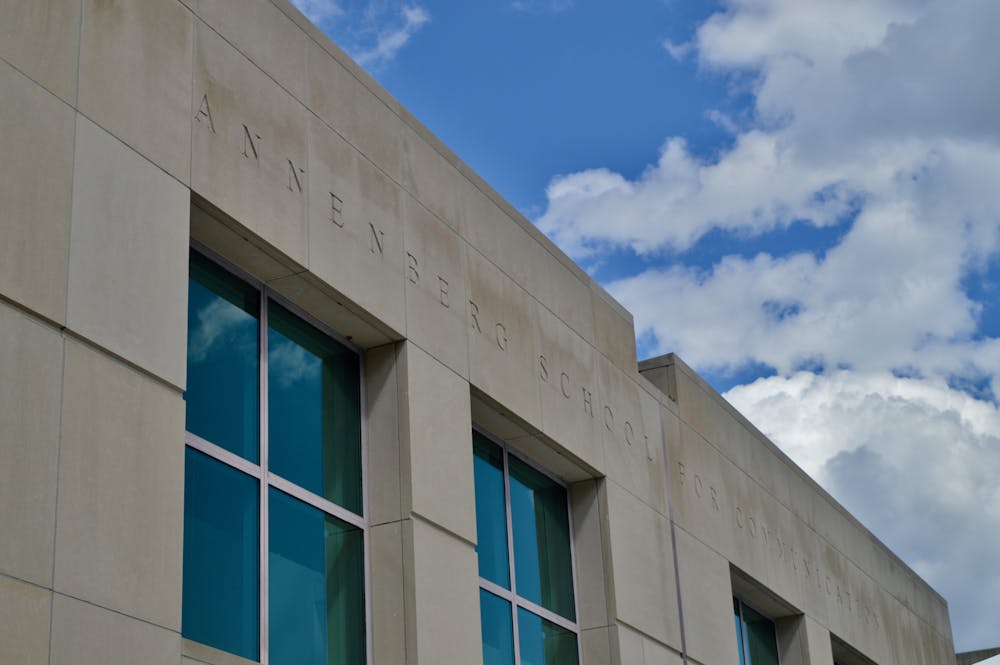
The Center for Media at Risk will close its doors on June 30 after eight years at the Annenberg School for Communication.
Established in 2018 as a response to an increasingly hostile climate for journalism under President Donald Trump’s first presidency, the center has served as a forum for discussing the challenges media practitioners face. Its closure comes as founder and director Barbie Zelizer retires from the Annenberg School.
In an interview with The Daily Pennsylvanian, Zelizer that her decision to retire evolved so quickly that there “wasn’t time” to find another director for the center.
She announced the center’s imminent closure in a June 2 email from the Center for Media at Risk’s newsletter. In the time since, Zelizer said, she has received an “unbelievable” amount of emails back.
“I don’t think I realized, quite honestly, how much people had been paying attention, how much people cared about the center, and how much people recognized that it really was one of a kind,” she said.
Annenberg School Dean Sarah Banet-Weiser told the DP that there “wasn’t even really a question” that the center would close because “it doesn’t really make sense to us to have a Center for Media at Risk without Barbie.”
“She’s an incredible force at Annenberg,” Banet-Weiser said. “This center has really solidified the role of critical journalism, and the responsibility that we all have at Annenberg to think about things like suppression of the press and journalists at risk.”
Banet-Weiser clarified that the Annenberg School had never outright declined a request to find a new director, but that it “seemed like a natural evolution of the center to sunset along with Barbie’s retirement.”
RELATED:
Center for Media at Risk hosts talk on self-censorship, harassment in media
Annenberg School launches strategic vision to ‘tell the story’ of communications at Penn
Center for Media at Risk Program Coordinator Madison Miller told the DP that the center’s website will be archived to “preserve” all of the research. Miller received a master’s degree from the School of Arts and Sciences in 2026.
Zelizer — who is also the Raymond Williams Professor of Communication — has taught at Penn since 1997. She said that sunsetting the Center for Media at Risk was her “biggest regret.”
“Professors retire, that happens, but you usually sunset a center when the work is done, when there’s an obvious time for a pause,” she said, adding that the center’s work “is just ongoing — and if anything, it’s certainly deepening.”
“It’s the thing I feel the worst about leaving behind,” Zelizer told the DP.
Zelizer said that she founded the center in 2018 following the “enormous” and “immediate” threat of Trump’s election.
“It needed people to be organizing in whatever fashion they could,” she said. “As a former journalist, I figured that was the best way that I could organize.”
Trump graduated from the Wharton School in 1968 with a Bachelor of Science in economics.
When creating the center, Zelizer said she was “interested in keeping the people — the individuals who practice the media — in the conversation,” explaining that “we’re not just dealing with an industrial structure, or an organizational logic, we’re dealing with actual people who have an actual craft.”
Banet-Weiser said that Zelizer was the “exact person to lead, to conceive of, and create the center,” particularly as journalists “around the world” were facing threats to their wellbeing.
“A center that called out media at risk came at the right moment to get us all thinking really intentionally about what it is that media practitioners, academics, journalists, can do to combat this increasing persecution of journalists, whether or not that’s with death threats or silencing them in other ways,” Banet-Weiser said.
“When you start thinking about the logic of industries, you forget that there are people — there are able-bodied individuals who have to kind of embody that structure,” Zelizer said. “We forget what it does to them.”
Each year, the center hosts visiting faculty. Last fall, Center for Media at Risk visiting practitioner and The Guardian columnist Arwa Mahdawi led a talk on her experiences while working as a journalist.
Anjali DasSarma — an incoming fifth-year graduate student at the Annenberg School and one of Zelizer’s advisees — told the DP that Zelizer was a “big proponent of bringing practitioners into the academic space.”
“I think sometimes academics are sort of theorizing about what practice actually looks like and media makers are kind of thinking about what academics are thinking about,” DasSarma said. “She actually brought everyone into the same room, which was a great opportunity for us all to learn from each other.”
DasSarma worked to plan the Center for Media at Risk’s annual December symposiums while also contributing to the center’s podcasts.
Banet-Weiser said that the center “involved doctoral students in a truly impressive way.”
“So much of the center’s daily activities were student-driven,” she added. “I think that that is really a testimony of how the center was not just about research on journalism and research on media, but about involving our own graduate students in that research.”
Zelizer said she had wanted the center “to be run by students.”
“I was trying to figure out a way for them to do a public-facing activity that would both answer their intellectual, political, moral needs, at the same time as it taught them a skill,” she said.
Muira McCammon, now an assistant Communication professor at Tulane University, was a graduate student at Penn when the Center for Media at Risk launched and served on its steering committee. She told the DP that a “major takeaway” of her time at the center was that “in sharing knowledge and networks, we offer each other something more valuable than any scholarly output — and that’s solidarity.”
She described the center’s events as involving “not only a kind of spirited debate but also real thoughtful engagement with both theory and practice,” adding that “it’s really hard to pull that off in academia.”
Washington State University assistant Journalism and Media professor Jennifer Henrichsen worked on the center’s steering committee while completing her graduate education from the Annenberg School. She told the DP that “aspects of the center’s work will remain alive” through Zelizer’s mentees.
“Her advisees who do work in these spaces, the people that she’s inspired in these spaces, her relationships and network of folks — all these people are still continuing on and committed to continuing to work forward,” Henrichsen said.
After graduating from Annenberg in 2021, Henrichsen returned to the center in 2024 as an alumni affiliate.
Despite sunsetting the center, Zelizer said that the work of helping journalists at risk continues.
“Where is the industry going?” she asked. “It’s not going where it needs to go, and it’s not going anywhere fast enough.”
Still, Zelizer expressed hope that students could “carry this forward.”
“Each and every one of them is doing their version of some kind of intervention like this,” she said.
Banet-Weiser similarly argued that the “idea that journalists and journalism are in crisis continues.”
“I wish that the sunsetting of the center meant that journalists or media practitioners were no longer at risk,” she said. “Of course, that’s not the case.”
RELATED:
Center for Media at Risk hosts talk on self-censorship, harassment in media
Annenberg School launches strategic vision to ‘tell the story’ of communications at Penn
Senior reporter Arti Jain leads politics reporting and can be reached at jain@thedp.com. At Penn, she studies economics and political science. Follow her on X @arti_jain_.