“Family” is the buzzword among sports teams, but how is it actually realized?
In a place that, according to junior forward Augustus Gerhart, is “pretty volatile,” how do college athletic teams create a family when each player stays for four or five years at the max and often less in the world of NIL and transfer portal?
And what happens to Penn men’s basketball family when head coach Steve Donahue, who led the program for the past 10 years and his entire coaching staff leave?
“My first instinct was like, ‘Dang,’” junior guard/forward Niklas Polonowski said, “We had so [much] blood, sweat, and tears shed together.”
Many on the team echoed similar sentiments of shock and the strange feeling of loss.
It’s a jarring reminder of the volatility that is college athletics, a jarring reminder that while it’s hard to build a family, it’s even harder to keep it. Head coach Fran McCaffery and his staff were well aware of this when they took over the program this past spring. That’s why their first priority was getting to know the guys.
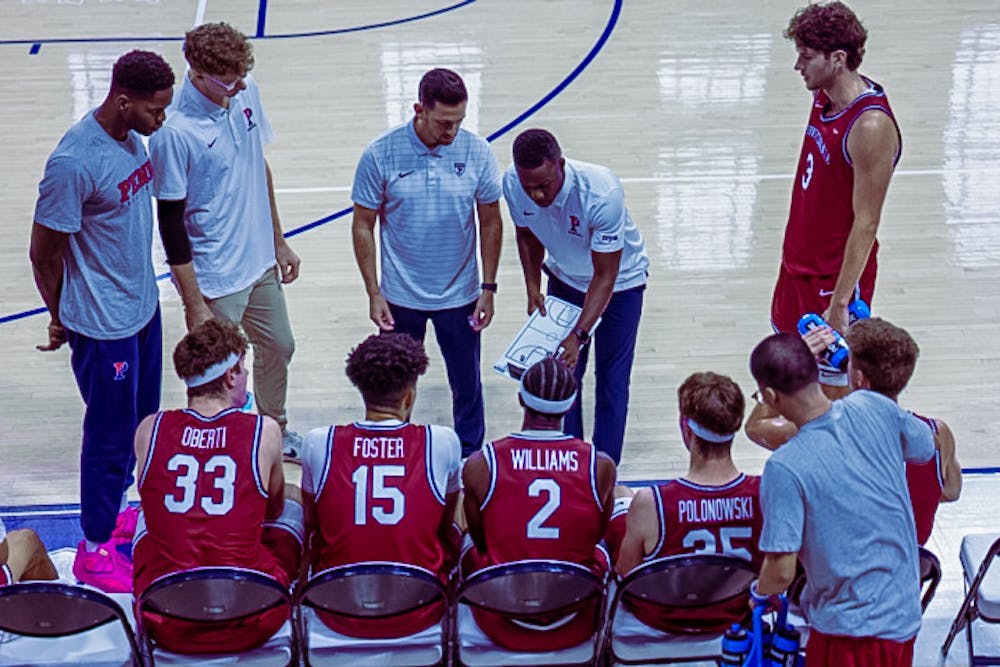
The staff wanted to create a “family environment,” according to assistant coach Tristan Spurlock, that all three assistant coaches already had with McCaffery.
Assistant coach Ronald Moore played for McCaffery during his four years at Siena College, and the two kept in touch in the following years, with McCaffery even attending Moore’s wedding. When McCaffery asked him to join his coaching staff, Moore called it a “no-brainer” and a “match made in heaven.”
“Him reaching out was something that was expected without saying so,” Moore said, “He’s always been trying to get me to coach since I stopped playing.”
Spurlock followed McCaffery from Iowa to Penn, and the Washington native had wanted to come back to the East Coast. “Me and Coach [McCaffery] are like family … he’s one of the best,” he said.
Assistant coach Ben Luber first met McCaffery when he was in high school, and McCaffery later acted as his mentor in coaching.
Now, these four coaches unite at Penn, and they’ve hit the ground running.
“They’re not going to come in here and have a couple seasons of transition,” Polonowski said, “We’re winning the Ivy’s this year. We wanna get to it.”
Sophomore guard AJ Levine noticed the difference in mindset between this year and last right away.
“Some people had individual goals, and coaches had goals. It wasn’t a collective unit,” Levine said of last year’s season, before continuing, “That’s the thing that Fran preaches is that we’re all in on this together. We’re not going to go win an Ivy chip unless we’re all in on that.”
“We look at each other in the eyes and tell each other the truth,” coach Luber said, “I think that’s a foundation in Fran’s program. We honor one another by telling each other the truth. We’re not gonna sugarcoat it.”
Levine has appreciated this direct communication. “I learn very directly and very quickly, and I just want people to tell me what I need to do better, and I will apply it,” he said.
Expectations, whether that be aggressiveness from senior guard Cam Thrower or pushing the pace and scoring within three or four seconds of inbounding, are communicated clearly and practiced concretely.
“Learning from either mistakes or from things that they’ve taught is the biggest thing that they want,” Thrower said.
But honesty and direct communication only work on a basis of trust.
“If I’m getting on [someone], it’s coming from a place of love,” coach Spurlock said.
‘My mentor’
From the beginning, the assistant coaches have made it a point to build a relationship with the team. Without off-court relationships, success is elusive, according to Moore.
Senior guard Dylan Williams found a mentor in Moore, with their shared position and similar build. This is not to mention Moore’s prolific college and professional basketball career, inspired Williams to practice one-on-one with Moore before or after practice twice a week. It began organically; Williams felt comfortable enough to text Moore to workout before practice, and the coach was always willing and available, no matter how early it was.
That comfort is something everyone on the team feels.
“I’ve never in my life had a relationship with coaches like I do now,” Levine said, “I’m going to hang out in the coaches’ office just to talk to them. … It doesn’t feel like a coach-player relationship. It feels like someone that’s my mentor.”
Levine, freshman guard Ryan Altman, special advisor to McCaffrey Michael Fink, and assistant coach Ben Luber all celebrated Rosh Hashanah together this year, which Levine said he never imagined doing with his teammates. But he is learning what McCaffery’s staff is emphasizing. It’s not a team; it’s a family.
Luber’s father is Jewish, but his mother is Catholic and he was raised Catholic, like senior guard and forward Ethan Roberts. Roberts and Luber bonded over their shared faith and even attend St. Agnes together on occasion.
It’s never just about basketball, and their relationships aren’t just for the courts. Spurlock keeps his phone open, calling players even when he’s grocery shopping, talking after practice about life and joking together.
“One thing I want them to always say about me is, ‘Man, Coach Spur never lied to me,” he said, “I know he always cared about me, always loved me.”
“We’re here to help them not only just be basketball [players], but to help them be young men,” Moore added.
Gerhart also appreciates the coaches’ trust in him.
“They give you freedom to mess up in class, to mess up on the court, to mess up in life a little bit,” he said, “I’ll make a bad read [in a game, but] I don’t get pulled out right away … [the coaches are] always saying like, ‘He’s a big boy, he can make his own decisions, he can make plays for himself.’”
That is exactly what McCaffery and his staff want.
“[We let] guys kind of make their own decisions within the kind of ideas that we want to do,” coach Moore said, “I think Donahue was more of a slower-pace style of play, [whereas] we’re fast paced and getting up and down.”
With the new coaching staff, change is already happening. McCaffery is emphasizing speed, pace, and conditioning. So the team has been doing a lot of running in practice, which, according to Gerhart, has been “competitive pretty much from the jump.”
“I was not in this shape last year, I’ll tell you that,” Levine added, “We’re able to play live and correct things on the go a little quicker and implement them very quickly.”
There’s been more film-watching. A different style of communication.
This is what the team was hoping for, or “probably better,” Williams said, “We think a lot of good things are gonna happen.”
‘New era’
Soon after Donahue and his staff left Penn, there was some uncertainty amongst the team members who stayed behind. When the team cautiously discussed who could potentially take over, no one predicted that McCaffrey would take the reins.
“Fran almost seemed like a little bit of a stretch at the time. And we were like, ‘Ah, no way he’d come here,’” Polonowski said.
Yet McCaffery came, bringing along coaches Luber, Moore, Spurlock, and special advisor Michael Fink, a new position in the staff and whom Gerhart said is “a really good friend and a great voice in the sidelines.”
But the excitement was tempered with some hesitancy.
“I’ve seen [McCaffery] screaming a little bit,” Polonowski said with a smile, “So I didn’t know if he was going to be hard on us like that.” There was also a bit of nerves about having to start all over again.
“I’m going to have to work twice as hard to get the minutes that I want,” Polonowski added, “I was nervous, but I knew that everybody else was nervous as well.”
No one knew what to expect. And that’s what made this year especially strange for the returning teammates.
“One of the weirdest things this year is not having an older voice or a senior who kind of knows what’s going on … we don’t know what next practice looks like or we don’t know how prep for the first game is gonna look like,” Polonowski said, “That’s been a cool transition, because we’ve seen different guys step up in different roles.”
He pointed to Gerhart as “one of the biggest reasons why we’ve had such a successful off-season so far … I think he’s ... [worked] extra hard to try and make sure that the other guys are comfortable.”
While the coaching staff came to fill in the hole that Donahue and his staff left, Gerhart and his returning teammates are trying to fill in the holes left by former forward/center Nick Spinoso and former guard and leading conference scorer Sam Brown.
That’s the tricky thing about college basketball and family. People come and go with graduations, transfers, and new jobs. This year, Penn men’s basketball experienced larger changes than usual, and while that was not easy, they are excited for what lies ahead.
According to coach Spurlock, “It’s definitely a new era and a very exciting one.”