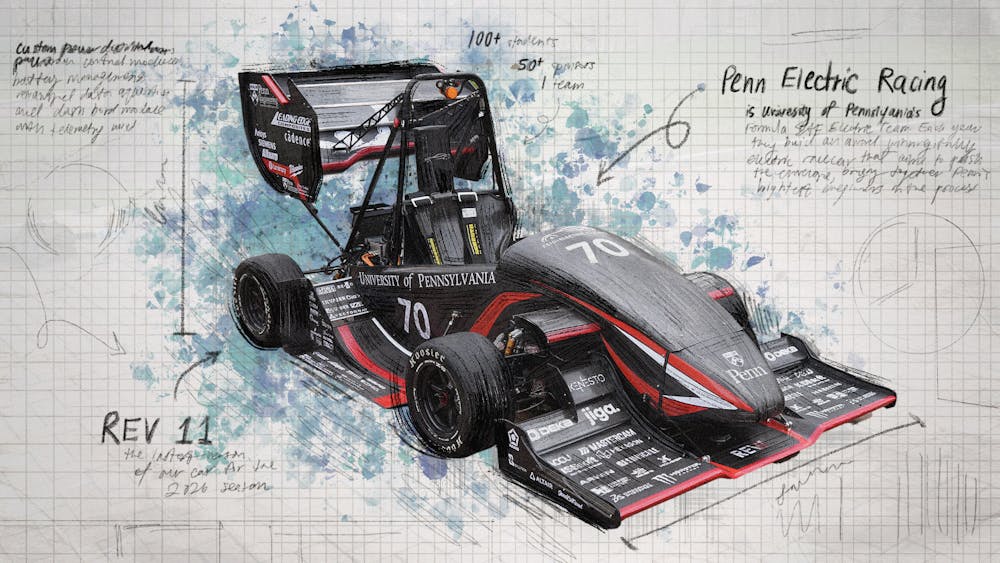
It was a historical night for Penn Electric Racing.
At 11 p.m. on Feb. 14 in University City, in the basement of the Towne Building, a few Penn Electric Racing members stayed late to put the finishing touches on their newest car. Among them were Engineering juniors Joshua Chen and Jason Mathew, co-leads of the mechanical team, who carefully lifted it off the jacks and bounced it to test the suspension. After giving it one last bounce, they stepped back. For the first time, REV11 rested fully on its wheels, completing what was the fastest build in team history — finishing 72 days ahead of schedule.
“Honestly, it was very surreal,” Chen said. “Seeing the car on the ground is very surreal. It’s honestly a great experience.”
“This is the most tested, the most validated car yet of Penn Electric Racing,” College and Engineering sophomore and operations lead Arjun Sharma said.
Following last year’s results at the Formula SAE Electric competition, including a first-place finish in cost efficiency among 80 teams, the group has been back at it to prepare for the upcoming competition in Brooklyn, Mich., in June. For eight months, members designed and manufactured the components of the car, and put together circuit boards and wrote software to build the electric systems.
Unveiled on March 27 and just under 430 lbs., REV11 is the lightest car the club has ever built. With a 0-to-60 mph time of 2.6 seconds, it runs faster than a Porsche 911 and will enter the competition as one of the lightest and fastest vehicles. By June, the car will have logged 150 miles, more than double the mileage of any previous team car.
Over the years, Penn Electric Racing has racked up 41 trophies and 11 cars — each version called REV for “Revision” — and boasts over 123 members from across all schools except the School of Nursing. And though this year the team built an improved car in record time, Sharma is quick to note that “REV11 would not be possible without the innovation that previous years at Penn have done. … We started with a very rudimentary software base back in the day and then now we’re basically making a Tesla.”
“I’ll walk through Towne first floor, and I can literally see on the walls of Towne that there’s murals of PER,” he continued, “So walking in a building that has already reflected the club’s legacy and working to collaborate and create something new and inspiring has been something that’s been super cool for not only me but the entire team.”
RELATED:
Penn Electric Racing unveils 2025 car at College Green event
Penn Electric Racing reveals fully electric vehicle in its tenth year of competition
Last fall, if you strolled down Locust Walk during the Student Allocations Commission fair, it would take five seconds to spot a race car parked on the lawn. Though the team kicked off its season back in June and already started designing over the summer, the recruitment cycle in August defined one of the most crucial aspects of the season.
The rookies in the club mostly consist of incoming freshmen, sometimes sophomores, who join the team to build a fully electric race car. They are split into three subteams: operations, mechanical, and electrical, with the latter two being the largest. The mechanical team builds the car’s musculoskeletal system to give structure and movement, while the electrical team controls the car’s nervous system by wiring sensors and controlling the battery to power the car.
“Mechanical can get the wheels on the ground,” Sharma says. “But electrical actually gets the wheel spinning.” As for his team of operations, Sharma handles the business and cost scenario events in competitions, procuring materials, and the team’s media.
Over the season, the team faced challenges with custom-printed circuit boards. The circuit boards are essential to the race car and help manage its battery and distribute power.
“We always run into a ton of issues,” Engineering junior and hardware co-lead Oscar Qu said. He worked closely with rookies in the computer lab and guided them through the process of designing circuits. Approaching his third year with the club, he knows it is common for mistakes to happen. Even so, he remains optimistic about these setbacks, saying that “running into these mistakes allows us to constantly learn and improve from them.”
A key approach this year with the rookies in the electrical team has been the “ground-up” mentality. Rather than ordering pre-made materials for the racecar, Qu emphasizes to his team that everything they make must be custom-built.
“The way we do things is everything is completely custom and from the ground up,” he said. “It’s kind of in the nature of this club, not only on the electrical team, but also from software, operations, and mechanical.”
With that, the team has seen improvements not only in the pacing of their work but in the quality as well. “Our weight has dropped significantly,” Sharma said. “Our aerodynamics and our suspension subsystems are working to provide the car with more grip, more traction, and an overall better performance.”
For their next step forward, they are going all out on reliability. The team has been putting REV11 through rigorous trials to evaluate its performance under different conditions. While the new race car has a top speed of 80 mph, they are focused on identifying its weak points and making sure the car is fully functional for the competition in June.
“In the world of electronics, anything that can go wrong, will go wrong,” Qu said.
“The time window from now to June is just really, ‘How can we validate the car?’” Sharma said. “How can we ensure that there’s no failures in our cars, that nothing goes wrong in competition?”
“You can build a car, but that’s only half of the equation,” he continued. “What really takes it to the final stages is testing it and validating it.”
One of the major criteria that the team gets scored on during the Formula SAE Electric competition is the car’s reliability, also known as the “endurance score,” where the car’s robustness and efficiency will be tried through a 22-kilometer driving test that it must complete without stopping or exceeding energy consumption limits. The team didn’t compete in this category last year, but it are ready to take on the challenge this June.
“We’re really looking to max everything out this year,” Chen said.
The team has worked hard and built a community through long nights, dumpling socials, and go-karting to make it happen. But it also dream beyond this summer, hoping to build a four-wheel-drive car next year.
Sharma said, “You can draft these ideas up on paper, but what matters is you need to have a team that’s committed to do that, right? And I think that this year we had a super cool, very motivated group of people, and I’m happy to see that Rev11 is driving.”
Penn Electric Racing doesn’t just want a car that can drive, though. When asked what the team’s goal in June was, Chen didn’t hesitate.
“Win.”
Sports Editor Hannah Chang contributed to reporting.