

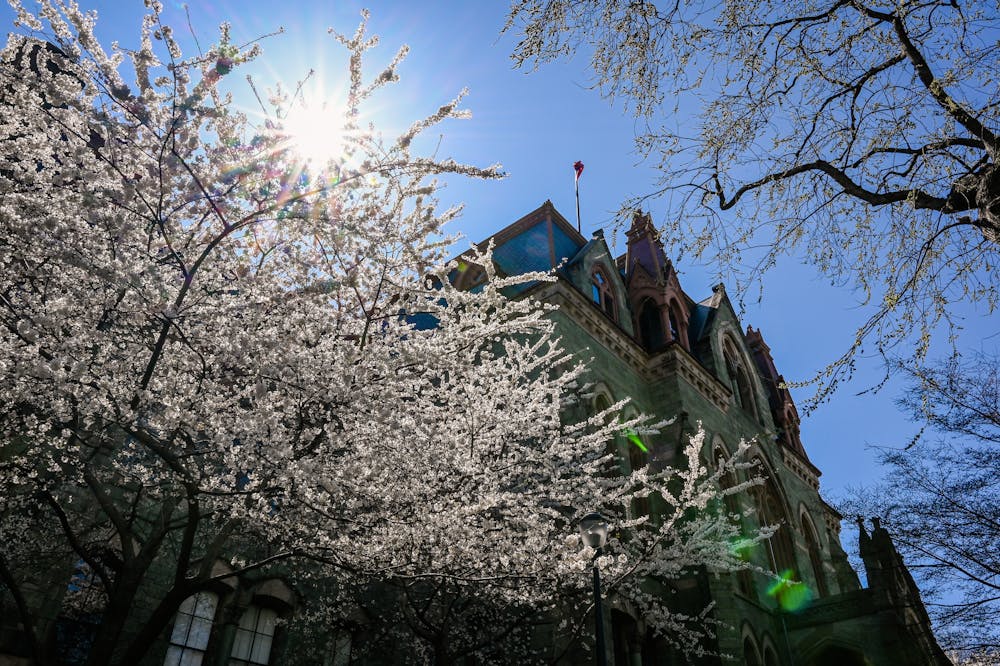
The history of the roughly 200 cherry trees scattered across Penn’s campus stretches back more than a century.
Many of Philadelphia’s first cherry blossoms — now an unmistakable sign of springtime — trace their origins to a 1926 gift from the Japanese government in honor of the nation’s 150th birthday. Ever since, Penn and the city have continued to celebrate these trees with yearly festivals and traditions.
This year’s Subaru Cherry Blossom Festival — which took place from March 28-29 — was attended by Philadelphia Mayor and 2016 Fels Institute of Government graduate Cherelle Parker. In a statement to The Daily Pennsylvanian, a spokesperson for Parker described cherry trees as “a beautiful, global symbol of friendship and goodwill.”
“Since 1994, the Japan America Society of Greater Philadelphia has planted more than 1,000 cherry trees across Fairmount Park, creating spaces where everyone can pause, reflect and connect,” the spokesperson wrote, adding that 250 more trees will be planted across the city this year.
According to Michael Dunn — associate director of urban forestry at Penn’s Morris Arboretum — the original species introduced to the United States from Japan was prunus sargentii, or the North Japanese Hill Cherry.
“There are native cherries in North America, but the ones that we think about when we think of cherry blossom festivals are all from Japan,” Dunn told the DP.
Some of the earliest known Japanese cherry blossoms to arrive in the U.S. were sent by physician William Bigelow and botanist Charles Sargent to the Morris Arboretum in the 1890s, arriving well before the gifts from the Japanese government in the 1900s.
According to the University’s Landscape Planner Chloe Cerwinka, additional cherry blossoms were added to Penn’s Landscape Development Plan in the late 1970s to complement the installation of Blanche Levy Park — now known as College Green.
RELATED:
Morris Arboretum plant science director discusses biodiversity crisis in DP interview
Philadelphia Mayor Cherelle Parker’s new budget introduces tax proposals, student loan services
In a statement to the DP, Cerwinka said that Penn’s landscape planning team has planted even more cultivars in the last decade, including the Helen Taft cherry and the Gyoiko cherry.
Dunn estimated that — among the roughly 5,900 total trees at Penn — there are over 200 cherry trees on campus. Locations of trees are available through Penn Facilities and Real Estate Services' newly launched web experience, the Plant Explorer Map.
The map includes a built-in “cherry tour,” which shows the locations of all the cherry trees on campus. As of publication, the map currently shows 62 cherry trees in bloom.
University Landscape Architect Brent Lewis wrote to the DP that while Penn typically prioritizes planting diverse native trees, they also plant certain non-native, non-invasive species that are “resilient and beneficial to campus.”
“The Japanese cherry trees fit this description as they bring a delicate beauty to our campus, each and every spring,” Lewis wrote. “Plus, they do so without creating any imbalances in our local and regional ecosystems.”
According to Dunn, cherry blossoms are one of the earliest trees to flower in the spring season. He explained that temperature fluctuations in early spring — such as those that occurred this year — can lead to a “muted flowering period.”
“If it gets warm fast and then gets cold again, we might lose significant flowering period, which is unfortunate,” Dunn said. “But they are fairly well suited to climate change.”
RELATED:
Morris Arboretum plant science director discusses biodiversity crisis in DP interview
Philadelphia Mayor Cherelle Parker’s new budget introduces tax proposals, student loan services
Senior reporter Norah Findley leads coverage of science and health and can be reached at findley@thedp.com. At Penn, she studies environmental studies. Follow her on X @NorahFindley_.


