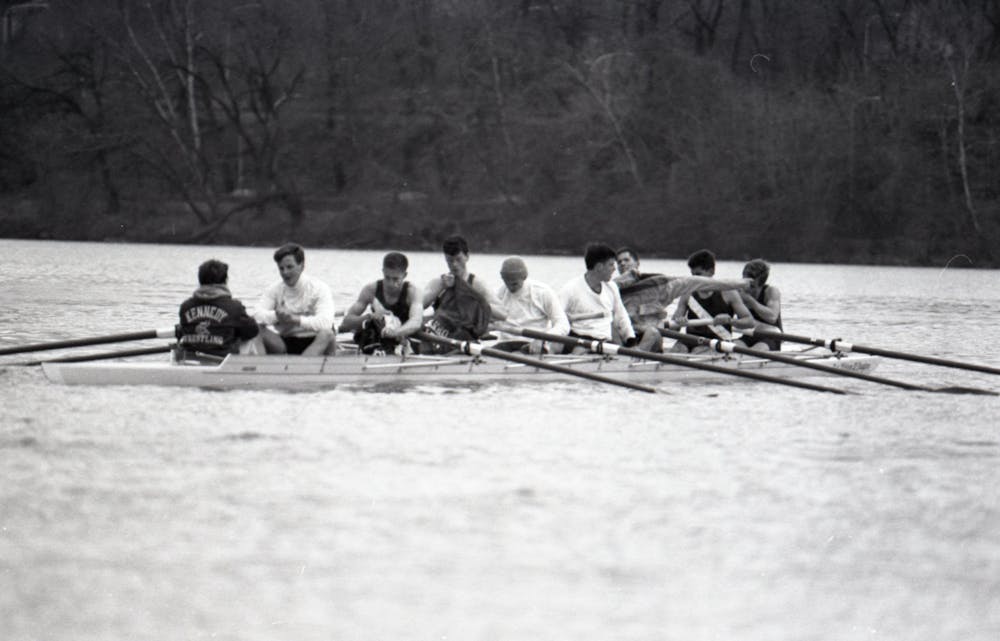
In 1879, Penn had just moved its campus to West Philadelphia. The Wharton School didn’t exist. The entire University had less than 1,000 students. But on the Schuylkill River, Penn men’s heavyweight rowing team was lining up for its first intercollegiate race, facing off against Princeton and Columbia for the Childs Cup.
Penn would go on to win that race, a fitting start for a team that quickly became a major rowing power.
In the late 19th and early 20th centuries, “American rowing was starting to come into its own, and Penn was at the forefront of that,” Penn heavyweight rowing coach Al Monte said.
Under first rowing coach Ellis Ward, Penn won three straight Intercollegiate Rowing Association national championships between 1898 and 1900. The team also represented the United States at the Henley Royal Regatta in England, which is still one of the biggest and most prestigious regattas in the world today.
In 1917, Penn once again conquered a new frontier in rowing.
Then-coach Joseph Wright advocated for a new category to create opportunities for lighter rowers to compete at the collegiate level. Thus, the first lightweight rowing team in the United States was born. The lightweight team quickly developed into a dominant force, losing only one race from 1919 to 1928.
Its success was by no means short-lived, as the team embarked on a 23-race win streak in the early 1950s and later won 26 straight cup races from 1975 to 1978.
Despite its success, lightweight rowing at Penn faced its fair share of challenges.
In 1951, the team was under an existential threat when it was discontinued by the University. However, the crew would not give up so easily. 14 lightweight rowers persuaded the administration to reverse their decision and headed for the Eastern Association of Rowing Colleges Championships. But the day before their race, tragedy struck when their boat was swamped and damaged in a practice run. An MIT boatman worked all night to fix it, and the next day, Penn won the title. But the success didn’t end there.
RELATED:
Penn softball walks it off to win series against Yale
Penn to host 2027 Ivy Madness at Palestra
The crew subsequently won the Thames Challenge Cup two years in a row, competing against heavyweight teams — an impressive achievement.
Meanwhile, the men’s heavyweight rowers were climbing back to the pinnacle of the sport. In 1955, the men’s eight won the Grand Challenge Cup at Henley, which typically features national — and Olympic — caliber teams.
“That’s kind of the trifecta,” Monte said. “Not only do you have collegiate recognition, you have international [recognition]. They were arguably the fastest crew in the world at the time.” One member of that team, 1957 College graduate Harry Parker, would go on to be one of the winningest coaches in collegiate rowing history, leading the Harvard varsity team for 50 years.
The 1970s ushered in an era of change for Penn rowing, with the introduction of women’s rowing as a varsity sport. Women’s rowing had existed in some capacity at Penn since 1934, when the University offered a class that took place on the Schuylkill. A club team was founded in 1967, and eight years later, after the passing of Title IX, women’s rowing became Penn’s 14th women’s varsity team. The women’s NCAA Division I Rowing Championship was not created until 1998.
The Quakers started with a bang, with the women’s four winning the Eastern Sprints title in 1976 and 1977. Penn quickly rose to prominence, boasting a 50-18 record from 1976 to 1982, most notably going undefeated in the 1980 season under then-captain — and Olympian — Hope Barnes.
Both programs enjoyed significant success throughout the 1980s. On the men’s side, coach Stan Bergman took the helm in 1984, ushering in a new era for the program that saw it win the Eastern Sprints once in 1986 and again in 1991.
“Right off the bat, they were very competitive,” Monte said, “That was a very swift turnaround, particularly at that time in collegiate rowing.”
The 1990s brought more victories: In 1998, the women’s team qualified for the D-I championships for the first time, placing third in the Petite Final. Its success was not limited to the collegiate level. Members of the women’s team would go on to forge an Olympic tradition, culminating in 2004 College and School of Arts and Sciences graduate Susan Francia’s two gold medals in the women’s eight at the 2008 and 2012 Olympics. In total — across all genders and weight classes — Penn rowing has produced dozens of Olympians, including both coaches and athletes, several of them medalists.
However, the new millennium would bring significant challenges for the program. For men’s heavyweight, Bergman retired in 2006, ushering in a more turbulent period for the program.
“I might be the sixth head coach [since 2006],” Monte said. “Just a lot of turnover. I think it was really tough for the program to find traction during that period of time, also at a time when collegiate rowing was changing, becoming more modern. Penn was just a little bit behind the eight ball.”
Penn had historically relied on walk-ons to make up freshman novice crews, whom coaches would then train into varsity rowers. Other collegiate teams also used this strategy, evidenced by the gold medal-winning U.S. men’s eight at the 2004 Olympics, in which six of the eight rowers were college walk-ons. But increased interest in high school rowing, greater international recruiting, and the elimination of freshman teams led to a tightening of the roster, and with that came a changed team dynamic and fewer opportunities for walk-ons.
Despite the challenges to the program, the team’s mission has remained the same.
“[Penn has] a long and proud history and tradition, and our job is to make sure that we’re adding to that in a positive way,” Monte said. “The standards of the program are at the highest level … because it wasn’t a flash in the pan. Penn rowing has been good for generations.”
This is evidenced in the recent success of all three teams.
Men’s lightweight won the 2025 IRA national championship in the varsity four, achieving back-to-back IRA medals for the first time since the 1992 and 1993 seasons. Meanwhile, from 2022 to 2025, the women’s team qualified for the NCAA D-I championships four years in a row, achieving its best-ever finish of the NCAA era in 2022.
Men’s heavyweight won the Clayton W. Chapman Trophy in 2023, awarded to the most improved team in the nation at the IRA championships, and has improved its results consistently since then.
This week, 147 years since the team was founded, the men’s heavyweights will compete for a familiar prize, once again facing off with Princeton and Columbia for the Childs Cup.
Throughout its storied history, Penn rowing has weathered changes to both its program and the sport as a whole. But some things remain constant.