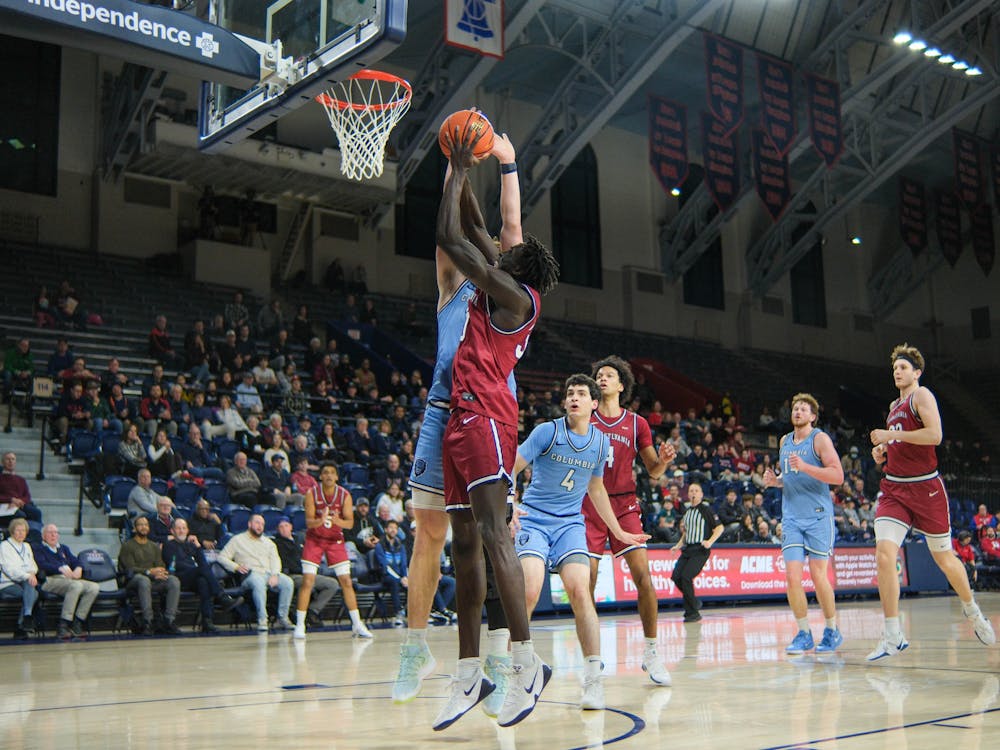
Two weeks ago, Penn men’s basketball went on the road to Cornell and earned a decisive victory that showcased the team’s promising ceiling. Now, three additional wins later, the Quakers look the part of a team that will return to Ithaca, N.Y., for the Ivy League tournament in March.
A 2-0 home weekend that included wins over Columbia and the Big Red has Penn (13-10, 6-4 Ivy) on a four-game win streak, its longest in conference play since 2023. The stretch also has the Quakers in sole possession of third place in the Ancient Eight, putting them firmly in the driver’s seat for a bid to Ivy Madness. Some models have Penn’s tournament chances as high as 93%.
Offensively, Penn saw solid performances from a few familiar faces — senior guard/forward Ethan Roberts had a welcome resurgence, scoring 12 points in the final three minutes. Against Cornell, junior forward TJ Power notched 17 points on 50% shooting.
But the breakout star of the weekend was freshman guard Jay Jones, who scored a career-high 17-point performance against the Big Red that showcased a new degree of offensive polish.
Coach Fran McCaffery sings Jones’s praises nearly every chance he gets, and for good reason — as far as rookie guards go, it’s rare to find one as comfortable dictating the offense as Jones. He’s also unique in his ability to impact the game in multiple ways. At 6-foot-4, Jones is a plus-defender, an impact rebounder for his position (he’s averaged 4.75 boards per game during Penn’s current win streak), and he rarely makes mistakes (one turnover in the last four games).
On Saturday, Jones paired his scoring with his playmaking. While nine of Jones’ points came from the free throw line, Jones’ slashing ability, particularly in the first half, was pivotal for a Quakers offense that shot just 3-of-20 from three. Penn’s general size advantage over the Big Red was a major factor in its ability to generate offense — the Quakers finished the game with 41 attempts from the charity stripe.
Here, Jones’ full skill set was on display. His length and defensive effort helped force a turnover on Cornell’s Cooper Noard, then he pushed into transition, stayed in the air and converted a gnarly and-one lay-in through contact.
“The coaching staff has done a great job of giving me a bunch of confidence,” Jones said. “You'll see me looking at the coaching staff after I shoot my first [shot] all the time, just seeing what they’re saying, because I’ve got a lot of trust in them.”
Jones was not the only Quaker to recorded a career high against Cornell. Sophomore forward Lucas Lueth scored 11 points on 4-of-5 shooting, part of a banner weekend for the Kirkwood transfer that saw him leave major fingerprints on both ends of the court.
Lueth’s role in the rotation has ebbed and flowed throughout the season — he played single-digit minutes against Dartmouth, Harvard, and Yale before not seeing the floor at all in Penn’s first matchup with Columbia. But after this weekend, it’s difficult to see that happening again. Lueth’s athleticism makes him a major difference-maker — his lateral speed helped him stay in front of Columbia and Cornell’s drivers, while his vertical leap helped him nab two blocks against the latter. Plus, the fastbreak slams don’t hurt.
That said, Lueth’s hustle is an even greater strength. He runs the floor like a maniac, never gives up on a play, and defends with energy. His injection into the lineup was a major swing against the Lions — after an 8-0 Columbia run that put the Lions ahead by double-digits in the second half, Lueth keyed a 10-0 counter-run by Penn, hitting a timely three and converting a putback.
Here, Lueth engineers a second-chance basket off effort alone, getting down the court and tipping in a missed layup by senior guard/forward Michael Zanoni.
“His length, his athletic power, he’s on the glass,” McCaffery said of Lueth. “He can guard the point guard, he can guard the center, everything in between. But his activity and his feel is so impactful.”
“Those two guys [Jones and Lueth] are the epitome of what character is,” McCaffery said. “They’re new to our program and new to our system, but they're both really smart, and they prioritize winning. They do the things that are necessary for a team to impact winning.”
When asked what overall aspect of the team’s play he was most pleased with over the course of the weekend, McCaffery’s answer was simple: “our defense.” While the Quakers allowed a combined opponent field goal percentage of 47.9% against the Lions and Big Red, they shined in another key area: generating takeaways.
Penn, which has forced the most turnovers in the Ivy League since the start of conference play, showed why in both weekend wins. The Red and Blue created 20 turnovers against Columbia and 16 against Cornell, resulting in 22 and 23 ensuing points, respectively.
Against Cornell, Lueth said that “heating [Cornell] up,” was a fundamental part of Penn’s game plan, and that was evident in the way it defended the pace-pushing Big Red — the Quakers sent significant pressure at Cornell’s on-ball actions, surrendering some buckets on the back end (Penn allowed 48 points in the paint) but creating enough chaos to make up for it.
No player authored more of those takeaways than sophomore guard AJ Levine, who is making a legitimate case for the Ivy League’s Defensive Player of the Year award with his game wrecking on the ball. Levine tallied a staggering 11 steals over the two games — six on Friday and five on Saturday — including a stretch of three straight in the final minute against the Lions that essentially won the game for the Quakers.
“We knew who [Columbia was] gonna go to — they were going to their guy [guard Kenny Noland],” Levine said. “And that was my assignment. ... I knew that I couldn’t separate from him at all. So just being as attached to him as possible and understanding what they were trying to do, I was able to anticipate and make a couple plays.”
Hard-nosed defense was Levine’s calling card when he arrived at Penn last season, but as he’s taken up a larger offensive role under McCaffery, it’s been easy to overlook his impact as a point-of-attack stalwart.
There was no overlooking his play this weekend. Levine is a highly physical defender who uses his hands and body to probe opposing ball-handlers for the slightest opening. When it comes, he pounces, using excellent timing and instincts to wreak havoc. Even when he doesn’t secure a steal, he’s liable to cause major disruption — look no further than his poke-away against Princeton guard Dalen Davis that preceded a game-sealing stop last weekend.
“He’s a game-changer, and an elite competitor,” Roberts said of Levine. “Having that at point guard is amazing. You definitely don’t want to go against him.”
Penn has a major road date with Yale next week that will speak volumes about the Quakers’ Ivy League title potential. But after seventh-place finishes in 2024 and 2025, the Red and Blue are unquestionably one of the conference’s top teams, and this weekend showed why.
WALKER CARNATHAN is a College senior and former DP Sports editor from Harrisburg, Pa. studying English and Cinema and Media studies. All comments should be directed to dpsports@thedp.com.